
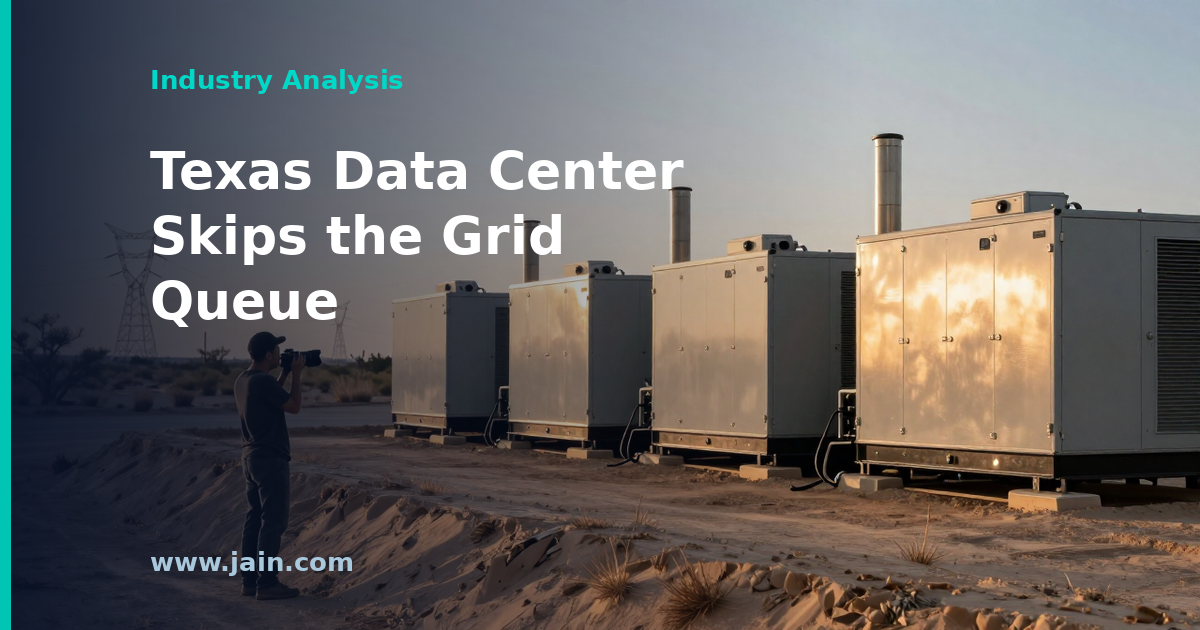
Data Center Knowledge reported on 9 May 2026 that a Texas data center has stopped waiting for a grid connection and will instead be served by generation sited behind the meter — industry shorthand for power that reaches the load without passing through the utility’s revenue meter, typically from plant on or adjacent to the customer’s own property. The stated trigger is delay in the interconnection queue: the study-and-approval process through which a large new load or generator is modelled, cleared and physically tied into the transmission network.
The report as circulated to us is headline-level. It does not name the operator, the site, the megawatt capacity, the generating technology, the counterparties or the energisation date, so the size of the commitment cannot be established from this source alone.
Executive Summary
The substantiated claim is narrow but consequential: at least one Texas data center project has concluded that private generation is a faster route to electrons than the queue for public grid capacity. That is a decision about time, not ideology. A shell with tenants and no power earns nothing, and self-supply converts a regulatory wait into a construction schedule the operator controls.
It matters because it inverts a fifty-year assumption in this industry. Data centers were historically sited where large, reliable, cheap grid power already existed; the operator’s job was to buy it well. When queue times stretch past the useful life of an AI hardware generation, the operator’s job becomes building a power plant as a precondition of building a data center — a different balance sheet, a different risk register and a different set of counterparties.
Read with appropriate caution. A single trade report of a single project establishes a direction of travel, not its magnitude. What follows treats the behind-the-meter decision as reported and examines the economics and risks that any such decision entails, while marking clearly where the source is silent.
What Behind the Meter Actually Buys — and What It Costs
Grid power is, in ordinary conditions, the cheapest and least troublesome electricity a data center can buy. Someone else finances the plant, maintains it, holds the fuel contracts, carries the outage risk and spreads the cost across many customers. Going behind the meter means taking all of that onto your own books: capital for generating equipment, firm fuel supply, air permits, spare parts, operators on shift, and redundancy engineered to the availability level your tenants’ contracts require.
What the operator gets in exchange is a schedule. Interconnection is an administrative queue in which the customer’s position is set by process, not by willingness to pay; on-site generation is a procurement and construction problem, and construction problems respond to money. The arithmetic that makes the swap rational is straightforward: if a leased or pre-let facility is earning nothing while it waits, the carrying cost of idle capital plus foregone revenue can exceed the premium on self-generated power for a long time. That premium is real, and it recurs every year the plant runs.
The corollary is that this decision is much easier with contracted demand behind it. Speculative capacity rarely justifies a private power plant. Where an operator has firm hyperscale or AI tenancy, the revenue is certain enough to underwrite generation assets; where it does not, behind-the-meter economics look considerably thinner. The report does not tell us which situation applies here, and that distinction changes how much the case should be generalised.
The Queue Became the Scarce Asset
For most of the past decade the constraints on data center siting were land, fibre routes, water, tax treatment and labour. Power was a line item. The last few years have promoted grid access to the binding constraint almost everywhere large campuses are proposed, and the practical effect is that a credible, near-dated path to megawatts is now the asset being competed for — more than the acreage it sits on.
That reordering creates identifiable winners. Suppliers of on-site generating equipment and the engineering firms that install it gain pricing power, because their delivery slots are what a stranded project is actually buying. Landowners with gas pipeline adjacency, existing industrial permits or brownfield interconnects become disproportionately valuable. Developers who can present a financed, permitted power solution can charge for certainty in a market where certainty is scarce.
The losers are less visible. Developers whose principal advantage was an early queue position lose that advantage when rivals stop queuing. Utilities forgo the load growth that would have supported their own investment cases, and lose the revenue base across which fixed network costs are spread. System planners face a harder forecasting problem when significant demand exists but does not appear as grid load. None of these effects is catastrophic at the scale of one project; all of them compound if the pattern holds.
Texas Rules, Texas Risks
Texas is a plausible place for this to surface first. ERCOT, the grid operator covering most of the state, runs an energy-only market and sits largely apart from the two big interconnections that cover the rest of the country, which has historically made it quick to build in and attractive to load. Rapid demand growth has strained that reputation, and Texas has abundant gas infrastructure and a permitting culture that makes private generation a more available answer than it would be in many jurisdictions.
It also lands in an unresolved policy argument that deserves scrutiny in both directions. Consumer advocates argue that very large loads which self-supply but retain grid ties for backup or standby service should still contribute to the network costs they rely on; operators argue that adding generation alongside new demand relieves rather than burdens the system. Both positions are testable and neither should be accepted on assertion: the fair questions are what the load’s actual grid interaction looks like under stress, whether the on-site plant is dispatchable to the system or purely captive, and what the standby tariff genuinely recovers. Nothing in this report answers those questions for this project.
The risk ledger is equally concrete. Generating equipment has its own multi-year lead times, so the swap is not automatically fast. Firm fuel transport must be contracted, and fuel price exposure moves onto the operator. Air permitting can consume the schedule the queue exit was meant to save. And behind-the-meter is often a bridge rather than a destination — many operators intend to connect eventually and run private generation as an interim or hybrid arrangement. Whether that is the plan here is precisely the sort of thing the available reporting does not say.
Background
Data centers were traditionally sited where large, reliable grid power already existed, alongside fibre routes, water and favourable tax treatment. The rise of AI training and inference workloads has pushed campus power requirements to a scale that many transmission systems cannot absorb quickly, and the interconnection queue — the sequential study process that clears new loads and generators for connection — has become the binding constraint on when a facility can open rather than a routine administrative step.
Texas is a focal point for that pressure. Most of the state is served by ERCOT, an energy-only market operating largely independently of the wider US interconnections, which long gave it a reputation for speed and low cost and attracted heavy data center investment. As demand growth has outpaced network build-out, operators there have increasingly explored on-site generation, co-location with power plants and other private-supply arrangements. Data Center Knowledge, which reported this case, is a long-established trade publication covering the sector.
Source: Interconnection Delays Push Texas Data Center Behind the Meter — Data Center Knowledge, 9 May 2026, reporting that grid connection delays have led a Texas data center to adopt behind-the-meter power.