
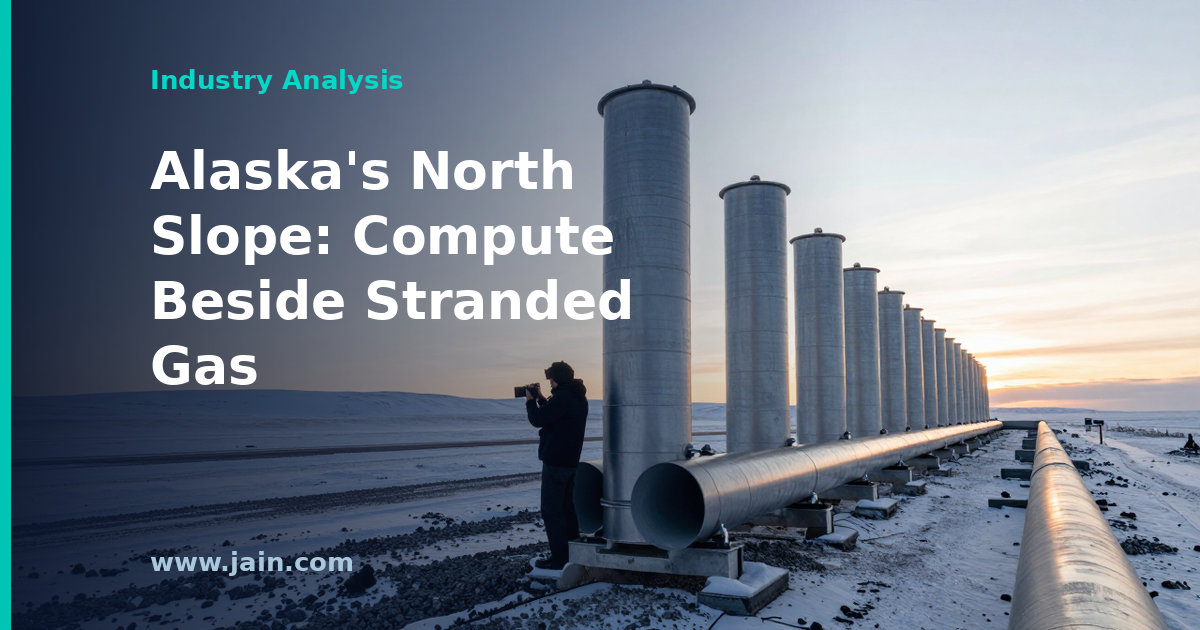
The Alaska Beacon reported on May 15, 2026 that a large data center campus could be developed on Alaska’s North Slope, the Arctic oil-producing region north of the Brooks Range. The attraction is straightforward: the North Slope sits on top of vast volumes of natural gas that currently have no route to market, and a data center is one of the few customers that can be brought to the fuel rather than the other way around.
Public detail remains limited. The report describes the concept and its setting; it does not, in the material available to us, establish a confirmed developer, a firm generating capacity, signed customers, financing or a construction schedule. Treat the project at this stage as a proposal being floated, not a committed build.
Executive Summary
For most of the industry’s history, data centers followed people and fiber. They clustered near metro interconnection points, cheap retail land and existing substations, because latency to users and access to networks mattered more than the marginal cost of a megawatt. AI training has inverted that logic. Large training clusters are batch workloads that tolerate tens of milliseconds of network delay, so their siting is increasingly decided by whichever constraint binds hardest, and right now that constraint is electricity.
A North Slope campus is the purest expression of that inversion yet proposed in the United States. There is no interconnection queue to wait in because there is no grid to interconnect to; the North Slope’s power is islanded and gas-fired, built to run oil fields. There is no transmission to build because the plan implies generating on site from gas that is otherwise reinjected into the ground for lack of a pipeline. The trade is that every other input, from construction labour to network diversity to spare parts, becomes harder and more expensive.
Whether that trade works is an empirical question, and the answer matters well beyond Alaska. If compute can be economically parked next to stranded hydrocarbons in one of the least accessible places in North America, the same argument applies to flared gas basins in Texas and North Dakota, to remote hydro in Canada and Scandinavia, and to any energy resource whose problem is distance to demand.
Power Now Picks the Site, and Everything Else Follows
The scarce input in AI infrastructure is not chips, land or capital. It is firm, contracted electricity delivered on a schedule that matches a two-to-three-year build. In established markets, utility interconnection studies and transmission upgrades routinely stretch project timelines by years, and grid operators in several U.S. regions have begun rationing large-load connections. A developer who can bypass that queue entirely buys back time, and in a market where the value of a training cluster decays with each hardware generation, time is the whole game.
Behind-the-meter generation, meaning power produced on site and never touching a public grid, is how developers are trying to buy that time. The North Slope version is behind-the-meter taken to its logical extreme: not merely bypassing a grid, but siting where none exists. That removes the interconnection risk and replaces it with construction, fuel-supply and operations risk. Those are real risks, but they are risks a private developer can price and manage, whereas an interconnection queue is a public process nobody controls.
The counterweight is that a self-generated island has no backstop. A campus tied to a large grid can lean on the system during a generator outage; an islanded campus cannot. That pushes redundancy back onto the owner in the form of extra turbines, extra spares and deeper on-site fuel and maintenance capability, all of which raise capital cost per megawatt. The economics only work if the fuel is cheap enough, and abundant enough, to pay for that redundancy several times over.
Stranded Gas Is Cheap Precisely Because It Has Nowhere to Go
North Slope fields produce large volumes of natural gas alongside oil. Because there is no pipeline carrying that gas to Lower 48 or Asian markets, most of it is reinjected into the reservoirs to maintain pressure and support oil recovery. Gas in that position is often described as stranded: physically abundant, commercially close to worthless, because its value is set by the cost of moving it to a buyer. Decades of proposals to build a gas pipeline or an LNG export project from the Slope have not produced a completed export line.
A data center changes the arithmetic by moving the buyer to the gas. That is genuinely attractive for the producer and the state, which collects royalties and taxes on production. But two cautions belong in any serious appraisal. First, gas that is currently reinjected is doing useful work supporting oil production, so diverting it is not free; it has an opportunity cost that only the field operators can quantify. Second, cheap fuel at the wellhead is not the same as a low delivered cost of power. Turbines, heat recovery, fuel treatment, Arctic-rated enclosures and a skilled operating crew all sit between the reservoir and the rack.
There is also a carbon question that buyers will ask before signing. Hyperscale tenants and their investors carry public emissions commitments, and unabated gas generation is a poor fit for them regardless of how cheap it is. A credible answer would involve carbon capture, offsets or a customer base less bound by those commitments, and none of that is settled by a project concept. The counterargument, that using gas which would otherwise be reinjected or flared is better than the alternative, is arguable but not automatic, and it will be argued.
The Arctic Build Problem: Permafrost, Logistics and Latency
Building on continuous permafrost means building on ground that must be kept frozen. Heat leaking from a structure thaws the soil beneath it and causes differential settlement, so Arctic construction relies on elevated pile foundations, thick insulating gravel pads and thermosyphons, passive devices that pull heat out of the ground in winter. A data center is a concentrated heat source, which makes thermal isolation from the ground a first-order design problem rather than a detail. None of this is unsolved, but it is expensive and slow, and the pool of contractors who have done it is small.
Logistics compound the cost. Heavy freight to the Slope moves by the Dalton Highway, by seasonal ice roads, by barge during a short open-water window or by air at a price that discourages mistakes. Labour is largely rotational and camp-housed. The upside is the climate itself: ambient air on the North Slope permits free cooling, meaning outside air can reject server heat for most or all of the year without mechanical chillers, which is a material and durable operating saving.
Networking is the input most often underestimated. Terrestrial and subsea fiber reaching the Arctic coast and running south toward Fairbanks does exist, built primarily to serve oil-field operations and remote communities, so the region is not dark. The question is capacity, route diversity and the cost of adding more, because a large campus needs multiple physically separate paths, not merely a connection. Distance from users also shapes the workload mix. Training runs and other batch jobs are viable; latency-sensitive inference serving population centres is not the natural fit.
Who Gains, Who Waits
If a project of this kind proceeds, the clearest beneficiaries are field operators with gas they cannot sell, the state and the North Slope Borough through production and property tax bases, and turbine and modular-build vendors. Alaska has spent decades looking for a second industry to sit alongside oil, and compute is one of the few candidates that does not require moving a commodity thousands of miles. Local hire and community benefit, however, depend on commitments that a concept announcement does not contain.
The parties with reason to wait are customers. A tenant signing a long lease in an islanded Arctic campus is underwriting fuel supply, construction execution, network diversity and staffing continuity in a location where a serious failure cannot be fixed quickly. That risk is priceable, but it will be priced, and the discount a tenant demands may erode much of the fuel-cost advantage that motivated the site in the first place. Competing projects in gas-rich but road-accessible basins offer a similar power-first thesis with far less logistical drag.
The honest summary is that this proposal is interesting for what it tests rather than for what it has so far demonstrated. It is a clean experiment in whether power availability alone can outweigh every other siting factor. Until capacity, financing, offtake and permits are on the record, the analysis is about the thesis, not about a project.
Background
The North Slope is Alaska’s Arctic oil province. Prudhoe Bay, discovered in 1968 and brought online with the Trans-Alaska Pipeline System in 1977, remains the anchor of a region whose economy, roads, airstrips, power plants and camps were all built around crude production. Natural gas produced alongside that oil has never had a comparable export route; successive pipeline and LNG proposals have been studied for decades without a completed export project, so most of the gas is reinjected to support oil recovery.
Connectivity arrived later and separately. Fiber built to serve oil field operations and Arctic coastal communities links parts of the region and runs south toward Fairbanks, ending the assumption that the Slope is entirely off the network map, though capacity and route diversity remain far below what large metro data center markets take for granted. Against that backdrop, the arrival of AI-driven demand for firm power has made planners across the world reconsider remote energy resources, and Alaska is now part of that conversation.
Source: A huge data center could rise on Alaska’s North Slope — Alaska Beacon, May 15, 2026, reporting on a proposal to develop a large data center campus in Alaska’s Arctic oil region.