
TL;DR · 30-second read
The Short Version
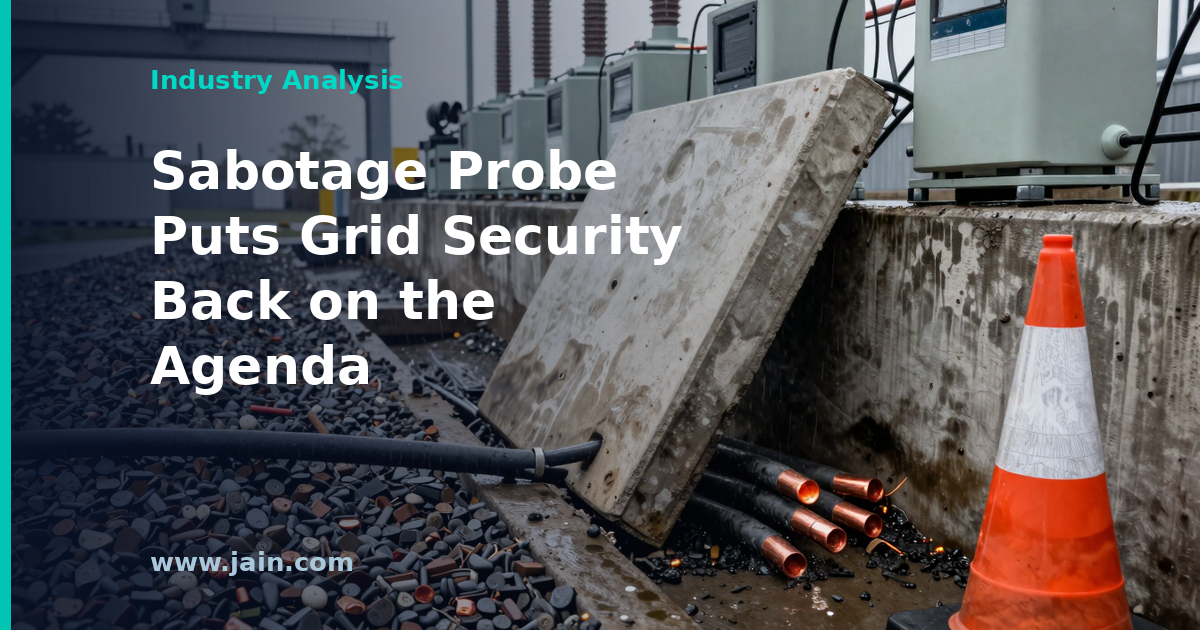
Investigators in Germany are looking into whether someone deliberately damaged equipment at two power substations. A substation is the fenced yard of transformers and switches that takes electricity off long-distance lines and turns it into the kind you can use in a building.
Nobody has been blamed yet. It matters because the warehouses that hold our email, banking and streaming data sit directly behind that equipment. If a substation goes down, backup generators buy hours or days — not weeks.
The Associated Press reported that German authorities have opened an investigation into suspected sabotage following disruption at two electricity substations. Substations are the switching and voltage-conversion nodes that connect the high-voltage transmission network to the lower-voltage lines serving homes, industrial sites and data centers.
“Suspected sabotage” is an investigative classification rather than a finding: it describes how prosecutors are treating the damage while they work, not a conclusion about who caused it or why. Attribution, motive and the full operational impact are among the questions the investigation exists to resolve.
Executive Summary
An open sabotage investigation at two substations is, on its own, a small news item. Its significance for digital infrastructure is that it moves grid security out of the tabletop-exercise category and into the physical one. Most of the industry’s security spending and regulatory attention over the past decade has gone to cyber defence — network segmentation, intrusion detection, supply-chain controls. The asset that actually determines whether a data hall keeps running is a fenced compound full of transformers and switchgear, frequently sited on the edge of an industrial park, and usually protected by perimeter fencing, cameras and a locked gate.
The number two is the part worth noticing. European transmission and distribution networks are planned around an N-1 standard, meaning the system is designed to survive the loss of any single element without dropping customer supply. Simultaneous or near-simultaneous disruption at two sites is precisely the scenario that N-1 planning does not cover, which is why investigators treat multi-site events differently from a single equipment failure.
For data center operators, landlords and their enterprise customers, the practical question raised is not whether this particular incident affected any specific facility. It is whether the substations that feed dense clusters of digital infrastructure are secured in proportion to what depends on them — and whether operators actually know which substations those are.
A Substation Is a Concentration of Risk in a Small Fenced Yard
A substation does three jobs: it changes voltage, it switches circuits, and it protects the network by isolating faults. The physical contents are unglamorous — power transformers, circuit breakers, disconnectors, protection relays, control cabinets — and are often visible from a public road. There is no redundancy inside the fence. A transformer is a single object weighing tens of tonnes, filled with oil, and it either works or it does not.
What makes substations a disproportionate target is the repair asymmetry. Damage can be inflicted quickly and cheaply; large power transformers are custom-engineered for a specific network position, built to order, and moved by specialised heavy transport. Replacement is measured in months, not days, unless the operator holds a compatible spare and can physically get it to site. Utilities manage this with spares pools and mutual-assistance arrangements, but those programmes were sized for storms and equipment failure, not for a pattern of deliberate damage at multiple locations.
This is also why an investigation into two sites reads differently from an investigation into one. Coordination, if it is established, changes the planning assumption. It is worth being precise here: coordination has not been established, and treating an open probe as a confirmed campaign would be running ahead of the evidence.
Where Data Centers Actually Sit in the Blast Radius
A well-built colocation facility has layered protection against utility failure. Uninterruptible power supplies — battery or flywheel systems — carry the load for seconds to minutes. Diesel or gas generators then take over and, given fuel and fuel-delivery contracts, can run for days. Higher-resilience designs take two utility feeds, ideally from separate substations on separate network paths, so that one upstream failure is survivable without ever starting an engine.
Two things weaken that picture. First, “two feeds” is often two circuits that converge upstream at a single substation or a single transmission corridor — diversity on the invoice, not in the ground. Second, generators are engineered for outages measured in hours or days. A substation loss with a months-long transformer replacement is a different failure mode: the facility survives it technically, on fuel deliveries, at a cost structure nobody underwrote and with an emissions and permitting profile that many sites are not licensed for over extended periods.
The exposure is also geographically concentrated. Europe’s data center capacity clusters heavily around a handful of metros — Frankfurt above all, alongside London, Amsterdam, Paris and Dublin — precisely because that is where fibre, land and grid connections already exist. Concentration is efficient for interconnection and unhelpful for resilience: the same few substations and corridors serve a large share of a region’s compute.
Critical Infrastructure on Paper, Ordinary Utility Asset in the Field
Europe’s regulatory architecture already treats both energy and digital infrastructure as essential. The NIS2 Directive covers cybersecurity and incident reporting across sectors including energy and data centers, and the Critical Entities Resilience Directive addresses physical resilience — risk assessment, resilience plans, incident notification — for entities providing essential services. On paper, the substation and the data center it feeds are both in scope.
The gap is between designation and hardening. Obligations of this kind produce risk assessments, plans and reporting duties; they do not automatically produce ballistic barriers, intrusion detection at the fence line, hardened transformer walls or on-site response at every distribution node. The United States offers a useful comparator: after the 2013 Metcalf substation shooting in California, regulators adopted a dedicated physical security standard, NERC CIP-014, which requires targeted risk assessment and protection — but only for a defined set of transmission stations whose loss would cause instability or cascading outages. Most substations, in most countries, fall outside such tiers by design, because hardening every one of them is not economically serious.
That triage logic was built around outage consequence for the electricity system. It was not built around the question of which substations feed several hundred megawatts of concentrated digital load underpinning payments, logistics and public services. Whether those two rankings produce the same priority list is an open and answerable question, and one that data center operators are better placed to raise with their network operators than to wait to be told.
What Operators Can Reasonably Do Before the Regulation Catches Up
Nothing in an ongoing investigation obliges a data center operator to act. But the incident points at a diligence exercise that is cheap relative to its value: knowing, specifically, which substations and which transmission paths a site depends on, and whether the redundancy purchased is real upstream diversity or a paper duplicate. Many operators can answer this for their own switchgear and cannot answer it two nodes out.
The second exercise is duration. Contingency plans and service-level agreements are usually written against outages of hours. Modelling a multi-week loss of a primary feed changes the questions: fuel logistics and contracted supply priority, permit ceilings on generator run-hours, staffing rotations, and whether workload can be shifted to another region and at what latency and cost. Customers negotiating colocation or wholesale capacity are within their rights to ask for these answers in writing.
None of this argues for alarm. Grid operators handle equipment failure and weather damage continuously and restore service well; the system is more robust than a single investigation makes it look. The measured conclusion is narrower: physical security of the electricity assets serving digital infrastructure deserves the same explicit, documented attention that cyber risk has received, and right now, in most contracts, it does not get it.
Background
Electricity reaches a data center through a chain: generation, high-voltage transmission, one or more substations that step the voltage down, and finally the distribution circuits into the site’s own switchgear. Substations are the hinge points, and because they concentrate transformers and switching equipment in one compound they are also the points where a single physical failure has the widest effect. Grid planners compensate with the N-1 principle — designing the network so any one element can fail without cutting supply — and with spares pools and mutual-assistance agreements between utilities.
Digital infrastructure has been formally recognised as essential in European law: data centers sit within the digital infrastructure sector under NIS2, alongside energy in the same regime, and the Critical Entities Resilience Directive extends resilience duties beyond cyber to physical threats. The practical hardening picture is uneven, however, because protection regimes worldwide triage substations by their consequence for the electricity system rather than by the digital load they carry. That distinction is what an investigation into physical damage at grid assets brings into focus for the data center industry. Source: Germany probes suspected sabotage after disruption at 2 power substations — Associated Press report on an open German investigation into suspected sabotage following disruption at two electricity substations.Sources