
TL;DR · 30-second read
The Short Version
Building a data center is the easy part. Connecting it to electricity is not. That needs new power lines, new substations — the yards full of equipment that step electricity down to usable voltages — and the specialist crews who build them.
Quanta Services is one of the largest of those construction firms. It has now tied itself to an equipment maker, Hyosung HICO, in a venture making high-voltage breakers: the giant switches that cut power in a fraction of a second when something goes wrong.
Quanta’s shares have risen sharply over five years. The debate now is whether that price already assumes a decade of building.
Simply Wall St reported on September 6, 2026 that Quanta Services (NYSE: PWR) is back in investor focus following updates on analyst sentiment, earnings estimate revisions and the HYOSUNG HICO BREAKER joint venture, a partnership tied to grid modernization and the manufacture of high-voltage circuit breakers.
The shares closed at US$624.41. That price followed a 3.6% gain over seven days and a 7.1% decline over 30 days, set against a one-year total shareholder return of 67.8% and a five-year total shareholder return of 443.5%. The most-followed valuation narrative on the stock puts fair value at US$710.00, implying the shares are 12.1% undervalued, while Quanta’s trailing price-to-earnings multiple of 70.7x sits more than double the 32.5x construction industry average.
Executive Summary
Strip away the valuation debate and the operationally interesting item is the joint venture itself. Quanta Services is a contractor: it employs the linemen, the substation electricians and the heavy-equipment operators who physically build electric transmission and distribution systems. A venture in high-voltage breaker manufacturing moves it, at least partially, from installing grid hardware to having a stake in producing it.
That direction of travel matters because the constraint on connecting new load to the grid — whether that load is a hyperscale data center, a reshored factory or a wind farm waiting in an interconnection queue — is increasingly physical rather than financial. Capital is abundant. Skilled crews, energized substations and long-lead switchgear are not. A contractor that controls both the labor to build a substation and a share of the equipment that goes inside it is positioned at the narrowest point in that chain.
The market has already noticed. Quanta’s five-year return of 443.5% reflects an investor base that has repriced electrical contracting from a cyclical, low-margin trade into a scarce structural asset. The open question is not whether the demand is real — utility hardening, transmission expansion and AI-driven power demand are all visible — but how much of that decade is already in the price at 70.7x earnings.
The Binding Constraint Is Construction, Not Capital
The public conversation about artificial intelligence infrastructure has largely been about semiconductors and, more recently, about electricity generation. The less-discussed choke point sits between them: the wires, transformers, breakers and substations that carry power from where it is generated to where it is consumed, and the finite pool of qualified crews that install them. A gigawatt of contracted generation is worthless to a data center operator if the interconnection — the physical and contractual connection to the grid — cannot be built for several years.
Quanta’s business is precisely that middle layer. Its stated markets span electric and gas utilities, power generation, load centers, manufacturing, communications and pipelines. That breadth is the point: the same craft labor pool serves grid replacement, utility storm hardening, renewable interconnection and industrial reshoring simultaneously. When several demand waves draw on one labor pool, the contractor’s scarcity value rises independently of any single end market. This is the structural case behind the stock’s re-rating, and it does not depend on any particular AI capital-expenditure forecast holding.
The risk embedded in that same logic is symmetry. Diversified demand cushions a downturn in any one vertical, but it does not protect against a broad deferral of utility capital programs, nor against the execution risk that comes with very large, complex fixed-price programs. Simply Wall St’s own summary flags both: a slowdown in new grid or AI-related awards, and execution setbacks on large projects.
Moving Upstream Into the Equipment It Installs
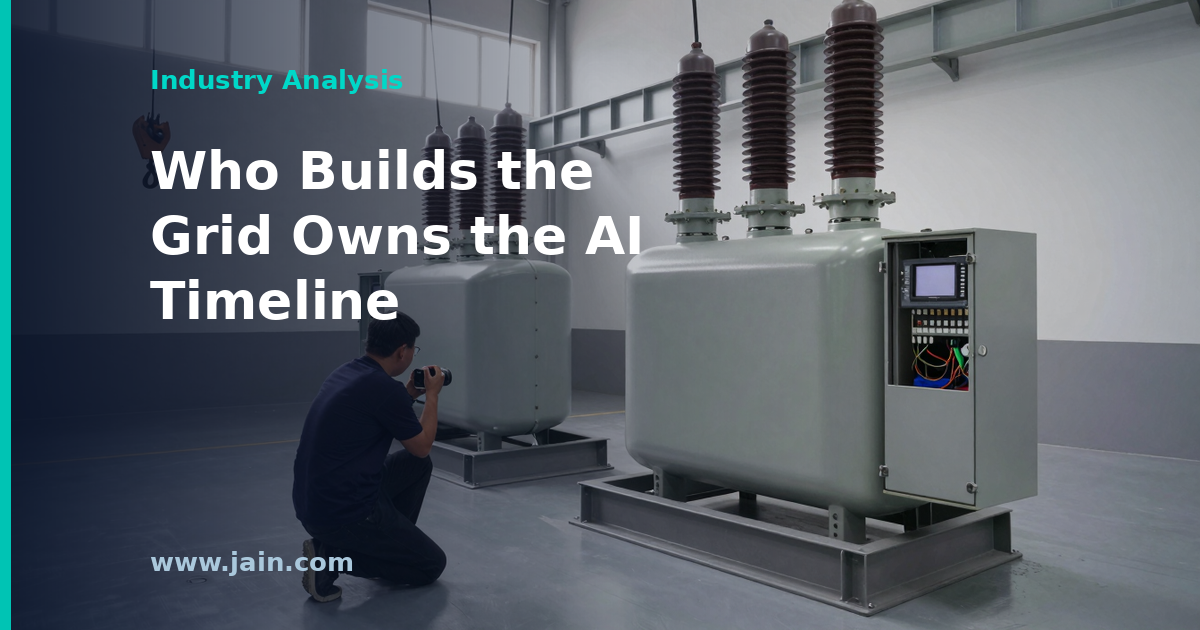
A high-voltage circuit breaker is the protective switch at the heart of a substation. When a fault occurs — a downed line, a short circuit — the breaker interrupts a current that would otherwise destroy transformers and start fires, and it does so in milliseconds. It is unglamorous, safety-critical, heavily engineered equipment, and the number of qualified manufacturers is small.
For a contractor, an interest in breaker manufacturing changes the negotiating posture on schedule. Contractors are typically at the mercy of equipment lead times: the crew is mobilized, the site is ready, and the project waits on switchgear. A manufacturing venture offers, in principle, visibility into that queue and a hedge against it. It also opens a second revenue line with a different margin profile from installation work — equipment manufacturing carries capital intensity and inventory risk that labor-led contracting does not.
Whether this venture delivers those benefits at meaningful scale is genuinely unknown from what has been disclosed. The joint venture is described in terms of its purpose — grid modernization and high-voltage breaker manufacturing — rather than its economics. Investors should treat it, for now, as directional evidence about strategy rather than as a quantifiable earnings contributor.
Two Valuation Frameworks, Opposite Conclusions
The stock currently supports two defensible and contradictory readings, and the release presents both. On a forward-looking narrative basis, fair value is pegged at US$710.00 against a US$624.41 close, implying 12.1% upside; the company also trades at a discount to analyst price targets. On a ratio basis, the picture inverts: a 70.7x price-to-earnings multiple compares with 32.5x for the construction industry, 33.8x for named peers and a 38.6x “fair ratio” benchmark.
These are not really disagreements about Quanta’s business. They are disagreements about classification. A multiple near the construction industry average assumes Quanta is a contractor whose earnings will eventually revert with the building cycle. A multiple near 70x assumes it is something closer to a bottleneck asset — a firm whose scarce labor base and customer relationships let it hold pricing power across a multi-decade grid rebuild. The peer set the ratio comparison uses, including Comfort Systems USA and EMCOR Group, are themselves specialty contractors that have re-rated on similar logic, which makes the “peer average” a moving target rather than a fixed anchor.
The practical implication is that the compression risk is arithmetic, not speculative. If sentiment cools and the multiple drifts toward the 38.6x fair ratio without a compensating jump in earnings, the required earnings growth to defend the current price is substantial. The 7.1% decline over 30 days, against a 67.8% one-year return, suggests the market is already testing that question rather than settling it.
Background
Quanta Services is one of the largest specialty infrastructure contractors in North America, providing engineering and construction services across electric and gas utilities, power generation, load centers, manufacturing, communications, pipelines and energy. Its core asset is not equipment but people: a large, trained and licensed craft workforce whose skills — high-voltage line work, substation construction — take years to develop and cannot be scaled quickly in response to demand.
That workforce has become unusually valuable. Utility capital spending has risen simultaneously across grid replacement, storm hardening, renewable interconnection and, most recently, the electrical infrastructure required to serve large computing loads. The result has been a sustained re-rating of listed specialty contractors, Quanta among them, from cyclical builders toward companies valued for structural scarcity — a shift reflected in Quanta’s 443.5% five-year total shareholder return and in the valuation debate that now surrounds the stock. Source: Quanta Services (PWR) Gets A Grid Venture Boost, Is The Stock Too Expensive? — Simply Wall St, September 6, 2026, reporting on Quanta Services’ HYOSUNG HICO BREAKER joint venture, recent share price performance and the competing valuation cases for the stock.Sources