
TL;DR · 30-second read
The Short Version
Two buildings north of Fargo, North Dakota are nearly finished, and together they are bigger than the largest building in the state, an Amazon warehouse two miles away. About 1,800 workers are on site.
The buildings will hold computers that run artificial intelligence, and they will draw about as much electricity as a small city. The local council approved the project in September 2025, and part of it is supposed to be running by the end of this year.
The company building it, Applied Digital, has not said which businesses will rent the space.
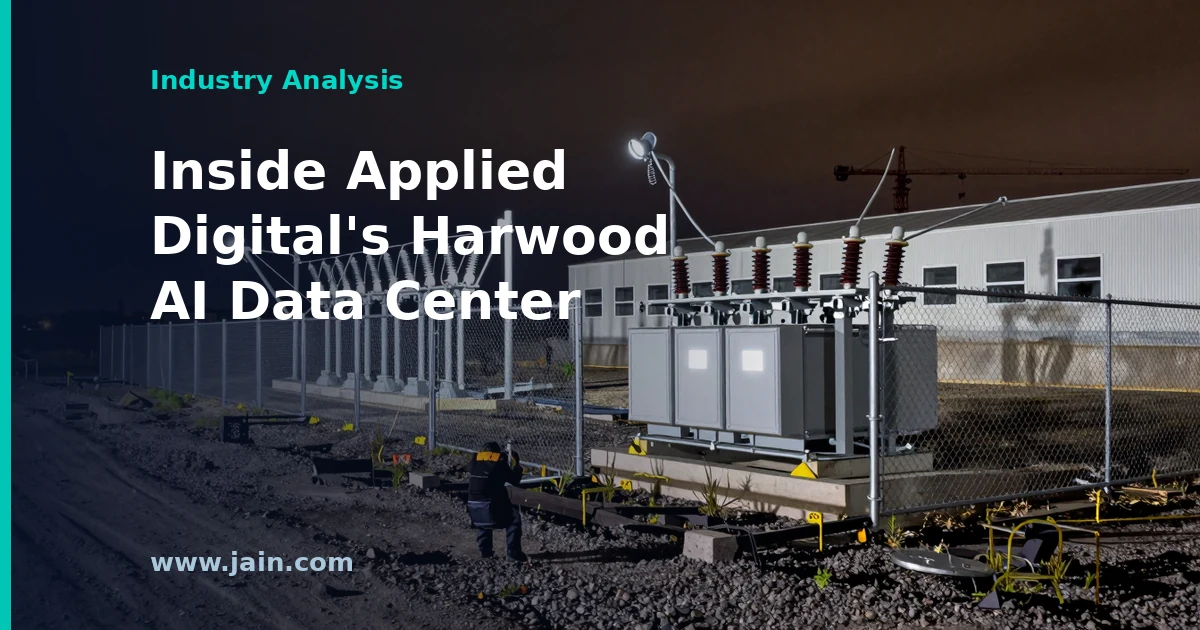
InForum reported that Applied Digital’s Polaris Forge 2 campus in Harwood, North Dakota is nearing completion, with roughly 1,800 workers finishing two buildings of 907,000 square feet each. The Harwood City Council approved the $3 billion project on September 10, 2025. Part of the campus is on pace to become operational by the end of 2026, with the remainder opening in early 2027, according to Nick Phillips, Applied Digital’s executive vice president of public affairs and real estate acquisition.
The site is a 280-megawatt facility drawing power from Cass County Electric, and Applied Digital is paying $112 million for the substation and transmission upgrades that serve it. The company has not disclosed which companies will occupy the buildings. It expects 200 to 250 permanent employees once the campus opens, on 400 acres of which about 300 have been graded.
Executive Summary
Harwood is Applied Digital’s third North Dakota project, after Jamestown and the Polaris Forge 1 campus at Ellendale, with a fourth under construction near Center. Ellendale, announced in late 2024, is partially operational. The pattern across all four is the same wager: build large blocks of power-dense capacity in a cold, cheap-power state and race to energize them while demand for artificial intelligence compute outruns supply.
What makes Harwood worth studying is the calendar. From a municipal approval on September 10, 2025 to first operational capacity at the end of 2026 is roughly fifteen months for a 280-megawatt campus. In a market where developers routinely quote three to five years between site control and delivered power, that interval is the entire product. “Time to power” is the industry’s shorthand for how long a tenant waits between signing and switching on machines, and it has become the variable that decides which sites win contracts.
The unresolved half of the story is commercial rather than physical. Steel, generators, cooling loops and a substation are visible and verifiable. Leases are not. Applied Digital has not named a tenant for Harwood, has not disclosed how much of the 280 megawatts is contracted, and has not detailed how the $3 billion build is financed. Those omissions do not undermine the construction progress, but they determine whether the speed converts into revenue.
Fifteen Months From Vote to Volts
The construction detail in the account is mostly a lesson in sequencing. Eight generator rooms in each building hold twelve units apiece, which is 96 generators per building and 192 across the campus, a level of on-site backup that signals a design intended for tenants who will not tolerate interruption. Roughly 86,000 electrical connections and several miles of copper cable have to be terminated and tested before any of it carries load. Workers wear helmets with augmented reality systems that check whether components are installed in the right place and whether crews are tracking to schedule, which is less a gadget than an admission that verification, not fabrication, is the thing most likely to slip.
Phillips describes the split inside each building as about 25% data halls and 75% supporting systems. That ratio is the clearest single indicator of how the economics have shifted. In a conventional enterprise facility, the computer room dominates the floor plan. In a building designed for dense artificial intelligence racks, the electrical rooms, switchgear, uninterruptible power supply gear and cooling plant swallow three-quarters of the envelope. Applied Digital is not really building a warehouse for servers. It is building a power conversion and heat rejection plant that happens to have servers in the middle of it.
The arithmetic underlines the point. If 280 megawatts is measured at the computers, spread across roughly 453,000 square feet of data hall, that is on the order of 600 watts per square foot, an order of magnitude above the densities most existing commercial data centers were designed for. Applied Digital has not specified whether the 280-megawatt figure is the load delivered to equipment or the total drawn from the utility, and the distinction changes that number materially. Either way, the campus is firmly in the density range that only recently became buildable at scale.
The $112 Million Sentence
The most consequential figure in the account is not the $3 billion headline but the $112 million Applied Digital says it will pay for the substation and transmission upgrades. That is roughly $400,000 per megawatt of connection, and it is the developer, not the utility’s other customers, footing the bill. Grid connection cost allocation is the live political question in nearly every jurisdiction now absorbing large computing loads, because the alternative structure, in which network upgrades are socialized across the rate base, is what makes residents worry about their bills. Harwood drew protesters on exactly that concern.
Applied Digital’s counter-claim is that its facilities do not raise electricity bills, and Phillips cited more than $46 million in savings for customers across North Dakota and South Dakota since the Ellendale project began. The underlying mechanism is plausible in principle: a very large, very steady customer spreads a utility’s fixed costs across more kilowatt-hours, which can lower the per-unit cost everyone pays. But the claim as stated is not yet verifiable by a reader. It does not identify which utility’s customers, over which period, measured against which counterfactual, or whether the figure is an avoided increase rather than a reduction. Those are answerable questions, and regulated utilities generally have to answer them in rate proceedings.
It is worth being precise about what each side is arguing, because they are not arguing about the same thing. The savings claim is retrospective and concerns Ellendale. The objection at Harwood is prospective and concerns what happens when a second large load lands on a different distribution system. A past result under one set of contracts does not settle the future question, and neither does a protest settle whether the mechanism works. The $112 million commitment is the strongest evidence Applied Digital has offered that it intends to carry its own interconnection costs, which is the part of the dispute that can actually be documented.
Air, Not Water, and Why North Dakota Rewards That Choice
Cooling is where siting logic becomes visible. Branden Cummins, the company’s civil structure architecture superintendent, described a closed loop that circulates fluid through six data halls in each building, carries it to the roof, and uses large fans to shed the heat before recirculating it. Because the loop is sealed, Applied Digital says water consumption will be comparable to a household. That is a meaningful claim in an industry now facing real scrutiny over evaporative cooling, which chills equipment by boiling away water and can consume millions of gallons a year at this scale.
The trade is not free. Rejecting heat to air rather than to evaporating water costs electricity for fans, and the penalty grows with ambient temperature. In a Texas or Arizona summer, that penalty is severe enough that many operators accept the water consumption instead. In eastern North Dakota, where cold hours dominate the year, the fan energy penalty is small and the water savings are close to pure gain. The closed loop is not primarily an environmental gesture; it is the design that the climate makes cheapest, and the environmental benefit follows from the geography.
Noise and setback receive the same treatment. Silencing equipment and sound barriers on the generator plant, with the nearest home about half a mile away and the town of Harwood more than a mile off, reflect a siting choice made before mitigation was needed. Developers increasingly buy distance rather than engineer around its absence, because generator testing and rooftop fan arrays are the two complaints most likely to follow a facility through its operating life.
A Builder Without a Named Tenant
Applied Digital is a merchant developer, meaning it builds capacity and then leases it, as opposed to a hyperscaler building for its own use. That model turns on a single question: how much of the capacity is committed before it is energized. The company has not disclosed which companies will occupy Harwood. Until it does, an observer cannot distinguish between a campus built against signed leases and one built on conviction about demand.
The local economics are more legible. Roughly 1,800 construction workers will give way to 200 to 250 permanent employees, a ratio close to eight to one that is typical of the sector and worth stating plainly: data centers are enormous construction projects and modest employers. The durable local benefit is tax base rather than payroll. Polaris Forge 1 at Ellendale paid about $4.3 million in property tax for 2026, Harwood is receiving no tax incentives or abatements according to the company, and Phillips estimated Applied Digital would become the largest single taxpayer in the state by 2029, while acknowledging that Harwood’s own assessment is not yet estimated because the building is not finished.
The absence of abatements is the notable item. Large data centers are frequently recruited with property tax exemptions that hollow out the fiscal case communities were sold, and a project that forgoes them changes the arithmetic for the county. It also suggests the developer’s binding constraint was schedule rather than subsidy. When capacity delivered in 2026 is worth materially more than the same capacity delivered in 2029, a year of negotiation over abatements costs more than the abatements are worth.
Background
Applied Digital is a Texas-based developer that builds and leases data center capacity rather than operating computing services itself, a model the industry calls merchant development. Its North Dakota expansion began with a facility in Jamestown, followed by the Polaris Forge 1 campus at Ellendale announced in late 2024 and now partially operational, the Harwood project approved in September 2025, and a fourth site under construction near Center, about 40 miles northwest of Bismarck.
The expansion tracks a broader shift in where computing gets built. Training and running large artificial intelligence models requires racks that consume several times the power of conventional servers, which has turned electrical capacity, rather than fiber or floor space, into the binding constraint on the industry. Developers have responded by moving to regions with available generation, cold climates that reduce cooling costs, and utilities able to energize large loads quickly. That has brought industrial-scale construction to rural communities with no prior exposure to it, along with recurring local debates over electricity rates, noise, water and tax base that Harwood has seen in full. Source: An inside look at the Harwood data center as it nears completion — InForum’s report from Applied Digital’s Polaris Forge 2 construction site in Harwood, North Dakota, with detail on schedule, power, cooling, staffing and taxes from company executives.Sources