
TL;DR · 30-second read
The Short Version
A giant battery site in Moss Landing, California, caught fire again on Friday. The owner is Vistra, a large power company. The site uses batteries to store electricity for the grid, and it already burned badly in January 2025.
This time about 1,500 battery packs caught fire. They had been unplugged from the grid after the last fire, but they still held a charge. About 106 nearby residents were told to stay indoors.
This matters because power companies and huge computing centers are counting on big batteries to keep the lights on. A battery that has been switched off can still catch fire.
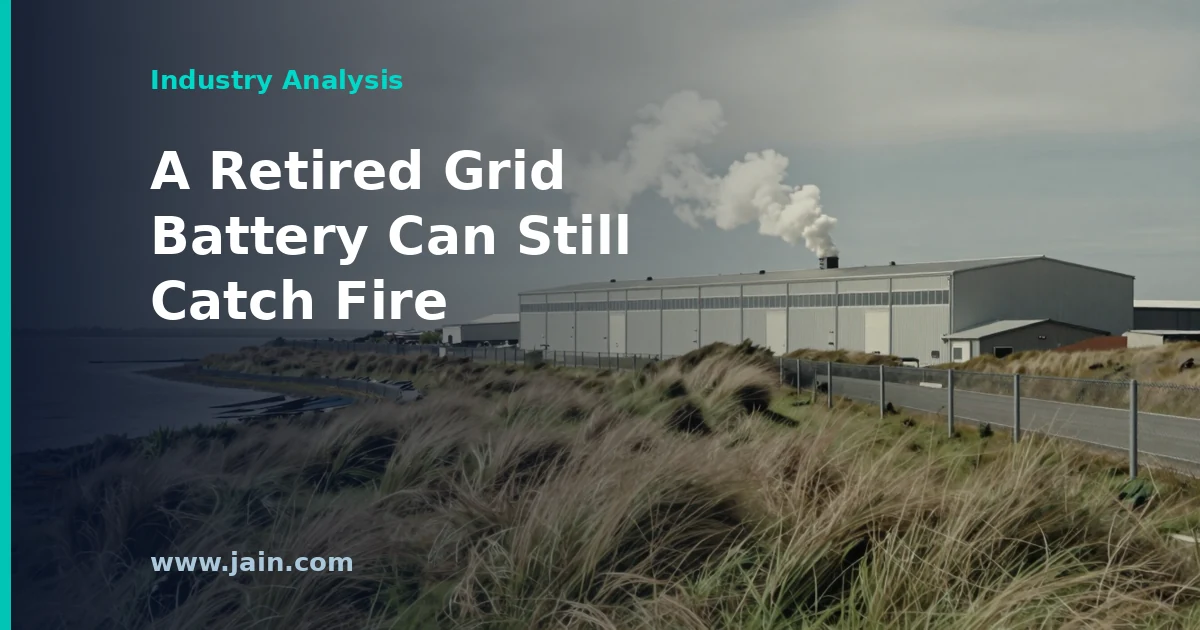
A fire broke out shortly after 6:15 a.m. on Friday, September 18, 2026, at Vistra’s battery storage facility in Moss Landing, California, the Salinas Californian reported. It started in the Moss 300 building, the same structure heavily damaged in the January 2025 fire. North Monterey County Fire District Chief Jess Cortez said the fire involved the roughly 1,500 battery modules left on the building’s north side. By a noon briefing there was no active flame. The site was “hot and smoldering” and expected to burn out within 24 hours, with drones checking battery temperatures.
A shelter-in-place order covered about 106 residents within a third of a mile of the plant, and Dolan Road stayed closed near the site. Vistra temporarily shut down the natural gas plant on the same property as a precaution. No injuries were reported. Air monitors detected some fine particulate matter (PM 2.5), but none above screening levels, and no hydrogen fluoride.
Executive Summary
This is the second fire in about 20 months at one of the world’s best-known grid-scale battery sites. The detail that matters most is where it happened. Vistra plant manager Ron George said the modules that burned were idle and disconnected from the grid, but still energized, inside a unit Vistra has already retired and is remediating with the U.S. Environmental Protection Agency.
For utilities and data-center developers who plan to use large batteries as “firming” capacity, meaning storage that fills gaps when solar, wind or other supply falls short, the lesson is about the full life of the asset. A battery that has left service can still hold energy and still ignite. The cleanup phase therefore carries its own safety, siting and insurance risk. Vistra also shut down the neighboring gas plant as a precaution, which shows how a battery incident can reach other generation on the same site.
Both Vistra’s investigation into the cause of the January 2025 fire and a California Public Utilities Commission investigation are still open. A second fire has now occurred before either has reported a root cause.
Retired Is Not the Same as Safe
The headline fact is simple. The 1,500 modules that burned on September 18 were not delivering power to anyone. George said they were idle and disconnected from the grid but still energized. The Moss 300 unit was retired after the 2025 fire, and Vistra is working with the EPA on remediation. The modules that burned were sitting in a damaged building while that cleanup was under way.
This is how lithium-ion storage behaves in general. Unplugging a battery from the grid stops it from trading power, but it does not remove the chemical energy stored in its cells. Until modules are discharged, removed or otherwise made safe, a damaged battery building remains a hazard. Operators usually model safety risk during commercial operation. Moss Landing shows that the period after an asset stops earning revenue can carry comparable risk, and the local community still bears it.
That changes the math for anyone buying storage-backed power. A data-center operator or utility signing a long-term capacity contract is exposed to more than the chance that a battery fails during its service life. It is also exposed to how long a failed asset takes to wind down, and to what happens to neighboring assets while it does.
One Fire, Two Assets Offline
Vistra shut down the onsite natural gas plant “out of an abundance of caution.” Co-locating batteries with existing generation is attractive because it reuses grid connections, land and permits that took years to secure. Moss Landing shows the other side of that choice. An incident at the battery portion of a site can take down generation that has nothing to do with the batteries, at least temporarily.
This correlation is directly relevant to AI infrastructure planning. Large computing campuses increasingly look for power from sites that pair several resources: gas, storage and solar. The goal is reliability through diversity. If one resource’s safety incident forces a precautionary shutdown of another, the reliability benefit of pairing them is smaller than it appears on paper. Buyers need to know how often that can happen and how long it lasts.
Safeguards Worked, but Answers Are Still Pending
Parts of the response went well. After the 2025 fire, the Monterey Bay Air Resources District oversaw installation of six additional air sensors. Four sit at the facility fence line, one at Elkhorn Elementary School and one at a nearby boatyard. Officials reported fine particulate readings within health standards and no hydrogen fluoride, a toxic gas that burning lithium-ion cells can release. Schools outside the shelter zone lifted their own orders the same day. No one was hurt.
The monitoring also has limits. The air district’s Richard Stedman said the sensors are not testing for heavy metals, “although we would expect that to be in the smoke.” And the core question from 2025, why the original fire started, remains open in both Vistra’s investigation and the CPUC’s. Without a published root cause, other operators, insurers and permitting authorities cannot yet say which design, spacing or suppression changes would prevent a repeat. The industry is still waiting for that input to its siting and insurance decisions.
Background
Vistra Corp. is a large U.S. power producer. At Moss Landing on California’s Monterey Bay, it built one of the world’s largest battery energy storage installations next to an existing natural gas power plant, reusing the site’s grid connections. The batteries charge when power is abundant and discharge when California’s grid needs extra supply, often in the evening as solar output fades.
In January 2025 a major fire damaged the facility’s Moss 300 building, which Vistra has since retired. After that fire, the Monterey Bay Air Resources District oversaw installation of six additional air monitoring sensors around the site and the community. Vistra and the California Public Utilities Commission are each still investigating the 2025 fire’s cause. Source: Fire at Moss Landing battery facility ‘smoldering,’ officials say: Salinas Californian report on the September 18, 2026 fire at Vistra’s Moss Landing battery storage site.Sources