
TL;DR · 30-second read
The Short Version
LG Uplus, one of South Korea’s three big mobile phone companies, is building a giant data center in Paju, just north of Seoul. A data center is a warehouse full of computers, and this one will run artificial intelligence.
The first building won’t open until next year, but one large customer has already rented all of it. The whole site is designed to draw 200 megawatts, roughly the electricity a small city uses.
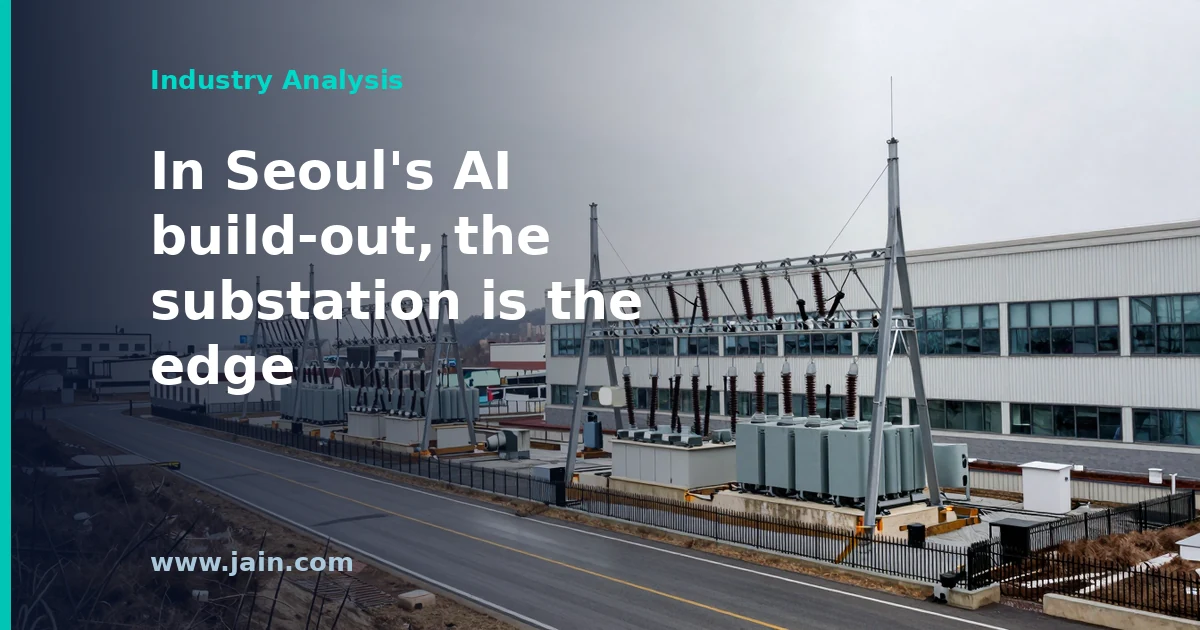
The surprising part: its biggest advantage isn’t the computers. It’s a major hub of the high-voltage power grid right across the road. Near Seoul, that kind of electricity hookup is hard to get.
Korea JoongAng Daily reported on June 7 that LG Uplus (LG U+) has made its Paju AI Data Center the centerpiece of a plan to win 5 trillion won ($3.3 billion) in cumulative AI data center orders by 2030. The site in Wollong-myeon, Gyeonggi Province, has a confirmed 200-megawatt power supply and will eventually hold five buildings with about 152,000 square meters (1.64 million square feet) of floor space.
Building 1 was about 20 percent complete at a June 5 site visit and is due for completion in June 2027. It is a 50-megawatt structure carrying about 30 megawatts of IT load, and it is already fully contracted to an unnamed large customer. LG Uplus expects more than 1 trillion won in orders a year through 2030 and projects 15 to 20 percent average annual revenue growth for the business.
Executive Summary
LG Uplus is repositioning itself from a traditional data center operator into what it calls an “AI Factory Operator.” In this model, the company sells the power, cooling and operational reliability that AI workloads need, not just rack space. Paju is the template. The site pairs a 200-megawatt grid connection with a hybrid air-and-liquid cooling design built in from the foundation. The first building sold out before its concrete had cured.
The announcement matters for two reasons. First, it shows where the scarcity lies in AI infrastructure near a capital city. Demand is plainly there; the harder thing to secure is a large, high-voltage power connection at a usable address. Second, it gives buyers and investors specific markers to track: the order target, the revenue growth projection, the 2027 completion date, and the commercial verification of liquid cooling later this year.
Vice president Ahn Hyurng-gyoon tied the build to a shift from training AI models to running them, known as inference. He said monthly token-processing volumes had risen roughly 67-fold over the past year. Tokens are the small chunks of text that AI models read and write.
Near Seoul, the Scarce Input Is a Grid Connection
LG Uplus led its pitch with power, and the details explain why. The Paju site draws from a 345-kilovolt substation directly across the road. That is a backbone transmission voltage, the level that carries bulk electricity across the grid. A 154-kilovolt line serves as backup, and both run underground at a depth of about nine meters. The company says the 200-megawatt supply was locked in after a formal power-impact assessment last August. It says local opposition has been muted because the land sits inside a former LG Display industrial complex.
Those facts matter more than the building rising above them. Concrete, steel and chillers can be bought and scheduled. The right to draw hundreds of megawatts at a specific address cannot be hurried in the same way. Near a capital region, it depends on an existing substation with spare capacity and on neighbors who will accept the load. LG Uplus’s own framing makes the point. It claims Paju will be the only hyperscale-class facility of its size in the greater Seoul area. Because demand clearly exists, with Building 1 sold out about a year before completion, that is in effect a claim about who secured the grid capacity.
Three groups feel the consequence. AI tenants that want large capacity close to Seoul’s users and enterprises have few alternatives at this scale, which strengthens the operator’s position on pricing and contract length. Rival developers face the same constraint: their bottleneck is less capital or construction skill than sites already wired to high-voltage infrastructure, which makes former industrial land valuable. The uniqueness claim itself is LG Uplus’s assertion, and it will be tested as competitors bring their own capacity forward.
Fifty Megawatts on the Building, Thirty for the Servers
Building 1 is described as a 50-megawatt structure carrying about 30 megawatts of actual IT load, the power that reaches servers, storage and networking gear. The rest is not wasted. In data centers, that margin typically covers cooling, power conversion losses, and the redundant headroom that keeps a site running when a component fails. But the gap is a reminder that the headline megawatt figure on an AI campus is not the same as the compute it can host.
For buyers comparing providers, the IT-load figure is the one to ask for. If the same ratio held across the full site, 200 megawatts would mean something closer to 120 megawatts for servers. That is an extrapolation, not a company figure, and later buildings may be designed differently. Cooling is where LG Uplus is trying to narrow the gap. Paju is designed as a hybrid air-and-liquid facility, with floor loads, waterproofing and piping engineered for liquid from the start. Its primary method is direct-to-chip cooling developed with LG Electronics, in which a cold plate is attached to the processor and coolant carries heat away. The company says its tests showed about 24 percent better energy efficiency than air cooling.
Designing for liquid up front is the operationally significant choice. Retrofitting pipes and reinforcing floors under a live data hall is disruptive and costly, and the newest AI chips increasingly run too hot for air alone. All three computing floors of Building 1 are designed for direct-to-chip cooling, so a tenant can switch as its hardware changes. The caveat is timing. Full commercial verification in a live server room is scheduled for later this year. Immersion cooling, in which servers are submerged in non-conductive fluid, still awaits certification.
An Order Target Is Not Yet a Revenue Line
The 5 trillion won ($3.3 billion) goal counts cumulative orders through 2030. LG Uplus expects more than 1 trillion won in orders a year to get there, or roughly a fifth of the target annually. Orders are contracted future business, not booked sales. A multi-year colocation contract can carry a large headline value that turns into revenue slowly over its term. The company’s separate projection of 15 to 20 percent average annual revenue growth is a better guide to what will reach the income statement, but the starting revenue base was not given.
The strategic repositioning is the more durable story. LG Uplus opened Korea’s first internet data center in 1999 and now runs 16 facilities nationwide. Ahn argued that competitiveness now depends “not on the scale of the facility but on how stably you can operate the entire infrastructure.” He pointed to a 27-year record of 99.999 percent uptime, which works out to about five minutes of downtime a year. That is a credible differentiator for a carrier with decades of network operations. It is also a claimed record, and the company itself says sustaining it at 200 megawatts is harder.
The first building also shows concentration risk: all of it is contracted to one unnamed customer. That validates demand, but it also means Paju’s early economics rest on a single relationship whose terms have not been disclosed.
Background
LG Uplus is one of South Korea’s three major mobile carriers, alongside SK Telecom and KT, and part of the LG Group. It opened Korea’s first internet data center (IDC) in 1999 and now operates 16 data centers nationwide. Its Paju project draws on group affiliates: the cooling system was co-developed with LG Electronics, and the site sits inside a former LG Display industrial complex.
AI data centers differ from traditional ones mainly in power density. Chips that train and run AI models draw far more electricity and give off far more heat per rack. That makes grid connections and liquid cooling central to design choices that were once secondary. Source: Paju AI data center at heart of LG U+’s $3.3 billion order push. Korea JoongAng Daily’s on-site report on LG Uplus’s 200-megawatt Paju AI data center and its 5 trillion won order target through 2030.Sources