
TL;DR · 30-second read
The Short Version
Amazon has dropped plans to build a large group of data centers on the grounds of a nuclear power plant in southern Maryland. Data centers are warehouse-sized buildings full of computers that run apps, websites and artificial intelligence. This one would have covered roughly 40 football fields of floor space.
Having a giant power plant next door was not enough. Local voters removed three county leaders who had resisted pausing these projects, and the county is now considering a six-month freeze. Amazon calls it a business decision. Either way, local approval proved as important as electricity.
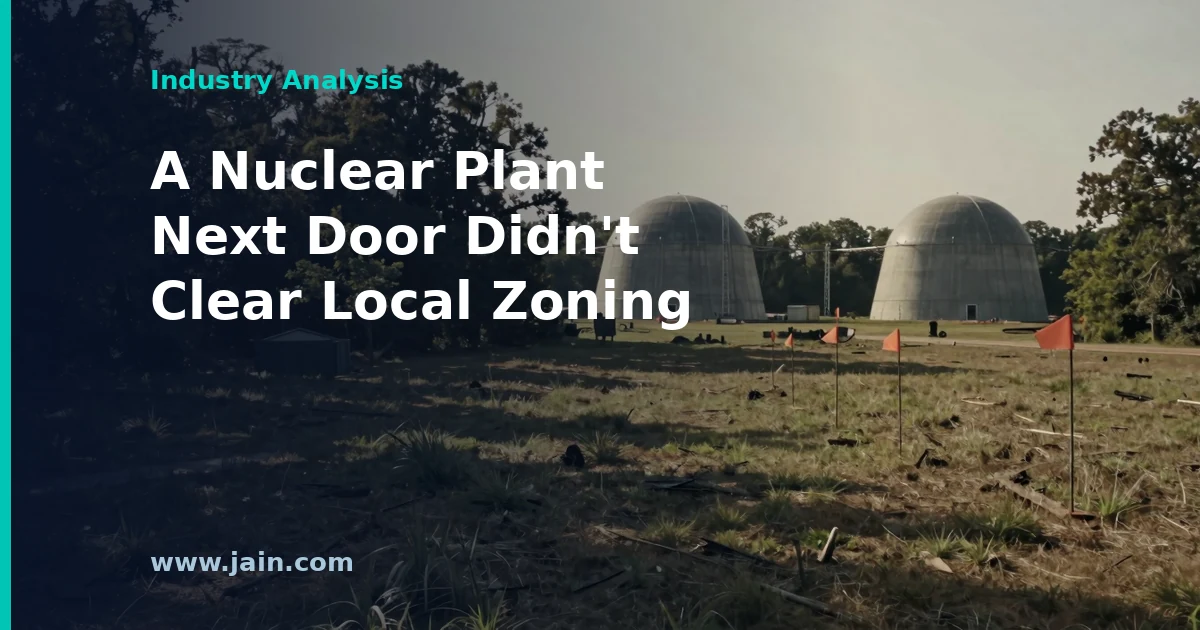
Amazon Web Services (AWS), Amazon’s cloud computing arm, has abandoned its proposal to build data centers on the campus of the Calvert Cliffs Nuclear Power Plant near Lusby, Maryland, Maryland Matters reported on August 4, 2026, citing a Calvert County government news release. The proposal, submitted to the county in early May, called for “multiple data center campuses” covering 2.4 million square feet.
The withdrawal follows the June 23 primary election, in which all three Calvert County commissioners who had voted against a pause on data centers lost their races. The county has scheduled an August 18 public meeting on a temporary six-month moratorium on site plan approvals for data center projects. Amazon described the move as a business decision; plant owner Constellation Energy said the opportunity at the site continues.
Executive Summary
AWS has walked away from what was, on paper, one of the most attractive data center sites in the Mid-Atlantic: land beside a nuclear plant that Constellation calls Maryland’s largest source of clean, reliable energy. Co-locating a data center with a power plant is the siting strategy much of the industry has pursued to secure the large, round-the-clock electricity that AI and cloud computing demand.
The Calvert Cliffs outcome shows the limit of that strategy. Power next door does not remove the need for local land-use approval, and in Calvert County the politics of that approval shifted sharply between Amazon’s May filing and its August exit. Amazon’s own statement names development timelines as a deciding factor — the variable a county moratorium directly controls.
For developers, utilities and investors, the lesson extends well beyond one county. Much of Maryland’s population now lives under some form of data center moratorium, according to a regional climate advocacy group, and state lawmakers may take up statewide proposals in 2027.
Power Next Door Did Not Replace the Permit
Data center developers have spent the past two years chasing power, not land. Large facilities that train and run AI models draw electricity continuously, and securing that supply through a crowded regional grid can take years. Building beside a nuclear plant — often called co-location — is attractive because the plant produces large amounts of steady, carbon-free power on site. Calvert Cliffs, with Units 1 and 2 near Lusby, offered exactly that.
But a site plan still has to be approved by the county. Amazon filed its 2.4 million-square-foot proposal in early May. On June 23, voters removed commission president Todd Ireland, vice president Mark C. Cox Sr. and commissioner Earl F. “Buddy” Hance, the three commissioners who had voted against a data center pause, in favor of candidates critical of the county’s data center trajectory. On August 4, the county announced both Amazon’s withdrawal and a hearing on a six-month moratorium on data center site plan approvals, intended to allow time for new zoning rules and studies.
Amazon says the decision was a business one, and nothing public contradicts that. Its statement, however, lists the factors it weighs: “development timelines, operational requirements, and our ability to deliver quickly for customers.” A six-month pause followed by a zoning rewrite is a timeline risk that no amount of nearby generation can offset. The mechanism is straightforward: the power advantage of a nuclear site is realized only after the building exists, while the permitting clock starts first. For hyperscalers — the largest cloud operators — that measure value in speed to capacity, an uncertain local calendar can outweigh a favorable power position.
Maryland’s Moratorium Map Is Now a Siting Input
Calvert County is not an isolated case. The Chesapeake Climate Action Network (CCAN), an advocacy group that supports moratoriums, said in July that nearly 77% of Maryland’s population lives under some kind of data center moratorium. That figure comes from an interested party, but the underlying measures are matters of public record: Prince George’s County enacted a two-year hold in July, Harford County has a ban with no time limit, Montgomery County, Baltimore County and Baltimore City have adopted measures, and Queen Anne’s and Washington counties have one-year pauses.
The political signal is also visible in Frederick County, where voters ousted council chair Brad Young after the council expanded a data center zone in Adamstown. County Executive Jessica Fitzwater then paused data center development through year-end — while county leaders still intend to proceed with a planned 2,500-acre campus. That combination matters: it suggests the backlash is producing delays and new process rather than blanket rejection everywhere, which is a different risk for developers to price.
CCAN’s Maryland director expects the General Assembly to consider statewide moratorium bills in 2027. That is a forecast, not a filed bill, but for anyone evaluating Maryland sites it turns a county-by-county patchwork into a possible statewide variable.
What Constellation and the Next Applicant Are Left Holding
Constellation, which owns Calvert Cliffs, loses a named tenant but not its thesis. It said the opportunity remains to “create jobs, grow the economy and support in-state federal agencies” and that this can be done “responsibly while protecting and expanding” the plant. Those are claims about future projects that have yet to be specified; the county’s proposed review of zoning and heavy industrial use is where they would be tested.
Opponents have their own case to make. Petition organizer Melissa Emmal, whose Change.org petition has passed 10,000 signatures, and the nonprofit Save Lusby Inc. are asking for studies and zoning changes before any project proceeds. The June results suggest broad local support for that position, though the scope of the studies and the criteria for lifting a pause remain undefined — questions the county will need to answer if a moratorium is meant to lead to rules rather than indefinite delay.
Meanwhile, the pipeline has not emptied. Natelli Holdings has proposed a separate data center nearby along Route 4, near Calvert Cliffs State Park, an existing landfill, a wastewater treatment facility and a county-owned gun range. Amazon could also resubmit. Whoever moves next will face the same question Amazon did: not whether the power is there, but how long approval will take.
Background
Calvert Cliffs Nuclear Power Plant, with Units 1 and 2 near Lusby in Southern Maryland, is owned by Constellation Energy, which describes it as the state’s largest source of clean, reliable energy. Amazon Web Services is one of the hyperscalers — the handful of companies that build and operate the largest cloud and AI data centers — and has been pursuing sites with reliable access to large amounts of electricity.
Maryland has become a focal point for local resistance to data center development. Through 2026, counties including Prince George’s, Montgomery, Harford, Baltimore County, Queen Anne’s and Washington adopted pauses or bans, and data center policy became a deciding issue in county primaries in Calvert and Frederick counties. Source: Amazon abandons plans for data center campus at Calvert Cliffs — Maryland Matters on AWS withdrawing its Calvert Cliffs data center proposal after a county primary centered on data centers.Sources