
TL;DR · 30-second read
The Short Version
The federal government’s main pollution regulator said on June 10 that it will not write national environmental rules for the giant computer warehouses that run artificial intelligence. States and local towns will decide instead.
That does not mean fewer fights. Some of these sites burn natural gas on their own property to get electricity quickly. In April, civil rights and environmental groups sued the company xAI, saying it ran 57 gas-fired generators near Memphis without the pollution permits the law requires. How that case ends will decide who gets to challenge these projects in court.
US Environmental Protection Agency (EPA) Administrator Lee Zeldin said at the Politico Energy Summit on June 10, 2026, that the agency will not pursue any nationwide environmental requirements or recommendations aimed at the AI industry, Crowell & Moring reported. Zeldin acknowledged that technologies exist to reduce data centers’ water consumption and air pollution, but said deciding the right practices for each facility is a matter for states and local communities, not EPA.
The announcement follows a year of EPA actions easing permitting for power generation and data centers, and it lands amid active litigation: an April 14 Clean Air Act citizen suit by the NAACP, the Southern Environmental Law Center and Earthjustice alleging that xAI and its subsidiary MZX Tech operated 57 unpermitted portable methane gas turbines to power the Colossus 2 data center in South Memphis, and a June 16 Department of Justice motion to intervene and have that suit dismissed.
Executive Summary
EPA has taken itself out of the business of writing AI-specific environmental rules. There will be no national standard for data center water use, air emissions or cooling practices, and no federal list of recommended best practices. That removes a layer of regulation developers had reason to expect, but it does not suspend the Clean Air Act or the Clean Water Act, and it does not change the fact that most day-to-day permitting decisions sit with state and local agencies.
The practical effect is to relocate risk rather than remove it. The part of an AI campus most exposed is on-site combustion — gas turbines and backup engines that make electricity on the property — because that equipment is what triggers air permits. With no federal template, those permits will be judged against differing state and local standards, and enforcement increasingly runs through private lawsuits, as the xAI case shows.
Whether that private enforcement route stays open is now itself in question. The Department of Justice has argued that private groups cannot pursue Clean Air Act suits over the federal government’s objection. The outcome of that argument will shape the legal risk attached to fast-tracked on-site power across the industry.
Stepping Back Is Not the Same as Fewer Permits
Zeldin’s June 10 statement rules out new federal requirements and recommendations aimed at AI. It does not rewrite existing law. Data centers that burn fuel on site still fall under the Clean Air Act, and those that discharge water still fall under the Clean Water Act. New Source Review (NSR) — the Clean Air Act program requiring a permit before a large new pollution source is built — still applies. Until EPA finalizes the rule it proposed in May 2026, a major NSR permit is still required before any construction begins.
Read in sequence, EPA’s recent actions share a pattern. In May 2025 it issued guidance allowing certain emergency engines to run up to 50 hours a year in non-emergency conditions to support grid reliability for data centers. In September 2025 it gave developers flexibility to start non-emissions-related building work before obtaining a Clean Air Act permit. In May 2026 it proposed redefining when construction legally ‘begins’ so non-emitting structures can go up earlier. Each step lets the concrete and steel move faster. None of them exempts the equipment that actually emits.
Why 57 Turbines Mark Where the Risk Now Sits
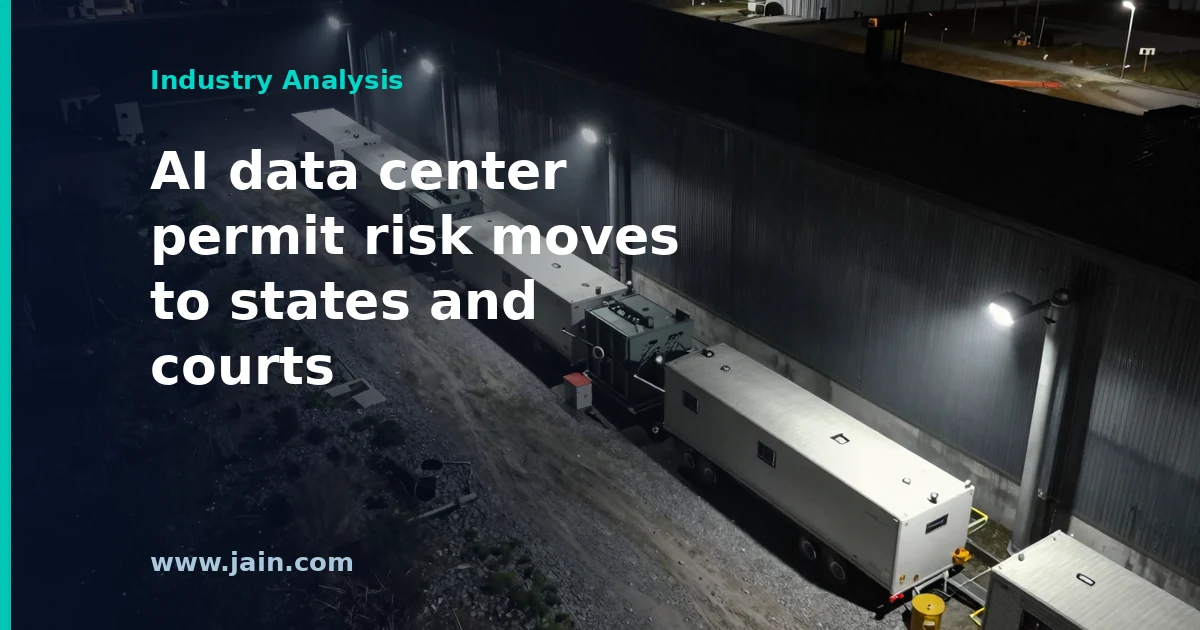
The server halls of an AI campus do not need an air permit; the generators feeding them can. That is the mechanism behind the title’s claim. When grid connections lag behind construction schedules, some developers bridge the gap with on-site gas generation, and that generation is precisely where Clean Air Act obligations bite. The citizen suit filed April 14 alleges that xAI and MZX Tech ran 57 portable methane gas turbines without required air permits to power Colossus 2 — a fleet the complaint treats as the data center’s power supply, not an ancillary backup. The allegations have not been proven in court, and the plaintiffs seek substantial penalties and cite health risks for families in South Memphis and North Mississippi.
With EPA declining to set a national standard, the questions that decide cases like this — whether equipment crosses major source thresholds (the emissions levels above which a facility needs the most demanding permits), what controls are required, how long ‘temporary’ generation may run — are answered by state air agencies and local boards, and tested by private plaintiffs in federal court. A citizen suit is a lawsuit a private party can bring to enforce a federal environmental law after giving 60 days’ notice. The people most affected are developers using on-site generation to beat grid timelines, the lenders and customers relying on those schedules, and the communities living next to the equipment.
The Justice Department’s Intervention Is the Swing Variable
On June 16, the Department of Justice moved to intervene in the xAI case and have it dismissed. Its filing argues that the suit threatens national security by seeking to cut power to AI infrastructure that supports the Department of War’s operations, and, more broadly, that the executive branch holds exclusive authority to enforce federal law, so private parties cannot pursue Clean Air Act citizen suits over the government’s objection.
If a court accepted that theory, it would sharply narrow a private right of action Congress wrote into the statute and raise separation-of-powers questions, since the executive branch would effectively decide which cases reach a judge. Crowell & Moring’s attorneys consider it unlikely the court will accept the argument. Either way, the ruling matters well beyond Memphis: it will tell developers whether federal non-enforcement actually lowers their exposure, or whether private enforcement fills the space EPA has left.
A Patchwork Rewards Early Paperwork
Without a national baseline, requirements will diverge by state and locality, and a multi-state developer will face different rules for the same turbine or cooling design. That favors operators who secure permits before breaking ground, audit whether their generation crosses major source thresholds, and treat compliance with federal law as protection against both citizen suits and a future administration that enforces more aggressively.
Zeldin’s own acknowledgment that pollution- and water-reducing technologies exist points to a hedge: voluntary adoption of measures such as closed-loop cooling, which recirculates water rather than evaporating it, may reduce the odds of state action and local opposition. The competitive edge in this environment belongs less to whoever builds fastest than to whoever can show a regulator, a neighbor or a judge that the power plant behind the data center was permitted from day one.
Background
The US Environmental Protection Agency sets national rules under laws such as the Clean Air Act and Clean Water Act, but state and local agencies issue and enforce many of the permits that apply to individual facilities. The rapid growth of AI data centers — and the electricity they need — has drawn activity from Congress, the executive branch, federal agencies and the courts, without yet producing a cohesive regulatory framework.
Since May 2025, EPA has issued a string of actions aimed at speeding data center and power plant construction, and in January 2026 it held a roundtable with the Data Center Coalition, the industry’s trade association. xAI’s Colossus 2 in South Memphis has become the most visible test of how environmental law applies to AI campuses that generate their own power on site. Source: EPA Steps Back from AI Data Center Regulation: What Developers Must Know Now – Crowell & Moring LLP — EPA’s June 10, 2026 decision not to set national environmental standards for AI data centers, and the Clean Air Act litigation over xAI’s Colossus 2 turbines.Sources