
TL;DR · 30-second read
The Short Version
Data centers are full of computers that run hot, and fans have long blown that heat away. Fans alone use about 15% of a data center’s electricity, according to one company’s chief executive.
Newer servers pipe liquid directly over their hottest chips, so many fans can be removed. The catch: smaller parts nearby, like network and memory cards, can then overheat and slow the whole machine down.
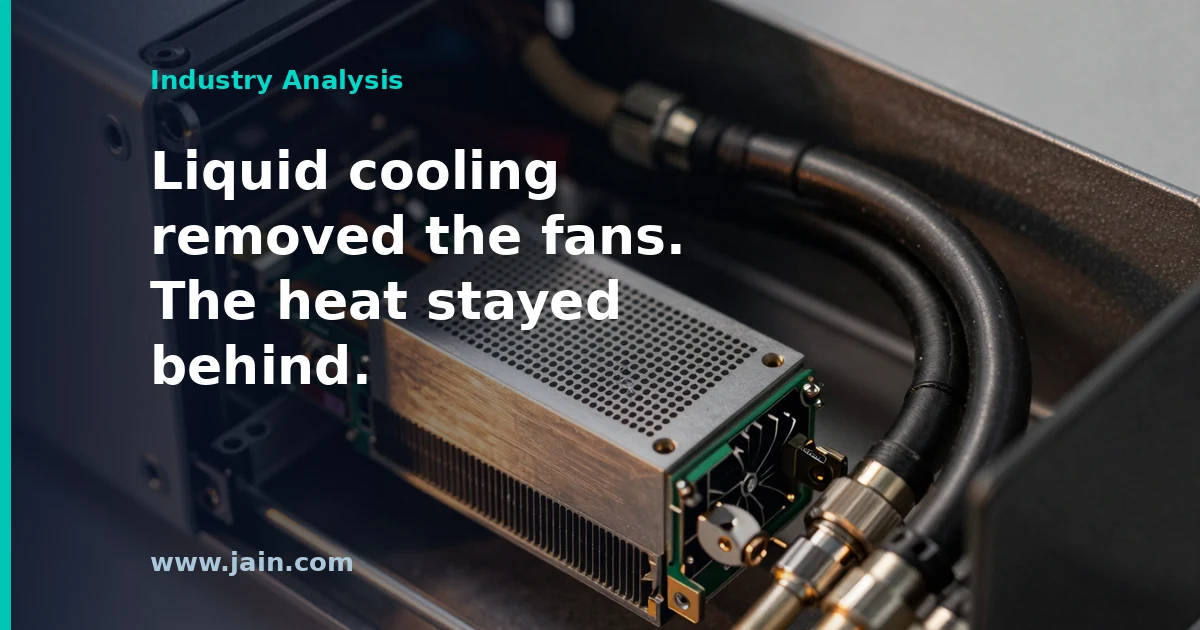
Ventiva makes a tiny, silent air mover with no moving parts that uses electrically charged air to cool those parts. It is still being tested, and laptops get it before data centers do.
Ventiva, a cooling technology company founded about 15 years ago as Thorn Micro Technologies, is qualifying a fanless “ionic air mover” for use inside data center servers. CEO Carl Schlachte told Facilities Dive that the device is aimed at a specific problem created by direct-to-plate liquid cooling. When operators remove bulk fans after moving processors onto liquid-cooled plates, lower-value components such as network interface cards (NICs), boot-optimized storage solution (BOSS) cards and memory modules (DIMMs) can overheat and throttle server performance.
According to Schlachte, fans consume about 15% of the energy flowing into data centers, and the component needs only one or two cubic feet per minute (CFM) of airflow to cool those parts. Ventiva is qualifying the device with server manufacturers for the rest of 2026. First shipments go into laptops and mini PCs next year, and data center deployments follow.
Executive Summary
The announcement is less about a new way to cool a data center and more about a gap in an existing one. Direct-to-plate liquid cooling runs coolant through metal plates mounted on the hottest chips, the CPUs and GPUs, and it lets operators strip out many of the bulk fans that used to push air through a server. Removing those fans saves energy. It also removes the incidental airflow that kept everything else in the chassis cool. Ventiva is selling a product for that residual heat.
This matters because liquid cooling adoption is being driven by dense GPU servers, and every liquid-cooled server still contains air-cooled parts. If those parts throttle, operators lose some of the performance they paid for. Ventiva’s pitch is that a solid-state air mover built into the card can recover it without bringing the fans back.
The 15% figure attached to the story needs careful reading. It describes fans’ share of data center energy as Schlachte characterised it. It is not a measured saving from Ventiva’s device, which targets component temperature and performance rather than facility power.
Liquid Cooling Moves the Heat Problem Rather Than Ending It
A cold plate cools only the chip it touches. In a conventional air-cooled server, bulk fans pull a large volume of air front to back, and that stream cools the processors as well as everything downstream of them: network cards, boot drives, memory modules and power components. When direct-to-plate cooling takes over the processors, operators can reduce or remove those fans. The processors are fine. The components that were riding along in the airflow lose their cooling.
This is the mechanism behind the headline. Schlachte described servers that were “throttling due to overheating at the back”, meaning the chips automatically slowed down to protect themselves. He said the fix does not require much air: one or two CFM moving between DIMMs is enough for things to “start to get better almost immediately.” For comparison, a single conventional server fan is designed to move far more air than that. The operational point is that a liquid-cooled server needs very little airflow for its residual components, but it still needs some, and it needs that airflow in the right place. A device small enough to sit on the card itself could supply it.
The people affected are server manufacturers designing liquid-cooled platforms and operators retrofitting air-cooled halls with direct-to-plate systems. In both cases, the residual air-cooled load is a design problem. It does not disappear when the coolant loop goes in.
Reading the 15% Correctly
Coverage of the launch attached a 15% energy efficiency figure to the device. As Schlachte described it, 15% is the approximate share of data center energy consumed by fans. That figure is the reason operators want to remove fans, and removing them is a benefit of liquid cooling. Ventiva’s product does not produce that saving. At most, it makes the saving easier to keep by solving the thermal side effect.
The company’s own performance claims are softer and not yet quantified in public. Schlachte said upgraded servers would run “some double-digit percentage better” and suggested operators would get “15% more uptime.” Neither figure came with a test configuration, workload or baseline. Uptime is normally measured as the share of time a system is available, so a 15% improvement implies a starting point that few production data centers would accept. The claim may mean fewer throttling events or fewer thermal faults, but it has not been defined. These are plausible directions of benefit, but they are not substantiated results, and buyers should treat them as hypotheses until qualification data is published.
An OEM Channel, Not a Facilities Purchase
Ventiva’s route to data centers runs through server manufacturers. Schlachte described OEMs approaching facilities managers to propose an off-cycle upgrade: technicians would swap existing BOSS cards, NICs or DIMMs for versions with the air mover built in. He framed this as “no hit to you in terms of bottom line.” That framing leaves open who absorbs the cost of the new cards and the technician time.
This channel has advantages. The unit of adoption is a card, not a cooling plant, so an operator can trial it in a handful of servers without facility engineering work. It also depends on OEMs qualifying and warrantying the parts, which is why Ventiva is spending the rest of 2026 on qualification and thermal simulation. The sequencing reflects that dependency: laptops and mini PCs first next year, and data centers after that.
Old Physics, New Operating Conditions
The underlying principle, electrohydrodynamic flow, is well established. A charged wire creates a small plasma field that ionises nitrogen and oxygen molecules in the air. The ions drift toward a negatively charged collector and drag neutral air along with them, producing a breeze with no blades or motor. Schlachte noted that people have observed the effect for about 300 years. Removing moving parts removes a common failure point, and small size allows placement directly on a component.
The engineering question is whether that principle holds up for years inside a server, in a hall with its own dust, humidity and maintenance regimes. Ventiva has said it has cards running and simulations under way. It has not yet published the reliability, efficiency and service-life data that operators and OEMs use to decide whether a new component belongs in production racks.
Background
Data centers have traditionally been cooled with air: room-level systems chill the air, and fans inside each server pull it across the components. As processors, especially the GPUs used for AI workloads, have grown denser and hotter, operators have adopted direct-to-plate liquid cooling, which carries heat away from the hottest chips through coolant-filled plates. That shift lets operators reduce the number of bulk fans, which Ventiva’s CEO says account for roughly 15% of data center energy use.
Ventiva, originally Thorn Micro Technologies, has spent about 15 years developing solid-state air movers based on electrohydrodynamic flow, the airflow produced when charged ions travel between a wire and a collector. The company is positioning the technology first in compact consumer devices and then in servers. There, it targets components that are not on the liquid cooling loop but still need a small, steady supply of air. Source: Ventiva touts fanless cooler for 15% data center energy efficiency gains — Facilities Dive’s interview with Ventiva CEO Carl Schlachte on the company’s ionic air mover for liquid-cooled servers.Sources