
TL;DR · 30-second read
The Short Version
A Sacramento company best known for making clean fuel has launched a cooling system for the computer buildings behind artificial intelligence. Its selling point is that it uses no water.
Instead of blowing cold air over computers, it sinks them in a liquid that does not conduct electricity. The company says one unit can handle up to a megawatt of computing, roughly the electricity several hundred homes use, in a space about the size of a large bedroom.
The catch is that the heat still has to go somewhere, and the company has not said how the system copes on a hot day.
Infinium, a Sacramento clean-fuel company, has unveiled the EdgeSites Vector ONE, a self-contained data center cooling system that uses no water, the Sacramento Business Journal reported on July 27, 2026. The system submerges servers in dielectric fluid, a liquid that does not conduct electricity, rather than cooling them with air conditioning.
According to the report, Vector ONE supports up to one megawatt of computing power in 150 to 250 square feet, and the company says it allows computing in 70% less space than air-cooled equipment. No pricing, customers, shipment dates or energy-efficiency figures were given.
Executive Summary
Infinium is entering data center cooling with an immersion system, a design in which servers sit in tanks of non-conductive liquid that carries heat away from chips far better than air does. The product, sold under the company’s EdgeSites and Infinium Edge names, is pitched on two claims: it uses no water, and it packs up to a megawatt of computing into a footprint the size of a large room.
Both claims land on live issues in AI infrastructure. AI servers run hotter and denser than conventional servers, pushing air cooling to its limits, and data center water consumption has become a flashpoint with local communities and regulators. A product that addresses density and water at once is well aimed.
What the announcement does not yet show is the part that decides whether waterless cooling works at scale: how the system rejects a megawatt of heat to the outdoors, how much electricity that takes, and how its capacity holds up in hot weather, which is exactly when evaporative cooling earns its keep.
A Megawatt in a Large Room Is the Real Headline
The most concrete number in the announcement is density. One megawatt in 150 to 250 square feet works out to roughly 4,000 to 6,700 watts of computing per square foot of floor. That is far beyond what traditional raised-floor, air-cooled data halls are built to handle, and it is the kind of concentration modern AI hardware demands. Graphics-processor servers used to train and run AI models pack far more power into each rack than the general-purpose servers most facilities were designed around.
Immersion cooling makes that density possible because liquid absorbs and moves heat far more effectively than air. The claim of 70% less space follows naturally: without the aisles, air handlers and spacing air cooling requires, servers can sit much closer together. For operators short on floor space, or trying to fit AI capacity into an existing building or a small edge site, that is a genuine advantage.
Waterless Moves the Hard Problem Outdoors
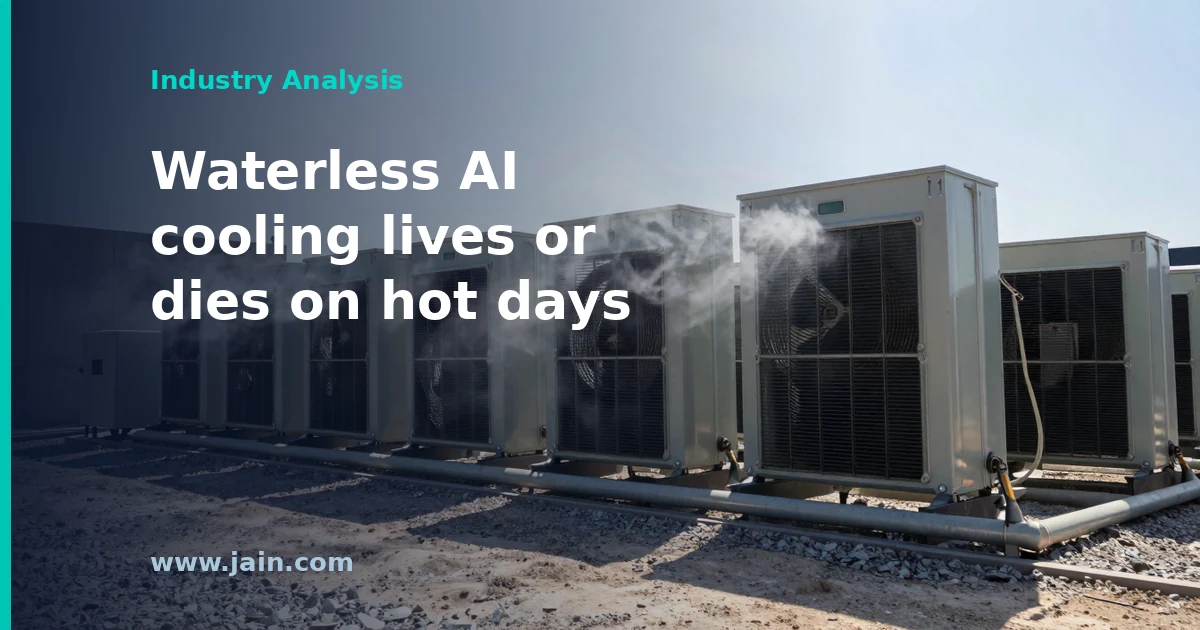
Immersion solves the problem of getting heat off the chip. It does not make the heat disappear. Every watt a server draws ends up as heat in the fluid, so a fully loaded Vector ONE has to shed up to a megawatt of heat continuously, and it has to do so from a very small footprint. That step, known as heat rejection, is where the water question is actually decided.
Many large data centers use evaporative cooling because evaporating water is an extremely effective way to dump heat, especially in hot, dry weather. A system that uses no water must reject heat by dry means, typically fans pushing outside air across heat exchangers. Dry systems avoid water consumption entirely, but their capacity depends on outdoor air temperature: the hotter the day, the harder they work and the more electricity their fans draw. Immersion helps here, because the fluid can run warmer than the air in a conventional data hall, which widens the gap between fluid and outdoor air and makes dry rejection more practical. How much it helps is a question of engineering data Infinium has not published.
This is why the density figure and the water claim are linked. Packing a megawatt into 250 square feet concentrates the heat-rejection burden, and the outdoor equipment, its size, noise, power draw and hot-day rating, becomes the component that determines whether the megawatt figure holds in July in Sacramento or Phoenix. Site developers in water-stressed regions, utilities sizing grid connections, and buyers comparing total energy costs are the people for whom that answer matters most.
Water Is the Pressure Point, Energy Is the Trade-Off
Positioning around zero water use is commercially astute. Data center water consumption has drawn scrutiny in drought-prone areas, and a cooling approach that removes water from the conversation can ease permitting and community relations. That value is real even before any efficiency numbers are considered.
The efficiency claim as reported, that immersion cools servers more efficiently than air conditioning, is a comparison with air cooling, a fairly low bar for liquid systems. The more relevant comparison for AI-scale sites is against water-assisted cooling, where operators trade water for lower electricity use. The industry-standard way to express that trade is power usage effectiveness, or PUE, the ratio of total facility power to computing power, alongside water usage effectiveness. Neither figure accompanied the announcement, so the claim that Vector ONE is both waterless and efficient remains to be demonstrated.
An Edge Product From an Unexpected Supplier
Infinium’s core business is electrofuels, synthetic fuels made from renewable electricity, and the company has recently landed an airline fuel deal and begun work on what it calls the world’s largest electrofuel plant. A cooling product is a notable step sideways, though both lines of business sit at the intersection of energy and heavy industrial engineering.
The EdgeSites and Infinium Edge branding, and the one-megawatt unit size, point toward modular and edge deployments rather than the hundred-megawatt campuses hyperscalers build. That is a sensible niche: edge sites are often in places where water hookups, space and cooling infrastructure are hardest to come by, and a self-contained unit that arrives ready to run fits those constraints. It also means Vector ONE competes with established immersion and modular data center vendors, where track record, server-maker support and service networks weigh heavily in purchasing decisions.
Background
Infinium is a Sacramento-based clean-fuel company that develops electrofuels, synthetic fuels produced with renewable electricity. It has announced an airline fuel supply deal and started construction on what it describes as the world’s largest electrofuel plant. The EdgeSites Vector ONE, marketed under its Infinium Edge name, marks its move into data center cooling.
Immersion cooling is an established technique that has moved from niche uses toward mainstream interest as AI hardware pushes power density beyond what air cooling handles comfortably. At the same time, data center water consumption has become a siting and permitting issue in water-stressed regions, increasing demand for cooling approaches that avoid evaporative water use. Source: Infinium unveils self-contained data center cooling system that uses no water (Sacramento Business Journal, July 27, 2026), reporting on Infinium’s EdgeSites Vector ONE waterless immersion cooling system.Sources