
TL;DR · 30-second read
The Short Version
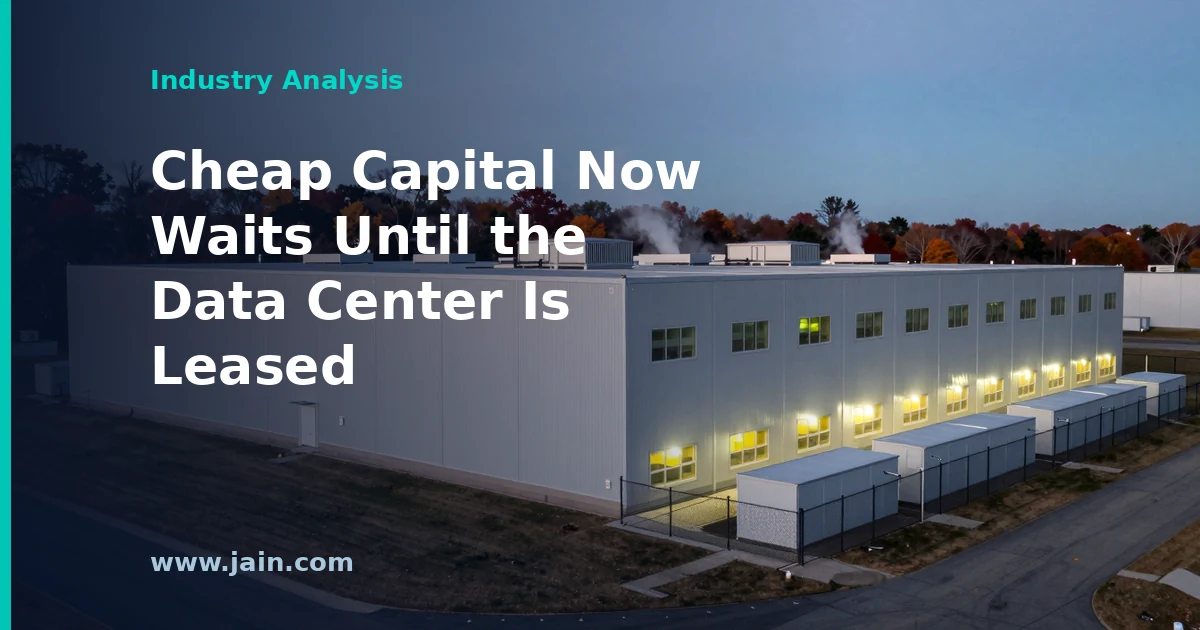
A company called Cloud Capital raised $520 million by selling bonds that are paid back from the rent on one huge data center in Northern Virginia. A data center is a building full of computers, and a major technology company leases this one long-term. It uses 80 megawatts of power, roughly what tens of thousands of homes use.
Three separate credit-rating firms gave the bonds their highest possible grade, a first for this kind of deal.
The takeaway: lenders now see a finished, already-rented data center as one of the safest things to lend against. The cheapest money goes to buildings that are done.
Cloud Capital has completed a $520 million asset-backed securities issuance through its newly established Cloud Capital ABS Master Trust, Pulse 2.0 reported on August 2, 2026. The notes were issued as a single A-2-I tranche. They are backed by an 80-megawatt hyperscale data center in Northern Virginia that is leased long-term to an investment-grade hyperscale customer. Fitch Ratings, Morningstar DBRS and Kroll Bond Rating Agency each rated the notes AAA, which the company says is a first for a data center ABS.
Guggenheim Securities was sole structuring advisor and sole active bookrunner. Deutsche Bank Securities and Morgan Stanley were passive bookrunners. Net proceeds will support the expansion of Cloud Capital’s Core Strategy, a joint venture backed by Realty Income and a major global institutional investor.
Executive Summary
Cloud Capital has turned the rent from a single leased hyperscale data center into $520 million of top-rated bonds. It has also set up a master trust that lets it repeat the process with other buildings. The company says the deal is the first data center ABS to earn AAA from three independent agencies. It also says the deal matched the tightest spread for the asset class since the Middle East conflict began in 2026.
The significance is less about one building than about who gets cheap money in the AI-era buildout. Triple-A pricing is available to capacity that is already finished and contracted. The construction, power and leasing risk that defines a new project stays with equity investors and construction lenders. That makes an executed hyperscale lease a financing asset in its own right. It also gives owners of stabilized portfolios a lower-cost way to recycle capital into their next acquisitions.
Key details remain undisclosed, including the notes’ pricing, the tenant’s identity and the lease term. Those are the figures investors would need to judge how large a cost-of-capital advantage the structure really delivers.
Why Three Agencies Reached Triple-A
An asset-backed security, or ABS, is a bond repaid from a specific pool of cash flows rather than from a company’s general balance sheet. Here the pool is the rent from one building: an 80-megawatt hyperscale data center in Northern Virginia. The company says it is leased long-term to an investment-grade hyperscale customer. Hyperscalers are the handful of cloud and internet giants that run computing at enormous scale, and their own debt typically carries strong credit ratings. Fitch Ratings, Morningstar DBRS and Kroll Bond Rating Agency each assigned the notes their top grade, which Cloud Capital says makes this the first data center ABS rated AAA by three independent agencies.
The company attributes the rating to “a conservative capital structure, long-term contracted revenue and stabilized infrastructure assets.” Contracted revenue means the rent is fixed by a lease rather than dependent on finding tenants. Stabilized means construction is finished and the tenant is in place and paying. A conservative structure generally means the bonds are sized well below the asset’s value, which leaves a cushion before bondholders are exposed to any loss. Taken together, the credit case rests heavily on the tenant’s obligation to pay, with the building securing that promise.
Two-Speed Financing: Finished Capacity Borrows Cheaply
The deal shows that triple-A money becomes available only after the hardest risks have been retired. A data center’s riskiest years come before it earns any rent. In that period the developer must secure land and grid power, build out electrical and cooling systems, and sign a tenant. None of that risk sits inside this transaction. The collateral is an operating, fully contracted building. That is why it could be rated at the top of the scale. It is also why, by the company’s account, it priced at a spread matching the tightest for data center ABS since the Middle East conflict began in 2026. A spread is the extra yield investors demand over a benchmark rate, and a tighter spread means cheaper borrowing.
This matters for the AI-era buildout. Demand for hyperscale capacity, driven in large part by AI alongside conventional cloud computing, is pushing developers to build at record pace. Yet the cheapest long-term money in this market reaches a project only after it has been built and leased. Until then, construction and lease-up are funded with equity and construction financing, which cost more. Once a site stabilizes, an owner like Cloud Capital can refinance it through a vehicle like this one and redeploy the proceeds. The release says net proceeds will support expansion of the company’s Core Strategy. The lowest cost of capital therefore goes to whoever holds the finished, leased building.
That has practical consequences. It favors owners with large stabilized portfolios; Cloud Capital says it has acquired 30 data center properties worth more than $12 billion since 2020. It raises the value of a signed hyperscale lease, because the lease is what unlocks the lowest-cost financing. It also deepens a market in which third-party owners supply hyperscale capacity funded by bond investors rather than by the tenant’s own balance sheet. One transaction does not establish a market-wide shift, but its structure makes the mechanism explicit.
A Master Trust Built for Repeat Issuance
The structure matters as much as the rating. A master trust is a single legal vehicle that can issue multiple series of notes over time against a growing pool of assets, so the owner does not need a new structure for every deal. Cloud Capital says this is its second ABS master trust. It describes it as the first programmatic data center ABS master trust established for a core joint venture. That venture is its Core Joint Venture Strategy, backed by Realty Income, the publicly traded net-lease real estate investment trust, and an unnamed major global institutional investor.
Jason Weaver, Cloud Capital’s head of capital markets, described the goal as a “repeatable financing platform” that diversifies funding and positions the company to “finance future growth at an increasingly competitive cost of capital.” The ambition is coherent, but its payoff depends on what comes next. The cost-of-capital benefit becomes demonstrable only if later series price as well as this one. It also requires more stabilized buildings to be added to the pool.
Reading the Claims Carefully
Several of the headline claims are relative rather than absolute. The spread claim compares this deal only with data center ABS priced since the Middle East conflict began, and no spread, coupon or maturity was disclosed. The “strong demand from a broad group of institutional investors” was not quantified with an order-book size or an oversubscription multiple. Guggenheim’s Matt Bissonette described the deal as “a new benchmark.” That assessment comes from the deal’s structuring advisor and lead bookrunner.
The collateral is also concentrated in one building, one tenant and one market. Triple-A ratings on a single-asset deal signal strong confidence in that tenant and lease. They also mean the notes’ performance depends on a single counterparty and on the long-term economics of Northern Virginia. It is the world’s largest data center market, and access to new grid power there has become a widely discussed constraint on growth. That constraint bears more on new development than on an operating, leased facility, but investors will weigh it when they assess renewal risk at the end of the lease.
Background
Cloud Capital was founded by Hossein Fateh, who previously co-founded DuPont Fabros Technology, a wholesale data center developer acquired by Digital Realty in 2017. The company says it has acquired 30 data center properties worldwide since 2020, with a combined value of more than $12 billion. Its Core Strategy centres on stabilized hyperscale facilities and is run through a joint venture backed by Realty Income and a major global institutional investor.
Data center asset-backed securities emerged in the late 2010s. Owners wanted long-term financing tied directly to leased facilities rather than to corporate balance sheets. Northern Virginia is the largest data center market in the world and hosts much of the capacity rented by the major cloud providers. Source: Cloud Capital Completes $520 Million Triple-A-Rated Data Center ABS Issuance (Pulse 2.0, August 2, 2026): Cloud Capital’s $520 million AAA-rated ABS, backed by an 80-megawatt Northern Virginia hyperscale data center.Sources