
TL;DR · 30-second read
The Short Version
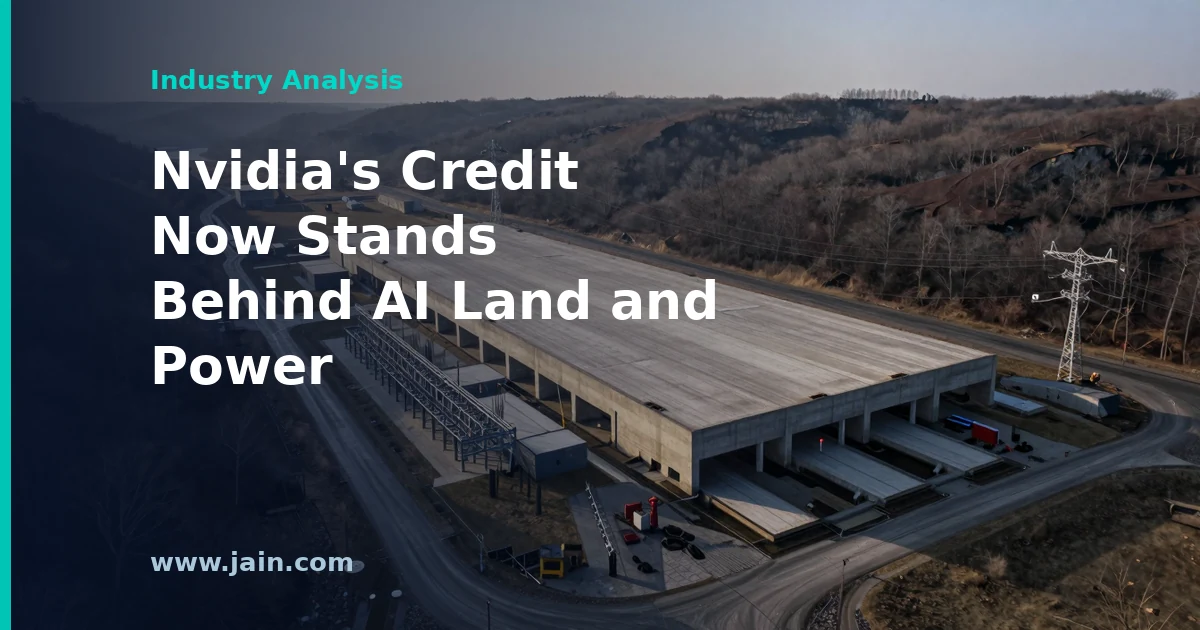
Nvidia, the company whose chips run most of today’s artificial intelligence, has agreed to financially vouch for the land, power and buildings of a huge computing campus in southern Ohio. The campus is on the site of a closed Cold War uranium plant.
In return, only Nvidia’s equipment can go inside. OpenAI, the maker of ChatGPT, has signed a 20-year lease to use it.
At full size, the computers would use roughly the output of eight large nuclear reactors. The first sections are due in 2028. The unusual part is the financing: a chip seller is helping pay for the buildings its chips will sit in.
Nvidia announced on August 17, 2026 that it will provide credit support for the land, power and shell buildout at SB Energy’s PORTS-Pike Technology Campus in Pike County, Ohio. In this context, credit support means Nvidia’s financial backing stands behind the project’s obligations. The support secures an initial 4.25 gigawatts of IT capacity, meaning power delivered to computing equipment, and Nvidia holds an option on the remaining 3.75 IT-GW. In exchange, Nvidia will be the exclusive AI compute provider on the site. OpenAI will be the customer for the full 8 IT-GW. SB Energy will build, own and operate the data center under a 20-year lease to OpenAI.
Nvidia will also invest $1.5 billion in SB Energy, joining existing investors SoftBank Group and OpenAI. SB Energy and SoftBank committed to build at least 10 gigawatts of new generation and to invest at least $4.2 billion in regional grid infrastructure with AEP Ohio. Capacity is expected to come online in phases beginning in 2028.
Executive Summary
The headline numbers are 8 gigawatts of AI capacity, a 20-year lease and a $1.5 billion equity check. The structural news is who is standing behind the real estate. Data center developers typically finance land, power hookups and building shells against the creditworthiness of the tenant. At PORTS-Pike, Nvidia is supplying credit support for the first 4.25 IT-GW. That makes the chipmaker a financial backer of the physical site as well as the vendor of the hardware inside it.
What Nvidia gets in return is explicit: exclusivity. Every AI system on the campus will be Nvidia’s, deployed on its DSX AI factory platform of GPUs, CPUs and networking. Jensen Huang framed it as securing “long-lived infrastructure for NVIDIA compute” that can be upgraded with each new chip generation. That implies a site designed to take several future Nvidia generations over the life of the lease.
The deal matters beyond Ohio for a simple reason. If a chip supplier’s balance sheet can make a gigawatt-scale site financeable, then access to land, power and shells becomes something hardware vendors compete for directly, not just something their customers arrange.
Why a Chipmaker Is Backing Buildings
A data center campus has three expensive layers that come before any chip is installed: land, power (generation, substations and grid connections) and the shell, meaning the building, cooling plant and electrical rooms. The industry abbreviates these as LPS. Whoever finances that layer wants confidence that someone creditworthy will keep paying for the space for the life of the investment. At PORTS-Pike, SB Energy owns the asset and OpenAI is the 20-year tenant. Nvidia is adding a third layer of assurance: credit support on the LPS buildout covering the first 4.25 IT-GW.
That is the mechanism behind the headline. Nvidia is using its own credit to reduce the financing risk of a site it does not own. In return, it gets a guaranteed home for its hardware at a scale of more than four gigawatts, with an option on 3.75 more. Nvidia’s statement makes the logic explicit: “land, power and shell have become vital in the age of AI.” A supplier that is worried about customers finding buildings and electricity for its systems fast enough is now helping underwrite the buildings and electricity itself.
Several groups are affected. Developers gain a new kind of counterparty whose backing may unlock project finance. Lenders get another large name standing behind the obligations. Competing accelerator vendors face a campus that is closed to them by contract. For OpenAI, the arrangement ties a very large block of future capacity to a single supplier’s roadmap. This is one deal, not yet a market pattern. It does show that chipmaker credit can serve as a financing input for AI sites, and other developers will take note.
Exclusivity, Upgrades and Concentration
The exclusivity clause is the price of the guarantee, and it cuts both ways. Nvidia describes the site as upgradeable “with each new generation delivering more intelligence and better economics.” A 20-year lease spans many hardware cycles, so the value to Nvidia is not a single sale. It is a standing claim on refresh after refresh. For OpenAI, a site built around one vendor’s full stack can simplify design and speed deployment. It also narrows negotiating leverage over future generations at this location.
A fair question is how tightly interlinked the parties now are. SoftBank Group and OpenAI were already investors in SB Energy. Nvidia is now investing $1.5 billion and backing the site’s buildout. OpenAI is the tenant and will run Nvidia hardware. Arrangements like this are not unusual in early infrastructure markets, and nothing in the announcement suggests anything improper. Still, it means the campus’s economics rest on a small group of counterparties whose fortunes are correlated with continued AI demand. The announcement asserts that demand is “growing at an extraordinary pace.” Investors will want to see it in contracted revenue as phases come online.
Power-First, With Overhead Built In
SB Energy and SoftBank committed to at least 10 gigawatts of new generation to support 8 IT-GW of AI capacity. The gap between those numbers is instructive. Roughly a fifth of the generation is not delivered to computing equipment. It covers cooling, power conversion and other facility overhead, plus any margin the developers are holding. That is a useful reminder that AI capacity figures quoted in IT-GW understate the electricity a campus actually requires.
The grid commitment is at least $4.2 billion in regional infrastructure through a partnership with AEP Ohio that the companies say is “designed to protect ratepayers.” The release does not explain how that protection works: who pays for which upgrades, and what happens to those costs if demand falls short. Those questions matter to Ohio households as much as to investors. Reusing the decommissioned Portsmouth Gaseous Diffusion Plant site, with the Department of Energy and Department of Commerce involved, may offer existing industrial land and transmission advantages. Spanning federal and private land also adds approval steps that the companies have not detailed.
Background
SB Energy describes itself as an integrated data center and power infrastructure company that develops, builds and operates gigawatt-scale data center campuses and utility-scale power generation. Its investors before this deal included SoftBank Group and OpenAI. Its pitch is a “power-first” model: securing electricity before building compute, on the view that power is the industry’s primary bottleneck.
The PORTS-Pike site sits on the former Portsmouth Gaseous Diffusion Plant in Appalachian Ohio. The plant was a Cold War-era uranium enrichment facility that has since been decommissioned. Redeveloping it as an AI campus places some of the country’s largest planned computing capacity in a region that SB Energy says has long shaped American industry, and it involves both federal and private land. Source: NVIDIA Guarantees SB Energy’s PORTS-Pike Technology Campus in Ohio to Exclusively Host NVIDIA AI Compute. Nvidia Newsroom, August 17, 2026: Nvidia’s announcement of credit support, exclusivity and a $1.5 billion investment in SB Energy for OpenAI’s 8 IT-GW Ohio campus.Sources