
TL;DR · 30-second read
The Short Version
Equinix, one of the world’s largest renters of data center space (the buildings full of computers that run websites and apps), is testing new electrical equipment from Schneider Electric inside a working facility.
The equipment is the heavy-duty switching gear that takes power from the grid and routes it safely into a building. Today it is usually custom-built for each site, which is slow. Schneider says its version uses one standard design controlled by software, and can be ordered and built up to three times faster.
The catch is timing. Most buyers will not be able to get it until 2028.
Equinix is piloting Schneider Electric’s newly launched software-defined medium-voltage (MV) switchgear inside a live colocation data center, Data Centre Magazine reported on September 29, 2026. Schneider unveiled the system at its YOTTA 2026 event in Las Vegas, running September 28-30, and describes it as the world’s first fully software-defined MV switchgear.
Schneider says the design allows up to three times faster ordering and manufacturing, up to two times faster commissioning and onsite acceptance testing, and upgrades with zero operational downtime. Pilot programs will continue through 2027, with broader availability expected from 2028.
Executive Summary
Medium-voltage switchgear is the equipment that receives power from the utility side and distributes and protects it before it is stepped down for use inside a building. It is typically engineered to order, meaning each lineup is designed for a specific site. Schneider Electric’s new product replaces that bespoke approach with standardized hardware whose functions are set and updated in software, including over-the-air updates that add features without physical modification.
Equinix’s role is to prove the concept where it counts: in an operating colocation facility, where multiple customers share infrastructure and reliability expectations leave little room for experimentation. Greg Metcalf, Equinix’s Senior Director of Global Data Center Design and Innovation, framed the value around standardization “for multiple use cases.”
The significance is less the software itself than what it enables. If power distribution gear can be ordered as a standard product rather than designed per site, one of the slower steps in bringing data center capacity online could shorten. That benefit, however, is on a 2028 horizon for most buyers.
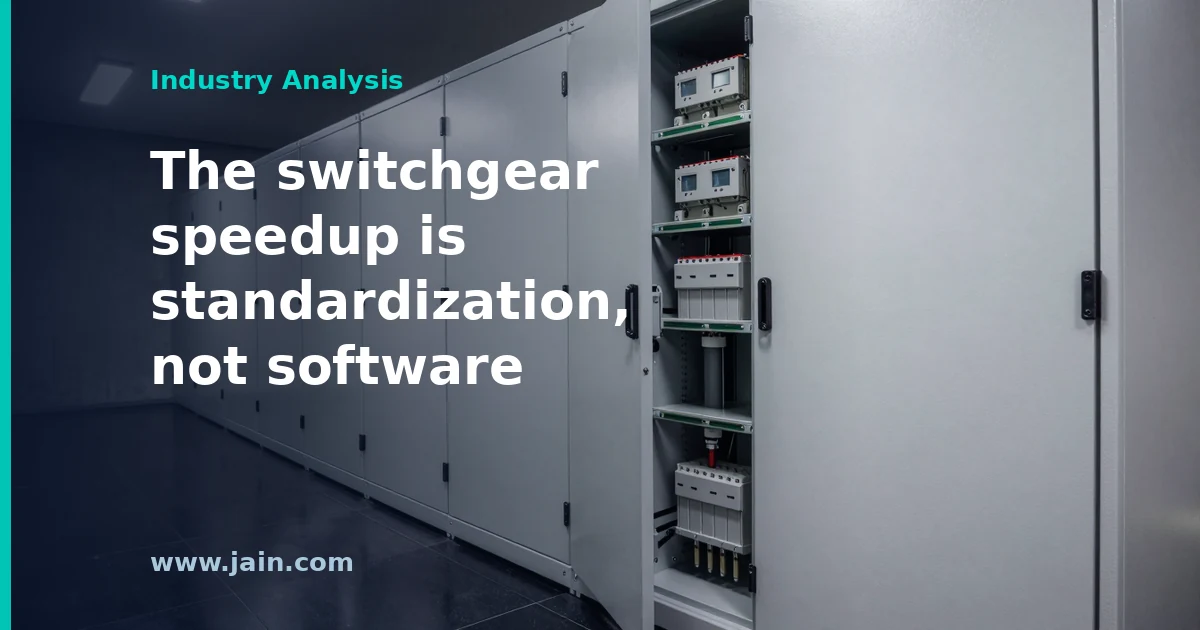
The Speedup Comes From Standardization
Schneider’s own explanation of the problem points to the mechanism. Traditional MV systems are engineered to order, which the company says leads to long lead times, complex procurement and limited scalability. The first change it lists is that standardized hardware platforms replace bespoke designs. Software is the tool that makes this possible: if protection settings, logic and features live in configurable software, one physical platform can serve configurations that previously needed distinct engineering. The claimed result is up to three times faster ordering and manufacturing.
That is why the headline claim is best read as a bet on off-the-shelf power equipment. An engineered-to-order product cannot be meaningfully ordered until a site’s electrical design is settled. A standardized one can, in principle, be ordered earlier, built in larger runs and configured closer to installation. For operators, that turns switchgear selection from a line item into a schedule decision: the lead time on this equipment helps determine when a data hall can be energized and sold.
Both executives emphasized this point. Metcalf cited “increased standardisation for multiple use cases,” while Melton Chang, Executive Vice President of Schneider’s Power Systems Division, said customers can “standardise across regions.” For a multi-market operator such as Equinix, a single qualified design deployable in many countries is a procurement advantage that compounds with every new build.
Why a Live Colocation Site Matters
Colocation facilities rent space, power and cooling to many tenants under one roof, so shared electrical infrastructure is difficult to take offline. That context gives Schneider’s “zero operational downtime” upgrade claim practical weight. Changes to conventional switchgear often require planned outages or physical work; changes delivered through software, if they work as described, avoid negotiating maintenance windows across many customers.
Chang put the broader pressure plainly: “Data centres are being asked to build faster than traditional power infrastructure can move.” The current construction wave, much of it tied to AI workloads, has made power equipment timing a visible constraint. A pilot in a working facility is the credible way to show that a new approach to critical power does not trade reliability for speed.
Software in the Power Path Raises New Questions
Moving function into software also moves risk. Switchgear performs protection: it detects faults and interrupts current to keep equipment and people safe. Over-the-air updates to devices in that role require rigorous change control, validation and cybersecurity, and the announcement does not describe how Schneider addresses them. The lifecycle layer adds further connectivity, with embedded analytics and AI-powered predictive maintenance through Schneider’s EcoCare Services.
The performance claims also need context. “Up to” three times faster ordering and “up to” two times faster commissioning are ceilings, not averages, and no baseline lead time accompanies them. Buyers will want to know how those figures translate into weeks saved on an actual project.
2028 Is the Date That Counts
Pilots run through 2027 and broader availability is expected from 2028, so near-term data center builds will largely rely on conventional gear. Schneider’s plan to extend the architecture across its MV portfolio, including PremSet and the AirSeT range (GM, RM and SM AirSeT), signals a portfolio-wide shift rather than a single product. For operators planning capacity for the later part of the decade, the Equinix pilot is an early reference point worth watching; for projects breaking ground now, it is not yet an option.
Background
Equinix is a global colocation operator, renting data center space, power and cooling to many customers in shared facilities and connecting them to networks and cloud providers. Because it builds in many markets, repeatable designs that can be deployed across regions are central to how it expands capacity.
Schneider Electric makes power distribution and energy management equipment, including medium-voltage switchgear lines such as PremSet and AirSeT. Its Software Defined Energy strategy aims to separate system intelligence from hardware so that power infrastructure can be updated through software rather than rebuilt. The software-defined MV switchgear, launched at YOTTA 2026 in Las Vegas, is the first product under that approach to be tested in a live data center. Source: Inside Equinix’s Pilot of Schneider Electric’s MV Switchgear (Data Centre Magazine), on Equinix’s live colocation pilot of Schneider Electric’s software-defined medium-voltage switchgear.Sources