
TL;DR · 30-second read
The Short Version
A new generation of encryption is coming, built to withstand future quantum computers that could one day crack today’s codes.
The catch: stronger locks can mean more work for the equipment that handles every connection, including the chatbots and other artificial intelligence services businesses now run.
VIAVI, a maker of network testing gear, released a pizza-box-sized machine that floods networks with realistic, quantum-safe encrypted traffic, so companies can find out whether the new locks slow things down before customers notice.
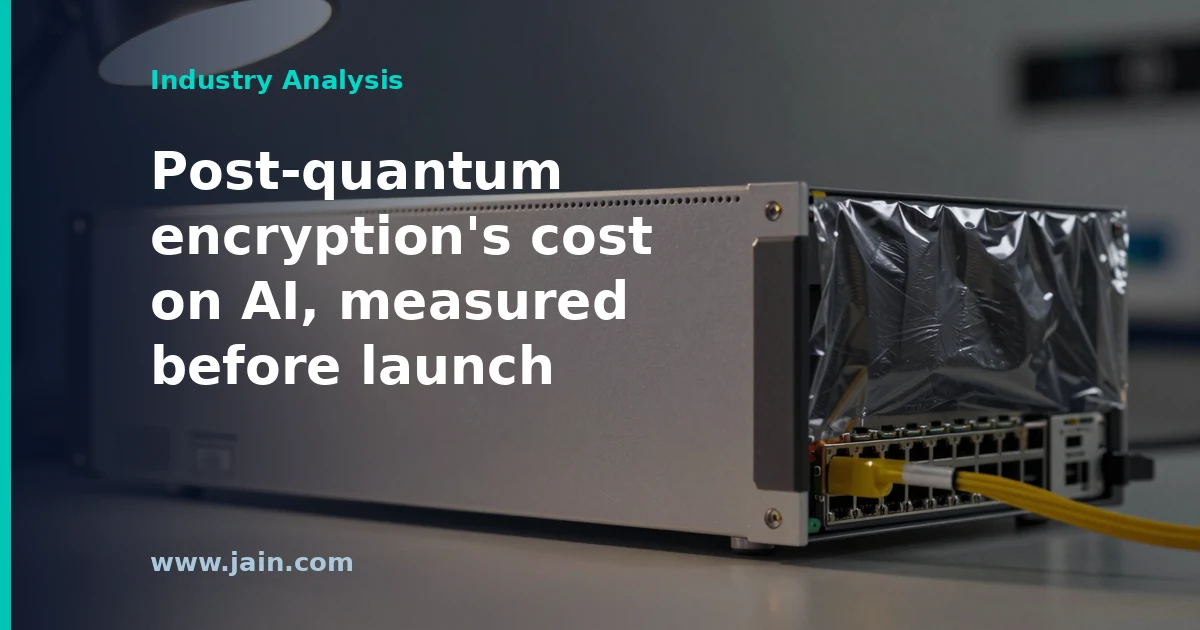
VIAVI Solutions (NASDAQ: VIAV) introduced the CyberFlood CF50 on September 29, 2026, a one-rack-unit (1U) test appliance that generates realistic encrypted application traffic at up to 100 gigabits per second (100G) to test application performance, security controls, AI inference and large language model (LLM) services. VIAVI said the CF50 includes native support for post-quantum cryptography (PQC), delivers TLS performance 1.75 times that of its nearest competitor, and has the industry’s lowest power consumption in its class.
The CF50 is aimed at network equipment manufacturers, systems integrators and service providers, and sits below the existing CyberFlood CF1000, which VIAVI targets at large enterprises that need the highest performance.
Executive Summary
The CF50 is a traffic generator: it impersonates large numbers of users and applications so that engineers can see how firewalls, gateways, load balancers and AI services behave under load before real customers arrive. What distinguishes it, by VIAVI’s account, is that it combines three things in a small box: Layer 4-7 traffic (traffic that looks like real applications rather than raw data packets), security assessment, and AI inference testing, with post-quantum encryption built in.
That combination matters because two infrastructure transitions are happening at once. Organizations are putting AI inference, the step where a trained model answers requests, into production over encrypted connections, and they are preparing to move those connections to quantum-resistant encryption. Both place new demands on the same security equipment. A tester that can generate both kinds of traffic turns the question of whether post-quantum encryption slows AI services into something a lab can measure rather than something operations teams discover after launch.
The headline performance claims, 1.75X TLS performance and lowest power consumption, are VIAVI’s own, and the company has not published the competitor, metric or test conditions behind them. The practical value of the launch rests less on those superlatives than on whether PQC and AI inference traffic can be exercised together at realistic scale.
Post-Quantum Encryption Is a Performance Question, Not Just a Security One
Post-quantum cryptography replaces the mathematical methods that protect today’s encrypted connections with algorithms designed to resist future quantum computers. The US standards body NIST published its first post-quantum standards in 2024, and the pressure to adopt them comes partly from the risk that adversaries are recording encrypted traffic now in order to decrypt it later. The trade-off is that post-quantum key exchanges use considerably larger keys than the methods they replace, which means more data and more computation each time an encrypted TLS session is set up. TLS is the protocol behind the padlock in a browser and behind most API traffic.
That cost does not fall evenly. It lands on the devices that terminate or inspect encryption at scale: next-generation firewalls, secure web gateways, load balancers and the Zero Trust architectures (security designs that verify every connection rather than trusting anything inside the network perimeter) that VIAVI’s announcement names. AI inference traffic runs through exactly this equipment. A user query to an LLM-powered service is typically an encrypted request that passes security controls before it reaches the model and after the answer comes back, and inference services are judged heavily on responsiveness. Any added handshake overhead or reduced connection capacity shows up directly as latency or as a need for more security hardware.
This is where the CF50 changes the workflow. VIAVI says the appliance generates encrypted and mixed application traffic up to 100G with native PQC support, and separately offers AI inference and LLM testing. For the network equipment makers, integrators and service providers VIAVI is targeting, that means the performance impact of switching a firewall or gateway to post-quantum TLS can be measured against realistic application and AI traffic in the lab, before deployment. The overhead becomes a number that goes into sizing and procurement decisions rather than a surprise in production. How fully that promise holds depends on whether both traffic types can run in the same test, which VIAVI’s announcement implies but does not spell out.
What the 1.75X and Lowest-Power Claims Do and Do Not Establish
VIAVI states that the CF50’s TLS performance is 1.75 times that of the nearest competitor and that it has the industry’s lowest power consumption. Both claims are plausible marketing for a product in a competitive test-and-measurement category, and both are unverified. The company has not named the competitor or product compared, specified whether the metric is new connections per second, concurrent sessions or encrypted throughput, stated whether the comparison used classical or post-quantum cipher suites, or published a wattage figure.
Those distinctions matter to buyers. A tester that leads on encrypted throughput may not lead on handshake rate, and handshake rate is where post-quantum overhead concentrates. A power figure matters for labs with constrained rack power, but lowest-in-class means little without knowing the class. The quote from Mauricio Sanchez of Dell’Oro Group supports the general case for realistic pre-deployment testing of AI and encrypted workloads. It does not address the CF50’s specific performance figures, and readers should not treat it as independent validation of them.
A Smaller Box Widens Who Can Afford This Kind of Testing
High-scale encrypted traffic testing has traditionally required large chassis systems and specialist operators. The CF50 packs the capability into 1U, a single standard rack slot about 1.75 inches tall, and replaces a Windows desktop client with a web interface. VIAVI also includes automated goal-seeking, which ramps load until a device under test reaches its limit, MITRE ATT&CK frameworks, a public catalog of real-world attacker techniques used to check whether security controls detect them, and repeatable traffic-mix testing.
The commercial logic is to extend enterprise-scale testing below the tier served by the CF1000 to smaller equipment vendors and integrators. If the portability and price hold up, more of the security and networking supply chain can test post-quantum and AI-traffic performance in-house rather than relying on vendor datasheets. VIAVI has not disclosed pricing, so the cost-effectiveness claim, like the performance claims, awaits specifics.
Background
VIAVI Solutions, based in Chandler, Arizona, is a test-and-measurement and optical technology company. Its test products are used to validate data center, communications network and security infrastructure, and it also supplies resilient positioning, navigation and timing systems for military, aerospace, railway and first-responder communications, alongside optical technologies for anti-counterfeiting, consumer electronics and automotive markets.
CyberFlood is VIAVI’s line of application and security test platforms, which emulate large numbers of users and applications to measure how networks and security devices perform. Before the CF50, the line’s flagship was the CF1000 for large enterprises. The new model arrives as organizations move AI inference into production and begin preparing encrypted connections for the transition to post-quantum cryptography. Source: VIAVI Announces Smallest, Lightest, Most Efficient Platform for 100G Enterprise-Scale Application, Security and AI Inference Testing, VIAVI Solutions’ September 29, 2026 announcement of the CyberFlood CF50 test appliance.Sources