
TL;DR · 30-second read
The Short Version
Eaton, one of the world’s biggest makers of electrical equipment, has finished enlarging its factory in Schrems, Austria. It added floor space nearly the size of an American football field in under ten months.
The new space makes small circuit breakers, the switches in a fuse box that cut power when something goes wrong, on fully automated lines. It also builds more of the larger equipment that spreads power around a building.
Why it matters: the computer warehouses behind artificial intelligence need large amounts of this gear. Eaton has not said how much more it will make.
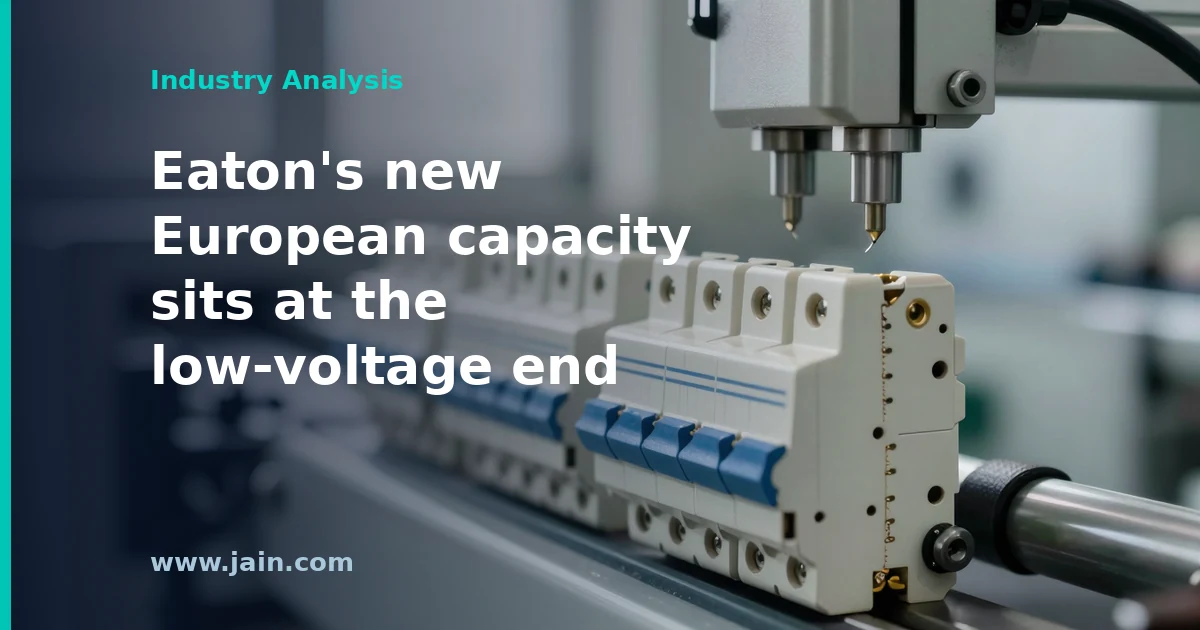
Eaton is marking the completion of a 5,000-square-metre expansion of its manufacturing site in Schrems, Austria, on 1 October 2026, according to a company announcement published by the Financial Times. The new space houses fully automated production of miniature circuit breakers (the small protective devices that sit in electrical distribution panels and trip when a circuit overloads or faults) and expanded assembly capacity for low-voltage systems.
Eaton says the project was completed in less than ten months and ties it to rising European demand from electrification, digitalisation and critical infrastructure that depends on highly available electrical power. The company did not disclose the investment amount, production volumes or headcount.
Executive Summary
Eaton, which reported $27.4 billion in 2025 revenue, has added 5,000 m² of manufacturing space at its Schrems plant in Austria. The expansion combines fully automated miniature circuit breaker production with a manufacturing execution system, software that links machines, internal logistics and enterprise systems in real time, and end-to-end traceability for every product that leaves the line.
The announcement matters to data center builders because of where the capacity sits. Miniature circuit breakers and low-voltage systems form the downstream end of a facility’s electrical chain, the layer that distributes and protects power close to racks, cooling and building systems. Large AI facilities use this equipment in volume, and Eaton names data centers among its core markets.
The announcement covers less ground than a headline about European power capacity might suggest. It says nothing about medium-voltage switchgear or transformers, and Eaton has not quantified the added output. The expansion adds European supply at the breaker and panel level. Eaton has not shown that it relieves the larger, grid-side equipment queues.
Capacity at the Low-Voltage End of the Power Chain
To see where this expansion matters for AI data centers, follow electricity from the grid to a server. Power arrives at high voltage and is stepped down by transformers. It then passes through medium-voltage switchgear, the heavy equipment that switches and protects large feeders, and into low-voltage switchboards and distribution panels. Finally, individual circuit breakers protect each circuit feeding racks, cooling units and building systems. Eaton’s Schrems expansion adds fully automated miniature circuit breaker production and more low-voltage systems assembly, which places it at the downstream end of that chain.
That placement shapes how buyers should read the news. A large data center contains a great many protected circuits, so breakers and distribution equipment are consumed in volume. More European output at this layer is relevant to electrical contractors and developers who source panels and protective devices regionally. The announcement does not mention medium-voltage switchgear or transformers. Those are the larger, more engineered items that tend to dominate discussions of power-equipment lead times on AI projects.
The practical read is that any easing this expansion brings will show up at the breaker and panel level. Projects whose schedules depend on grid-side equipment should not treat it as relief on that front. The same product families also serve Eaton’s residential, commercial, industrial and utility customers. Data center demand therefore competes for this output with every other electrification project in Europe.
Ten Months to Build, With Software Coordinating the Floor
Eaton says the expansion was completed in less than ten months. How fast a supplier can add capacity is one of the few supply-side variables it controls directly. A short build suggests Eaton can respond within a single planning cycle when it decides a product line needs more output.
The more distinctive element is the factory’s digital layer. A manufacturing execution system (MES) is the software that tells machines what to make, tracks work in progress and connects production to inventory and ordering systems. Eaton describes Schrems’ MES as linking manufacturing, intralogistics and enterprise systems in real time. Combined with end-to-end traceability, meaning each unit’s production history can be followed, this addresses what the company calls increasingly demanding performance and compliance requirements. Operators of critical facilities typically need documentation of exactly what was installed and how it was made.
Full automation also fits the product. Miniature circuit breakers are high-volume, standardised devices, the kind of item where automated lines can raise output without a proportional increase in labour. Eaton has not said what output the new lines deliver. The economic logic is sound, but its effect on supply cannot yet be measured.
Regional Manufacturing as a Supply-Chain Argument
Eaton makes its case in supply-chain terms: faster response to changing customer needs, lower logistics costs, a smaller carbon footprint from proximity to European markets, and greater resilience in critical supply chains. For European data center developers, regionally made equipment can mean shorter shipping legs and less exposure to cross-border disruption. Those advantages matter most when construction schedules are tight.
Scale needs perspective. Eaton operates across 180 countries with $27.4 billion in 2025 revenue, so a 5,000 m² addition at a single site is incremental relative to the whole company. What the expansion offers is a signal of direction. Eaton is adding European capacity in product lines that data centers consume, and it has done so quickly. That is not the same as a step change in regional supply.
The workforce element addresses a quieter constraint. Eaton points to partnerships with local schools and its Connected Learning Center, opened in 2024, as ways of building the automation and digital-manufacturing skills the site needs. Those skills determine whether new capacity can be staffed and sustained as well as installed.
Background
Eaton is a Dublin-based power management company founded in 1911. It makes electrical protection and distribution equipment for data center, utility, industrial, commercial and institutional, residential, machine building, aerospace and mobility customers. It reported $27.4 billion in revenue in 2025 and serves customers in 180 countries.
Inside a data center, power flows from the grid through transformers and medium-voltage switchgear, then into low-voltage switchboards, distribution panels and circuit breakers that protect individual circuits. Every layer must be delivered before a facility can energise. Supply of this equipment has therefore become a planning concern for AI builds, and capacity additions by major manufacturers are watched closely. Source: Eaton Strengthens European Manufacturing With Expanded Production Facility in Austria – Company Announcement (Financial Times): Eaton’s announcement of a 5,000 m² expansion at its Schrems, Austria, site adding automated miniature circuit breaker production and low-voltage systems assembly capacity.Sources