
TL;DR · 30-second read
The Short Version
- Equinix runs giant buildings full of computers that firms like Microsoft, Google and Amazon use. Its Irish business saw profit before tax fall by more than a third last year, to 4.4 million euros.
- That sounds alarming, but the drop mostly reflects a one-off payment the company received the year before. Sales actually grew 9%.
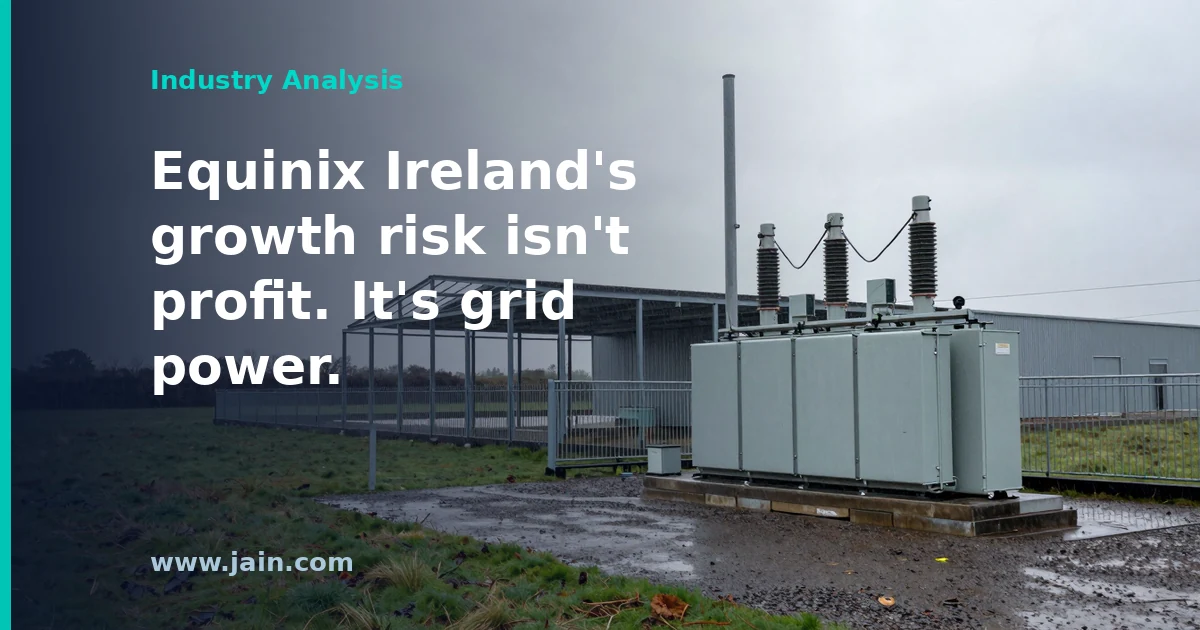
- The real worry is electricity. The company’s own directors warn that power suppliers may not be able to give it more in the places it wants to grow.
- In Ireland, where these computer buildings already lean heavily on the national grid, power may decide how fast they can expand.
RTÉ reported that newly published accounts for Equinix (Ireland) Ltd, the Irish arm of the California-based data centre operator, show pre-tax profit fell 36% to €4.4m in 2025, even as revenue rose 9% from €75.3m to €82.4m. The decline was due mainly to €2.9m of dividend income booked in 2024 that did not recur. Operating profit fell 6% to €5.43m, gross margin rose from 23% to 25%, and EBITDA (earnings before interest, tax, depreciation and amortisation) came to €13.2m.
During the year, Equinix bought BT Group’s Irish data centre business, including facilities in Citywest and Ballycoolin, Dublin, for €61.27m, a deal the Competition and Consumer Protection Commission cleared in August 2025. Headcount rose from 101 to 110, and the directors flagged the risk that electricity providers may not be able to supply further capacity where the company expects to expand.
Executive Summary
Equinix’s Irish subsidiary reported a sharp fall in pre-tax profit for 2025, to €4.4m from the prior year, on revenue that grew 9% to €82.4m. The directors attribute the fall mainly to a €2.9m dividend received in 2024 that was not repeated. The operating business tells a steadier story: gross margin improved to 25% on growth in recurring colocation and interconnection revenue, and operating profit slipped only 6% to €5.43m.
That steadier story carries a cost signal. Staff costs rose by about a quarter, from €14.18m to €17.8m, while headcount grew 9%, absorbing roughly half the year’s €7.1m revenue gain and thinning the operating margin even as gross margin widened. The company also added capacity through its €61.27m purchase of BT’s Irish data centre business.
The most consequential line in the accounts is not a number. The directors say they intend to keep increasing capacity, and they name electricity supply as the risk to doing so. In Dublin, where grid connections for new data centres have been restricted for years, that makes power availability, not customer demand, the variable to watch for Equinix, its customers and anyone pricing data centre capacity in Ireland.
A Dividend Explains the Headline, Not the Business
The 36% headline compares two years that are not like for like. In 2024, Equinix (Ireland) Ltd booked €2.9m of dividend income, money received rather than earned by running data centres, and that income did not recur in 2025. The directors identify it as the main reason for the fall. Measured on operations alone, the business held up: operating profit fell 6% to €5.43m, and after €1m of net interest the company reported pre-tax profit of €4.4m.
The cash-generation picture is firmer still. EBITDA, a rough proxy for the cash the operations throw off before financing and accounting write-downs, was €13.2m. The gap between that figure and operating profit is mostly €7.7m of depreciation, the non-cash charge that spreads the cost of buildings, generators and cooling plant over their working lives. Heavy depreciation is normal in a capital-intensive asset class like data centres and says little about demand, which the directors describe as having “remained solid.”
Wider Gross Margins, Thinner Operating Margins
Gross margin rose from 23% to 25%, which the directors credit to growth in recurring interconnection and colocation revenue. Colocation, renting space, power and cooling so customers can house their own servers, brought in €67.25m, more than four-fifths of revenue. Interconnection, directly linking customers to networks, clouds and each other inside the same building, contributed €9.44m, about 11%. Managed infrastructure added €3.6m and non-recurring revenue €1.85m, so nearly all income is recurring. Interconnection is valued in the colocation model because each new link adds revenue while using little extra floor space or power.
Below the gross line, costs grew faster than sales. Revenue rose by about €7.1m, while staff costs rose by €3.6m, roughly 25%, against a 9% rise in headcount, from 101 to 110 people (79 engineering and technical, 29 sales and administration, two directors). On the reported figures, operating margin fell from roughly 7.7% to about 6.6%. The accounts do not break down the staff cost increase; the year also included the integration of BT’s Irish data centre business, but the company has not linked the two.
Power, Not Demand, Sets the Pace of Expansion
The 9% revenue growth matters less than what it takes to repeat it. The directors say the company “intends to continue to increase its capacity,” and in the same accounts they name the risk that electricity providers may not be able to provide further capacity in locations where it expects to expand. In Dublin that is a live constraint: Ireland’s grid operator, EirGrid, has for several years restricted new data centre connections in the region, and the energy regulator has moved toward requiring new large energy users to bring their own generation or storage. For an operator that wants to grow, a grid connection, not a customer contract, is the scarce input.
The link to the AI buildout runs through power density. Equinix markets its 282 data centres worldwide as “AI-ready,” and the Irish directors list rising “requirements for power and cooling” among the market’s growth drivers. Denser computing, of which AI training and inference are the leading example, draws more electricity per rack, so customer growth consumes grid capacity faster than it consumes floor space. The Irish directors do not attribute demand to AI specifically; they cite internet traffic, financial services computing, cloud and software-as-a-service. But whatever the workload, more compute per site pushes power to the front of the queue.
Two consequences follow for the people who buy and finance this capacity. First, capacity that is already connected and powered becomes more valuable, which is consistent with the directors calling theirs “premium” and with the widening gross margin; buying BT’s operating Citywest and Ballycoolin facilities added capacity without waiting on a new connection, though the company has not framed the deal that way. Second, energy costs are moving toward customers: the directors say price increases are embedded in the budget and partly hedged, that “communication has started towards the customers,” and that a task force is looking for ways to cut primary energy use. Dublin tenants should expect power terms, not just space, to drive renewals.
Background
Equinix Inc., headquartered in California and listed under the ticker EQIX, owns and operates 282 data centres in 75 locations worldwide. Its model centres on colocation, renting secure, powered and cooled space for customers’ servers, and interconnection, which lets those customers link directly to networks, cloud platforms and one another inside the same facility. Its client list includes Oracle, Nvidia, Google Cloud, Microsoft, Dell Technologies and Amazon Web Services.
Dublin is one of Europe’s main data centre hubs, home to large cloud and technology operations, and also one of its most power-constrained. Ireland’s grid operator has restricted new data centre connections in the Dublin region for several years, making existing grid capacity a strategic asset. Equinix’s Irish subsidiary runs five Dublin sites and, in 2025, added BT Group’s Irish data centre business, including facilities in Citywest and Ballycoolin. Source: Pre-tax profits at data centre builder Equinix down 36% (RTÉ), a report on the 2025 accounts of Equinix (Ireland) Ltd.Sources