
TL;DR · 30-second read
The Short Version
DayOne, a Singapore company that builds the giant warehouses of computers behind artificial intelligence and cloud apps, has grown its Malaysian bank loan to about $7.2 billion.
Its customers, including some of the world’s largest tech companies, have signed binding contracts for about 2.3 gigawatts of computing space. A gigawatt is roughly what one large power plant produces. Only about 1 gigawatt is built and paying today.
The takeaway: the customers are already lined up. The hard part now is building fast enough to serve them.
DayOne Data Centers, a Singapore-headquartered data center developer, announced on October 14, 2026, in a release distributed via PR Newswire, that it has upsized its senior secured syndicated term financing in Malaysia to approximately US$7.2 billion. A seven-lender consortium arranged the facility, which supports DayOne’s data center platform in Johor and builds on an approximately US$3.5 billion syndicated financing secured in May 2025.
DayOne also said its Billings, meaning IT capacity under contract that is already generating income, have passed 1GW, up from 121MW at the end of 2024. Bookings, its total legally contracted capacity, reached about 2.3GW as of September 20, 2026, with a further 1.1GW of customer Reservations that are not guaranteed to convert.
Executive Summary
The headline number is the financing: about US$7.2 billion for Johor, roughly twice the size of the facility DayOne put in place in May 2025. Alongside it, DayOne has raised more than US$6 billion in equity since 2024 and works with more than 30 banks on project financing. For a company founded in 2022, that is an unusually deep capital stack.
The more telling number is the distance between two of DayOne’s own metrics. Bookings of about 2.3GW against Billings of just over 1GW means roughly 1.3GW of capacity is legally committed by customers but not yet producing income. That is the work the new money has to fund: turning signed contracts into energized, revenue-generating data halls.
For the industry, this is a useful marker of where AI infrastructure risk now sits for well-capitalized developers in Southeast Asia. Demand has been contracted in advance. What determines returns from here is how quickly and reliably capacity can be built, powered and handed over.
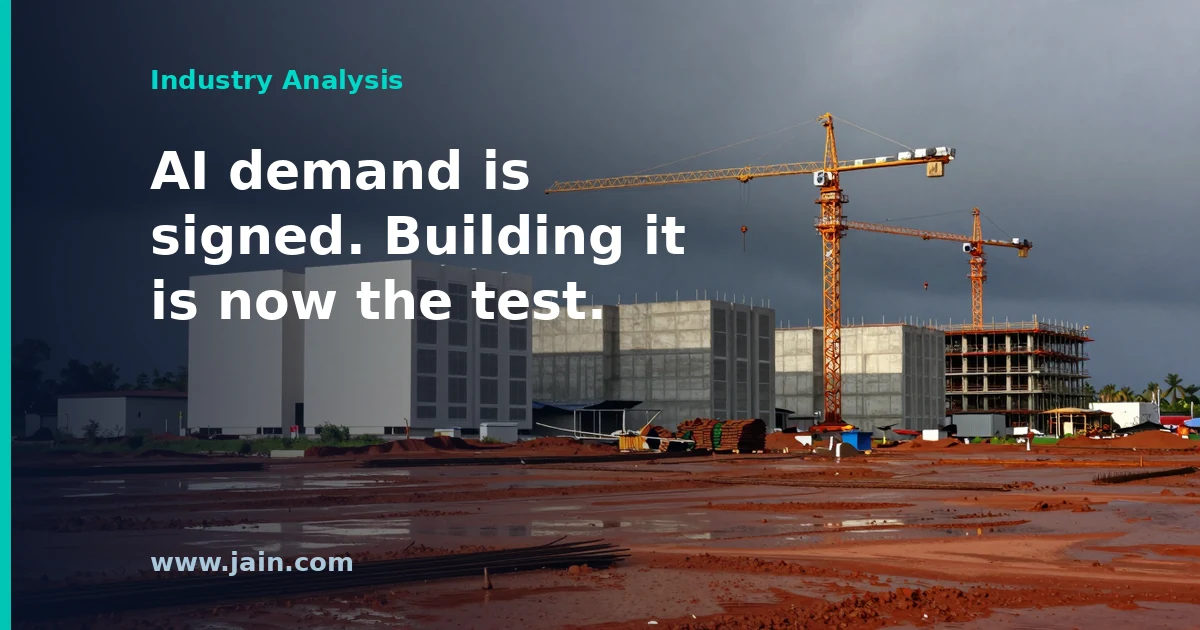
The Constraint Has Moved From Demand to Delivery
DayOne’s definitions make the arithmetic unusually clean. Bookings are all capacity committed under legally binding contracts; Billings are the subset of that capacity already generating income. With Bookings at about 2.3GW and Billings just over 1GW, roughly 1.3GW is sold but not yet delivered. For context, a gigawatt of IT capacity (the power available to the servers themselves, excluding cooling and other overhead) is a very large amount of computing; DayOne went from 121MW billing at the end of 2024 to more than eight times that in under two years.
That gap is why the upsized financing reads as a delivery bet rather than a demand bet. Customer commitment is already on paper. What the US$7.2 billion facility underwrites is the construction, mechanical and electrical fit-out, and commissioning needed to move capacity from booked to billing. In project finance generally, revenue starts only when a facility is ready for service, while construction costs and interest accrue from the first draw. Every month of slippage pushes income out without pushing costs out, so the economics of this facility depend on build speed and schedule discipline more than on sales.
The people most exposed to that execution risk are the lenders and equity holders, but also the customers: hyperscalers (the largest cloud and AI operators) that have signed for capacity are planning their own AI deployments around DayOne’s delivery dates.
Why Lenders Are Comfortable Doubling Down
A senior secured loan sits first in line for repayment and is backed by specific assets, so lenders scrutinize what generates the cash. Here the cash comes from contracts DayOne describes as long-term and legally binding, and the company says over 1GW of that capacity is already earning. A syndicate that sized a roughly US$3.5 billion facility in May 2025 and now supports about US$7.2 billion has watched Billings scale in the interim, which is the kind of track record that supports a larger commitment.
One distinction matters for readers: the US$7.2 billion is a Malaysia facility for the Johor platform, while the 1GW Billings, 2.3GW Bookings and 4.6GW Resources figures are company-wide across ten markets. DayOne has not said how much of the contracted capacity sits in Johor, so the headline financing and the headline megawatts should not be read as a one-to-one match.
Diversification Is Improving, Concentration Remains
Bookings now come from 15 customers, up from nine at the end of 2024, and four of the top five are with DayOne in more than one market. That multi-market pattern suggests customers are choosing DayOne as a regional partner rather than for a single site. DayOne also says it recently won additional orders from an existing U.S. hyperscale customer.
Still, the base is concentrated. Three hyperscale customers each have multi-market deployments of around or above 200MW, so those three alone account for something on the order of 600MW of commitments. Concentration is normal in hyperscale data centers, but it means a change in any one customer’s AI spending plans would register materially. The 1.1GW of Reservations deserves similar care: DayOne itself states there is no assurance these rights will be exercised or generate revenue.
Johor’s Next Test Is Physical, Not Commercial
Johor, the Malaysian state across the causeway from Singapore, became a major data center destination after Singapore paused new data center approvals in 2019 and demand looked for room nearby. At gigawatt scale, every campus there depends on grid connections, substation capacity and cooling water. DayOne’s Resources figure of 4.6GW, up from 2GW at the end of 2025, includes Secured Powered Land, which the company defines as sites with binding power and land agreements and the required power approvals and permits already in hand.
On DayOne’s own definitions, then, the company has more secured capacity than committed demand (4.6GW of Resources against 2.3GW Booked plus 1.1GW Reserved), which suggests land and power approvals are not its immediate limit on paper. The open question is whether utilities, equipment suppliers and contractors can energize that capacity on the timelines customers have signed for. That is where the delivery bet will be won or lost.
Background
DayOne was established in 2022 and has expanded to ten markets across Asia Pacific and Europe, with a strategy of acquiring powered land and signing anchor customers early in development. It describes its campuses as AI-ready, built for high-density computing loads from hyperscale cloud and AI customers, and has separately announced a registration statement filing for a proposed initial public offering.
Johor has become one of Southeast Asia’s fastest-growing data center markets, absorbing demand that Singapore’s land and power limits pushed across the border. Developers there compete on how quickly they can secure power, build, and hand over capacity to large tech customers. Source: DayOne Upsizes Malaysia Financing to US$7.2 Billion; Total Billings Surpass 1GW and Bookings Reach 2.3GW, DayOne’s announcement of its upsized Johor financing and capacity milestones.Sources