TL;DR · 30-second read
The Short Version
Centrus Energy, an American company that prepares uranium fuel for nuclear power plants, has bought one of its own suppliers, Westerman, for about $116 million.
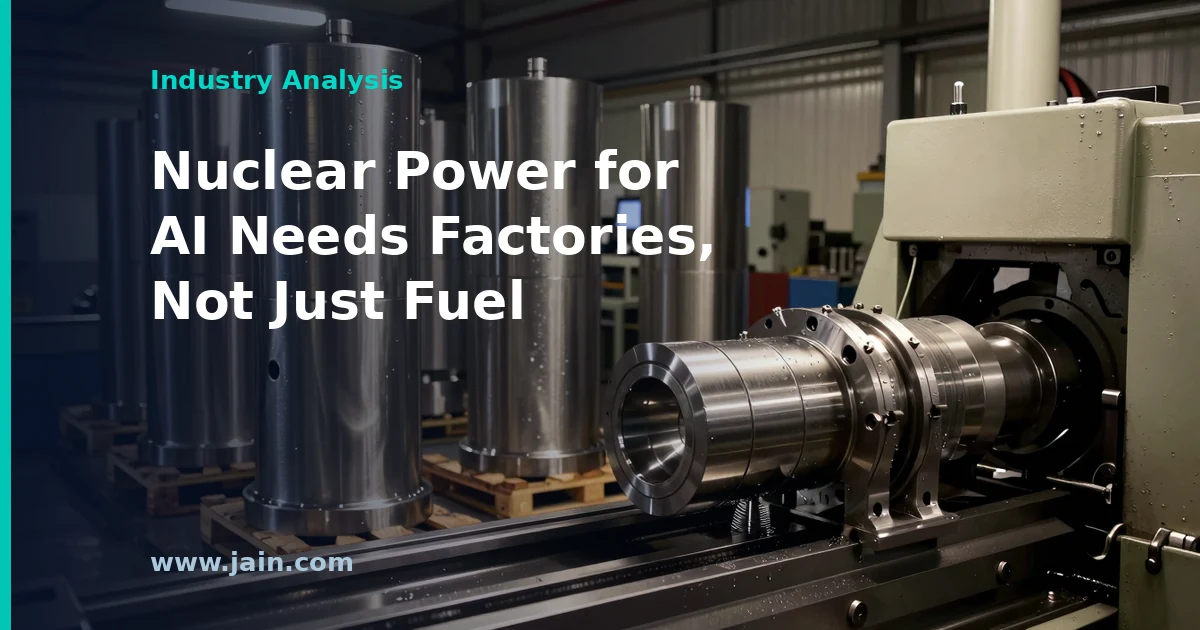
Westerman is an employee-owned metal fabricator founded in 1909. It builds the outer shells of the fast-spinning machines Centrus uses to concentrate uranium into usable fuel.
Why it matters: if nuclear power is going to help run the giant computer centers behind artificial intelligence, someone has to make more of that fuel. More fuel means building more of these machines. Centrus chose to own the factory rather than depend on it.
Centrus Energy (NYSE: LEU), a Bethesda, Maryland-based nuclear fuel supplier, has acquired Westerman Holdings, LLC for approximately $116 million. Westerman makes Centrus’s centrifuge casings and other major centrifuge components. According to an 8-K filed October 19, the deal closed October 16 and was paid with $95.0 million in cash and $21.0 million in Centrus Class A common stock. Westerman is now a wholly owned subsidiary.
Westerman was founded in 1909 and has about 400 employees and four facilities in Ohio, Oklahoma and Wyoming. Besides its nuclear work, it builds oil and gas equipment and nuclear-grade products, including UF6 cylinders, the containers used to hold and ship uranium hexafluoride. Centrus said the purchase supports its previously announced multi-billion-dollar expansion of uranium enrichment capacity.
Executive Summary
Centrus is turning one of its largest suppliers into a subsidiary. The company’s announcement gives four reasons for the deal: it secures a “key centrifuge component supplier,” it reduces risk in Centrus’s supply chain, it diversifies revenue into non-nuclear manufacturing, and it should lower project costs. Centrus also expects the acquisition to add to adjusted earnings per share in its first year.
For infrastructure readers, the important point is where the constraint sits. Centrus can only grow by manufacturing and installing centrifuges, and the casing is a major part of each machine. Owning the fabricator gives Centrus direct control over a component its enrichment expansion relies on. That makes the deal relevant to any nuclear-powered data center strategy, because that strategy ultimately rests on the same fuel chain.
The financial disclosures explain the deal’s structure clearly but give little operating detail. The 8-K shows that roughly $54.7 million of the price went to retiring Westerman’s debt and paying deal costs. Centrus has not quantified Westerman’s earnings, the expected cost savings or the production volumes involved.
Centrifuges, Not Contracts, Set the Pace
Uranium enrichment raises the share of the fissile isotope uranium-235 by spinning uranium hexafluoride gas through long chains, or cascades, of gas centrifuges. That makes adding capacity a manufacturing job: every new increment of output requires more machines to be built, installed and qualified. Centrus’s October 19 announcement says three things about Westerman. It already makes the centrifuge casings and other major centrifuge components for Centrus. It is one of Centrus’s largest suppliers. And buying it supports Centrus’s previously announced multi-billion-dollar expansion of enrichment capacity.
That is the link to AI infrastructure. Nuclear power has become a central part of the discussion about how to give data centers large amounts of steady, low-carbon electricity. Every reactor in that discussion, whether an existing plant or an advanced design, needs enriched fuel. Centrus did not frame the deal around AI; its stated rationale is supply-chain resilience and lower project costs. The mechanism is the same either way. A power agreement with a reactor operator is only as firm as the fuel chain behind it, and that fuel chain can only grow as fast as the factories building enrichment equipment. By buying the maker of its casings, Centrus has taken a known dependency for its expansion and brought it under its own ownership.
This point should not be stretched. A single supplier acquisition does not establish an industry-wide equipment shortage. Centrus has not said that Westerman was capacity-constrained or that the deal speeds up its schedule. What the deal does show is how a fuel producer chose to spend $95 million in cash: on control of manufacturing, which is a different lever from signing fuel sales contracts. For data center developers and utilities weighing nuclear supply, it suggests a useful diligence question. Beyond asking who has signed the fuel contract, they can ask who controls the hardware needed to fill it.
Nearly Half the Price Cleared Westerman’s Debts
Centrus’s 8-K breaks the roughly $116.0 million price into $95.0 million of cash and $21.0 million of Class A common stock. Out of that price, Centrus made three payments on Westerman’s behalf:
- about $31.5 million to retire Westerman’s subordinated notes (debt that ranks behind other lenders)
- $12.7 million to repay a term loan in full
- about $10.5 million of the seller’s and Westerman’s transaction expenses
Together that is roughly $54.7 million, close to half of the headline figure, before a customary working-capital adjustment. The seller was the Westerman Employee Stock Ownership Trust, acting through its trustee, Ventura Trust, which means the company had been owned by its employees. A key supplier carrying layered debt is a form of supply risk for its customer. Paying that debt off at closing leaves Centrus owning the plants without those obligations attached.
The filing also shows how Centrus protected itself. The representations and warranties (the factual promises the seller made about the business) did not survive closing, and both parties waived post-closing claims except for fraud. In their place, Centrus bought a buyer-side representations and warranties insurance policy. It also signed retention agreements with certain key employees, a sign that the specialized fabrication know-how matters as much as the buildings. Finally, Centrus agreed to use reasonable best efforts to file a shelf registration so the stock it issued can be resold over time.
The Diversification Case Still Has to Be Proven
Centrus describes a second benefit. Westerman’s non-nuclear work, including upstream and midstream oil and gas production equipment and engineered industrial systems, broadens Centrus’s revenue base. The company also expects the deal to be accretive to adjusted earnings per share in the first year, meaning it should raise per-share profit on Centrus’s adjusted measure, and to lower project costs. None of these statements comes with a figure. Centrus has published no Westerman revenue, no margin and no estimate of savings.
There is also a tension to watch. If the enrichment build-out ramps quickly, Centrus’s own casing orders could compete for the same shop floor as Westerman’s oil and gas customers. Centrus CEO Amir Vexler also described Westerman as a supplier to “the broader nuclear industry.” Those nuclear customers may now weigh what it means to buy from a subsidiary of a fuel supplier. Centrus says it will expand Westerman’s capabilities and keep the Westerman brand. That statement addresses Centrus’s intent, but it does not establish whether Westerman has the capacity to serve everyone.
Background
Centrus Energy supplies nuclear fuel and services to utilities and says it has provided more than 1,850 reactor years of fuel since 1998. It is producing High-Assay, Low-Enriched Uranium (HALEU), the fuel many advanced reactor designs are built to use, and describes itself as leading the effort to restore large-scale American uranium enrichment. Enrichment is the step that concentrates uranium-235 so the fuel can sustain a reaction in a reactor. It is done with gas centrifuges that spin uranium hexafluoride, which is why centrifuge manufacturing sets the pace of any enrichment expansion.
Westerman is an industrial fabricator founded in 1909, with about 400 employees and four facilities in Ohio, Oklahoma and Wyoming. Its customers span nuclear, oil and gas, marine and industrial markets. Barclays advised Centrus on the transaction, and Wachtell, Lipton, Rosen & Katz served as its legal counsel. Source: Centrus Acquires Centrifuge Supplier Westerman Holdings for About $116 Million (energynews.pro), coverage of Centrus Energy’s purchase of its centrifuge component supplier. Primary sources: Centrus Energy Corp. Form 8-K filed October 19, 2026 (SEC EDGAR); Centrus Acquires Westerman Holdings, LLC, Bringing a Key Supplier In-House and Diversifying Its Manufacturing Capacity (press release, Exhibit 99.1, October 19, 2026).Sources