
TL;DR · 30-second read
The Short Version
Carrier, the company that invented modern air conditioning in 1902, is spending more than $600 million on a new factory in Fort Worth, Texas. It will cover over a million square feet, about 17 American football fields.
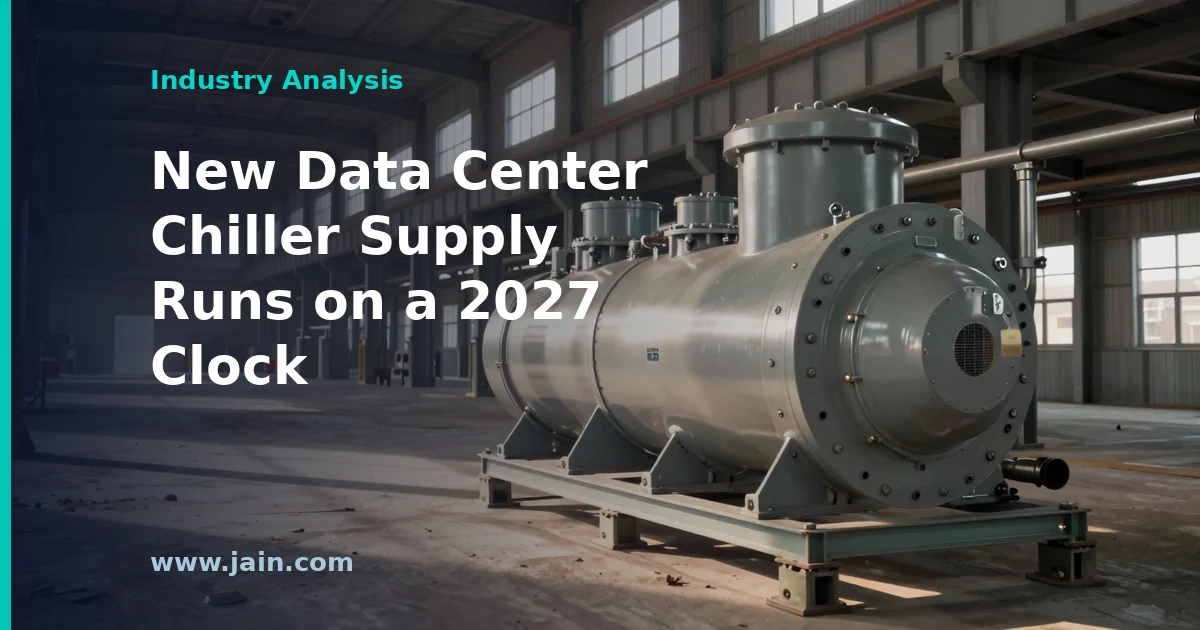
The plant will build chillers: large machines that make cold water to cool big buildings, including the warehouses full of computers behind online services and artificial intelligence.
It promises 1,500 jobs. But it is not expected to start running until next year, so the extra cooling equipment it makes is not here yet.
Carrier Global Corporation (NYSE: CARR) announced on Oct. 22, 2026, in a release distributed by PR Newswire, that it will invest more than $600 million over the next three years in a new advanced manufacturing and engineering center in Fort Worth, Texas. The facility, at the AllianceTexas development, will exceed 1 million square feet, expand production of air- and water-cooled commercial chillers, and create 1,500 manufacturing, engineering and other jobs.
Carrier said the investment supports record backlog levels driven by demand across data centers, healthcare, education, industrial markets and other verticals. Operations are expected to begin in 2027, and the site is expected to pursue LEED certification, a widely used green-building rating.
Executive Summary
Carrier is building a large new U.S. factory dedicated in part to commercial chillers, the industrial machines that produce chilled water to pull heat out of large buildings. In a data center, that heat comes from servers, and removing it reliably is as fundamental to keeping a facility online as its electricity supply. Carrier frames the $600 million-plus commitment as a response to record backlog, meaning orders it has booked but not yet delivered, and it names data centers first among the markets driving that demand.
The significance for infrastructure buyers is timing. A record backlog exists today, but the new capacity is expected to come online in 2027, with spending spread across three years. That means the Fort Worth site adds supply to projects scheduled for 2027 and beyond, while near-term orders continue to depend on Carrier’s existing production network. For data center developers planning cooling procurement, the announcement signals more domestic chiller output is coming, but not immediately.
The release is strong on scale (dollars, square footage, jobs) and light on operational detail. Carrier does not quantify the backlog, the share tied to data centers, or how much chiller output the new plant will add. Those figures determine how much the announcement actually changes supply conditions for buyers.
New Capacity Arrives in 2027, Not Today
The core mechanism is straightforward. Carrier says demand has produced record backlog, and its answer is a facility of more than 1 million square feet that is expected to begin operations in 2027, funded by more than $600 million spent over three years. Backlog is booked work waiting to be built and shipped. Until Fort Worth is running, that work flows through Carrier’s existing plants. The new site therefore adds chiller output to future delivery windows, and because the investment spans three years, it is reasonable to expect capacity to ramp rather than appear all at once when the doors open. Carrier has not published a ramp schedule.
That timing matters to the people who plan, build and finance data centers. Cooling equipment is ordered well ahead of a facility’s energization date, and chillers are among the long-lead items developers schedule around. A developer targeting 2027 or 2028 occupancy can reasonably treat Fort Worth as part of the future supply picture. A developer needing equipment sooner is still competing for output from existing lines, alongside hospitals, schools and industrial buyers that Carrier also lists among its growth markets. The announcement points to more domestic supply on a specific clock; it does not ease the queue for orders placed today.
It is worth keeping the claim proportionate. This is one manufacturer’s expansion, not a measure of industry-wide chiller supply, and Carrier’s rivals in commercial HVAC, such as Trane Technologies, Johnson Controls and Daikin, also serve these markets. What the announcement shows is that at least one major supplier views its current footprint as insufficient for the demand it is booking, and that its answer takes until 2027 to start operating.
Data Centers Lead the List, but Carrier Has Not Sized Their Share
Carrier names data centers first among the verticals behind its backlog, and the timing aligns with the broader buildout of artificial intelligence computing, whose dense server racks concentrate more heat in less floor space than traditional enterprise IT. Even as operators adopt liquid cooling, where coolant flows directly to processors, that heat still has to be rejected from the building, and chillers remain a common way to do it in many designs and climates.
There is a fair counterpoint for readers in the industry. Some liquid-cooled AI designs run at higher water temperatures, which lets operators rely more on dry coolers and outside air (so-called economization) and less on compressor-driven chilling. How much chiller demand AI campuses generate depends on those design choices, climate and water availability. Carrier’s mention of both air-cooled chillers, which reject heat to outside air with fans, and water-cooled chillers, which typically pair with cooling towers that evaporate water, suggests it intends to serve both ends of that trade-off. However, Carrier has not said what portion of the backlog comes from data centers versus its other listed markets.
Domestic Production as a Supply Chain Argument
Carrier presents the plant as strengthening supply chain resilience and describes itself as the largest U.S.-headquartered company in its industry. For buyers, domestic manufacturing can mean shorter shipping distances, fewer exposures to cross-border disruption and potentially simpler logistics for very large equipment. Fort Worth also sits within the Dallas–Fort Worth region, one of the country’s established data center markets, although Carrier cites workforce, manufacturing base and strategic location as its reasons, not proximity to any particular customer group.
The workforce piece is a real execution variable. The National Association of Manufacturers, quoted in the release, points to nearly half a million open U.S. manufacturing jobs. Carrier plans to fill 1,500 roles and to partner with local schools and colleges on training. How quickly it can hire and train production and engineering staff will help determine how fast the plant converts square footage into shipped chillers.
Background
Carrier Global Corporation, headquartered in Palm Beach Gardens, Florida, and listed on the New York Stock Exchange under the ticker CARR, traces its roots to Willis Carrier’s invention of modern air conditioning in 1902. Today it sells climate and energy products spanning residential and commercial heating, ventilation and air conditioning (HVAC), air quality and refrigerated transportation, and describes itself as the largest U.S.-headquartered company in its industry.
Commercial chillers sit at the heavy end of HVAC: large, engineered machines used to cool hospitals, universities, industrial plants and data centers. As data center construction has accelerated, cooling equipment has become a planning constraint alongside power, and manufacturers’ production capacity increasingly shapes when large facilities can be completed. Source: Carrier to Invest More Than $600 Million to Expand Advanced U.S. Manufacturing and Engineering Capacity, Carrier Global Corporation’s announcement of a new chiller manufacturing and engineering center in Fort Worth, Texas.Sources