
TL;DR · 30-second read
The Short Version
Equinix, one of the world’s biggest landlords for computer servers, has opened test rooms in London, Paris, Frankfurt, Osaka and Sydney where businesses can try liquid-cooled artificial intelligence hardware before committing to it.
The reason: one cabinet of the newest artificial intelligence chips can draw twenty to forty times the electricity that server buildings from a few years ago were designed to supply per cabinet. Nearly all that power turns into heat, and liquid cooling is how it gets carried away.
Few companies have run such systems before, so a supervised practice run is becoming part of what a server landlord offers.
Equinix has opened a network of liquid cooling test environments, called Enhanced Performance Innovation Centers (EPIC), inside five of its operating data centres: LD5 in London, PA10 in Paris, FR6 in Frankfurt, OS3 in Osaka and SY5 in Sydney, Data Centre Magazine reported on October 22, 2026. More locations are due to open in 2027.
Enterprises can bring liquid-cooled GPU and CPU platforms from Equinix’s hardware partners into the centres and run AI training and inference workloads under production conditions, supported by Equinix engineers. Ad-tech company Criteo is cited as an early user that tested liquid cooling in a live Equinix environment before scaling it across its AI infrastructure.
Executive Summary
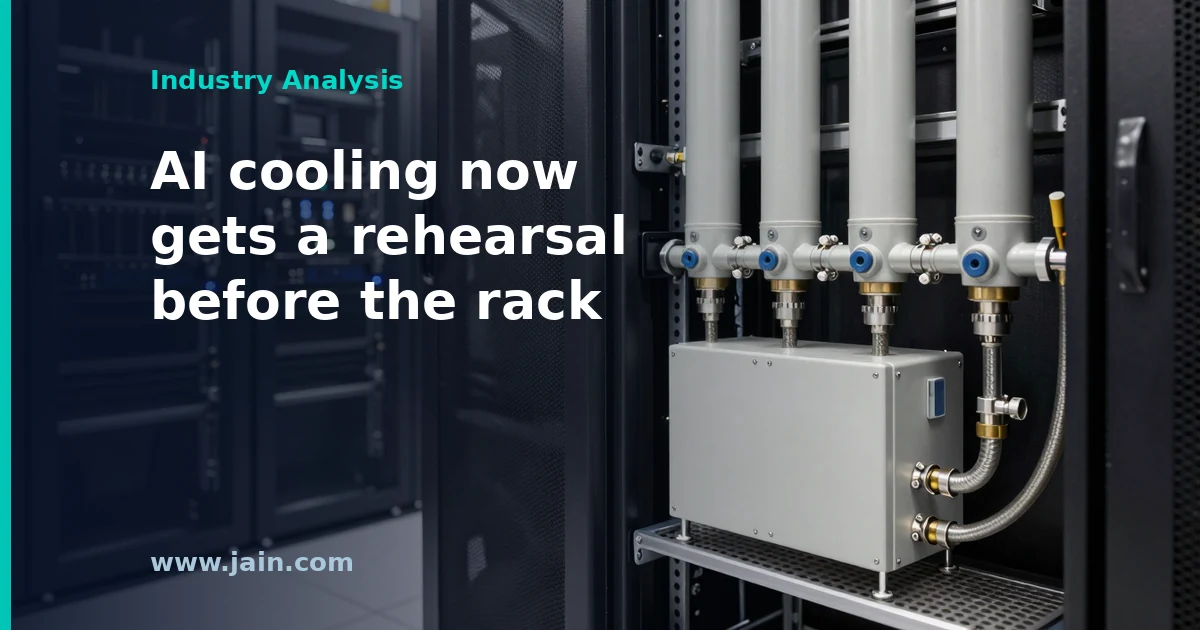
Equinix’s EPIC centres are rooms inside working colocation facilities, where customers rent space, power and cooling rather than building their own data centres. In these rooms, customers can test a complete liquid cooling stack before buying capacity at scale. All five sites share a common design. A primary coolant loop carries heat to the building’s chillers, and a secondary loop feeds coolant to the racks through manifolds, flexible hoses and quick-disconnect couplings. Sensors and automatic leak shutoff protect the equipment.
The launch matters because of the density figure Equinix published with it. A rack of current-generation GPUs can draw more than 200kW, while most data centres built a few years ago were designed for 5-10kW per rack. Equinix’s argument is that most enterprises lack the in-house expertise to make cooling, power, networking and facility operations work together at that density. On that reading, validating the thermal design before deployment becomes a step customers will want their colocation provider to supply.
EPIC is Equinix’s third testing programme, after a 2022 Co-Innovation Facility in Ashburn and 2024 Solution Validation Centers. The difference this time is the audience. The earlier facilities largely tested technology for Equinix’s own estate. EPIC is aimed squarely at customers deciding whether and how to deploy liquid-cooled AI.
Past 200kW a Rack, Cooling Has to Be Proven Before It Is Bought
The number that explains EPIC is the one Equinix published alongside it. A rack of current-generation GPUs can draw more than 200kW, against the 5-10kW per rack most data centres built a few years ago were designed for. A rack is the standard cabinet that holds servers, and kilowatts (kW) measure the power it consumes. Nearly all of that power leaves the chips as heat. A twenty- to forty-fold jump in heat from the same footprint is what is pushing demand toward liquid cooling, which carries coolant to the servers instead of relying on chilled air.
Equinix’s own framing locates the bottleneck in integration more than in the coolant. Few enterprises, it says, have the expertise to make cooling, power, networking and facility operations work together, and a gap in any one of them can hold up a deployment. The largest cloud operators keep that know-how in-house. A retailer, bank or ad-tech company running its own AI hardware for the first time usually does not. For that buyer, the risk is committing capital to a liquid-cooled cluster that then stalls on a facility question nobody anticipated.
EPIC turns the removal of that risk into something the colocation provider supplies. The step is thermal qualification: confirming that a specific hardware stack runs within its temperature, flow and pressure limits in the kind of building it will actually live in. That job has traditionally sat with the hardware vendor or the customer’s own engineers. Equinix is placing it inside its own facilities, staffed by its own engineers and original equipment manufacturer (OEM) partners. Criteo’s account describes the sequence the programme is built around: Matthieu Blumberg, Criteo’s SVP of Engineering Infrastructure, Security, Internal IT and CISO, says the company “saw how liquid cooling performed in practice, learned what it took to run it well, and then committed to scale.”
Why the Test Bed Sits Inside a Working Data Centre
Equinix could have built a standalone lab. Its stated rationale for placing EPIC inside live International Business Exchange (IBX) facilities is that customer equipment then meets the same cooling, power and networking conditions it will face in production. The shared design across all five sites reinforces that. Each runs the same primary-secondary loop architecture around a coolant distribution unit (CDU), which is the heat exchanger that separates building water from the coolant that reaches the servers. Each also uses the same quick-disconnect couplings, so servers can be connected to or removed from the coolant supply without draining the system.
A standard design across London, Paris, Frankfurt, Osaka and Sydney matters most to customers with distributed footprints. Blumberg’s point was that Criteo’s AI “runs across a distributed footprint, and the infrastructure must perform the same way wherever it sits.” If what a customer validates in Frankfurt behaves the same way in Osaka, one qualification exercise covers several regions. That is a useful property, but it rests on an assumption Equinix has not spelled out: that the production halls customers eventually deploy into use the same design and offer the same density as the EPIC rooms.
A Testing Programme That Doubles as an On-Ramp
EPIC extends a pattern. The 2022 Co-Innovation Facility at DC15 on the Ashburn campus let partners trial technology before it reached Equinix’s wider estate. ZutaCore tested direct-to-chip, two-phase rack cooling rated for more than 100kW per rack there, and Bloom Energy trialled solid oxide fuel cells that it later supplied to sites including SV5 in San Jose. The 2024 Solution Validation Centers then let customers validate deployments. EPIC applies that hands-on model to the specific problem of high-density AI.
The commercial logic follows from that history. A customer that qualifies its liquid-cooled hardware inside an Equinix building, alongside Equinix engineers, has an obvious next step, which is deploying in an Equinix building. EPIC is presented as a testing service, but it also works as an on-ramp to colocation contracts for AI capacity. That is a legitimate strategy rather than a criticism. For the wider colocation market, the launch raises a question every provider courting enterprise AI will face: whether the ability to prove a cooling design on site, before the contract is signed, is becoming part of the product.
What the Launch Establishes, and What It Asserts
The launch firmly establishes five named sites, a common technical design, a 2027 expansion plan, a lineage of earlier programmes and a named early customer. Other claims are broader and carry less support. Brian Stein, Equinix’s SVP of Infrastructure Products and Services, calls liquid cooling “a hard requirement for customers deploying AI” and cites Equinix’s “unmatched ecosystem.” No data accompanies either statement, such as the share of customer AI deployments that actually need liquid cooling or how the ecosystem compares with rivals’.
The 200kW figure also needs careful reading. It describes what current GPU racks can draw. It is not a stated rating for the EPIC rooms or for Equinix’s production capacity. Five sites out of 282 is a starting footprint, and none of the five is in the Americas, although the earlier Co-Innovation Facility sits in Ashburn. The programme credibly addresses an expertise gap. Whether it also addresses a capacity gap depends on figures Equinix has not published.
Background
Equinix is a colocation and interconnection provider. Its customers rent space, power and cooling for their own servers in shared data centres and connect directly to networks, clouds and other companies housed there. It operates 282 data centres globally, branded International Business Exchange (IBX) facilities and identified by metro codes such as LD5 (London) and OS3 (Osaka). Its AI work predates EPIC. In January 2024 it launched a fully managed private cloud service for running NVIDIA DGX AI systems in its IBX sites, and in 2024 it partnered with the National University of Singapore on a Co-Innovation Facility at SG6 to incubate liquid cooling for tropical climates.
The broader market backdrop is a rapid rise in rack density. GPU platforms for AI training and inference concentrate far more power and heat in a single cabinet than the general-purpose servers most existing data centres were designed for. Liquid cooling technologies such as direct-to-chip systems, which ZutaCore tested at Equinix from 2022 at more than 100kW per rack, have moved from specialist deployments toward mainstream requirements for operators competing for AI workloads. Source: Equinix Opens EPIC Liquid Cooling Innovation Centres for AI (Data Centre Magazine) — Equinix launches liquid cooling test environments in London, Paris, Frankfurt, Osaka and Sydney, with more planned for 2027.Sources