TL;DR · 30-second read
The Short Version
Tech companies want nuclear power to run the huge computer centers behind artificial intelligence. But reactors need fuel, and making that fuel depends on rows of fast-spinning machines that concentrate uranium.
Centrus Energy, an American nuclear fuel supplier, just paid about $116 million for Westerman, a 117-year-old manufacturer with about 400 workers that builds the outer shells of those machines.
The takeaway: nuclear power for artificial intelligence depends on factory work that has to happen well before any reactor switches on.
Centrus Energy (NYSE: LEU) acquired 100% of Westerman Holdings, LLC on October 16, 2026, according to an 8-K the company filed with the SEC on October 19. The seller was the Westerman Employee Stock Ownership Trust, acting through its trustee, Ventura Trust. Centrus paid approximately $116.0 million: $95.0 million in cash on hand and $21.0 million in newly issued Class A common stock.
Westerman, founded in 1909, has about 400 employees and four facilities in Ohio, Oklahoma and Wyoming. Centrus’s announcement describes it as one of Centrus’s largest suppliers and an existing manufacturer of centrifuge casings and other major centrifuge components, as well as UF6 cylinders, alongside equipment for oil and gas, marine and industrial customers.
Executive Summary
Centrus, which supplies enriched uranium fuel to nuclear utilities, has bought the fabricator that makes core physical parts of its enrichment centrifuges. The company says the deal secures a critical supplier, de-risks the supply chain for its previously announced multi-billion-dollar expansion of uranium enrichment capacity, lowers project costs, and adds non-nuclear revenue. It expects the deal to be accretive to adjusted earnings per share in the first year after closing.
The significance reaches beyond one supplier relationship. Enrichment capacity is built machine by machine, so whoever controls centrifuge manufacturing influences how quickly new enrichment comes online. By pulling that step in-house, Centrus has made the pace of its expansion depend more on its own execution and less on an outside vendor’s capacity and priorities.
For anyone counting on nuclear power to serve data centers, the deal is a reminder that new nuclear supply starts well upstream of the reactor, in fuel production and the factories that build fuel-production equipment.
Why the Centrifuge Shop Comes Before the Reactor
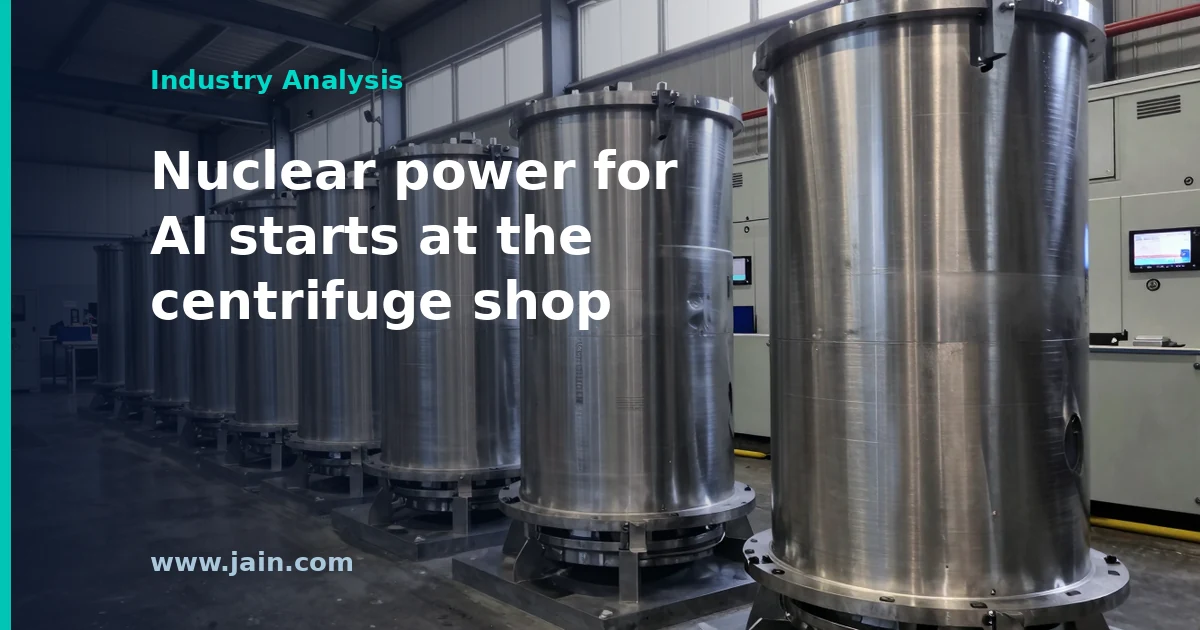
Public attention on nuclear power for data centers tends to settle on reactors: restarts, new builds, smaller modular designs. But a reactor runs on enriched uranium, and enrichment capacity is, quite literally, a count of machines. Each centrifuge is a fast-spinning cylinder that separates uranium atoms by weight. A plant’s output rises only as more of these machines are built and connected into cascades, the linked lines of centrifuges that progressively concentrate the fuel. According to Centrus’s announcement, Westerman is an existing manufacturer of centrifuge casings and other major centrifuge components for Centrus. It also makes UF6 cylinders, the containers that carry uranium hexafluoride, the gaseous uranium compound fed into the process.
That is why the $116 million is best read as a bet on the manufacturing step. Centrus called Westerman’s capabilities “critical,” said bringing them in-house “strengthens and de-risks” its supply chain, and tied the deal directly to its previously announced multi-billion-dollar enrichment expansion. A company planning to build many more machines has bought the business that makes a core part of them. That reduces the familiar risks of supplier dependence: a vendor that runs short of capacity, prioritizes other customers, or cannot scale on the buyer’s schedule.
The consequence for the AI buildout is indirect but real. Data center developers and utilities counting on new nuclear supply ultimately depend on enriched fuel, and new enrichment depends on centrifuge manufacturing scaling up. Centrus did not mention artificial intelligence or data centers, and owning a casing maker adds no enrichment capacity on its own. What the deal does is move one manufacturing dependency inside the company responsible for the expansion. The speed of that expansion now rests more squarely on Centrus’s own execution.
What the $116 Million Actually Bought
The 8-K breaks down the headline price. Centrus paid $95.0 million in cash and $21.0 million in Class A stock, with the share count set by the October 15 closing price. Out of the purchase price, Centrus paid about $31.5 million to retire Westerman’s subordinated notes (debt that ranks behind other lenders) and $12.7 million to repay a term loan in full. Another approximately $10.5 million covered the seller’s and Westerman’s transaction expenses. Roughly $54.7 million of the $116 million therefore went to clearing those obligations and deal costs. The price remains subject to a customary adjustment based on Westerman’s net working capital at closing.
The structure is typical of a private-company deal. The representations and warranties did not survive closing, and both sides waived post-closing claims except for fraud. Centrus bought a buyer-side representations and warranties insurance policy, so if undisclosed problems surface, its recourse is mainly that policy rather than the seller. Centrus also signed retention agreements with certain key employees at closing, and Westerman CEO Jacob Garrett becomes President of Westerman and a Vice President of Centrus. Both moves suggest that the people and their know-how are central to what was purchased.
The accretion claim deserves a careful read. When a supplier becomes a subsidiary, its sales to the parent become internal transactions that drop out of consolidated revenue. Any first-year lift to adjusted earnings per share therefore has to come from Westerman’s outside customers and from the cost savings Centrus expects in its own projects. Centrus has not published Westerman’s revenue, margins or the share of its business that came from Centrus, so the expectation cannot yet be tested from outside.
The Oil and Gas Business Is a Hedge, and a Competing Claim on the Shop Floor
Westerman serves upstream and midstream oil and gas, meaning production sites and the pipelines and processing that follow, as well as marine and industrial customers. Centrus presents this as diversification beyond its core nuclear business. The operational logic is sound: large enrichment build-outs arrive in uneven waves, and non-nuclear orders can keep welders, engineers and facilities busy between them, preserving the skilled workforce that nuclear-grade fabrication requires.
The same diversification raises a capacity question. If Centrus’s expansion and Westerman’s other customers both grow, four facilities and about 400 people will need to serve both. Centrus says it intends to expand Westerman’s capabilities and grow the business alongside its enrichment program, but it has not said how much it will invest, at which sites, or on what schedule. For buyers whose plans depend on new nuclear fuel, that investment plan matters more than the purchase price.
Vertical integration involves trade-offs on both sides. Centrus gains control over a key input and expects lower project costs. In return, it can no longer play competing suppliers against one another on price, and it inherits exposure to oil and gas demand cycles. Neither outweighs the strategic rationale on the available facts, but both belong in any assessment of the deal’s value.
Background
Centrus Energy is a Bethesda, Maryland-based supplier of nuclear fuel and services. The company says it has provided utility customers with more than 1,850 reactor-years of fuel since 1998, which it equates to more than 7 billion tons of coal. Centrus is pioneering production of High-Assay Low-Enriched Uranium (HALEU), a more concentrated fuel that many advanced reactor designs are built to use. It also says it is leading the effort to restore American uranium enrichment capability at scale, and it has previously announced a multi-billion-dollar expansion of enrichment capacity.
Westerman, founded in 1909, is an industrial fabricator whose main business has been equipment for oil and gas production, dehydration, filtration and metering, alongside nuclear, marine and industrial work. Before the acquisition, it was owned through an employee stock ownership trust and served as one of Centrus’s largest and most diversified suppliers. Source: Centrus strengthens fuel supply chain (Nuclear Engineering International) and Nuclear Fuel Capacity Expands via Centrus Energy Westerman Acquisition (ETF Database), coverage of Centrus Energy’s acquisition of centrifuge component supplier Westerman Holdings. Primary sources: Centrus Energy Form 8-K filed October 19, 2026 (Item 1.01, Membership Interest Purchase Agreement); Centrus Acquires Westerman Holdings, LLC, Bringing a Key Supplier In-House and Diversifying Its Manufacturing Capacity (Exhibit 99.1 press release, October 19, 2026).Sources