
TL;DR · 30-second read
The Short Version
The US government has offered Constellation Energy, the country’s largest owner of nuclear power plants, a loan of up to $5 billion.
The money would pay for upgrades that get more electricity out of eight nuclear plants that are already running. Together the upgrades would add about as much power as one large new nuclear reactor, enough for hundreds of thousands of homes.
This matters because artificial intelligence computing centers need enormous amounts of round-the-clock electricity, and upgrading existing plants is far quicker than building new ones. The loan is not final yet.
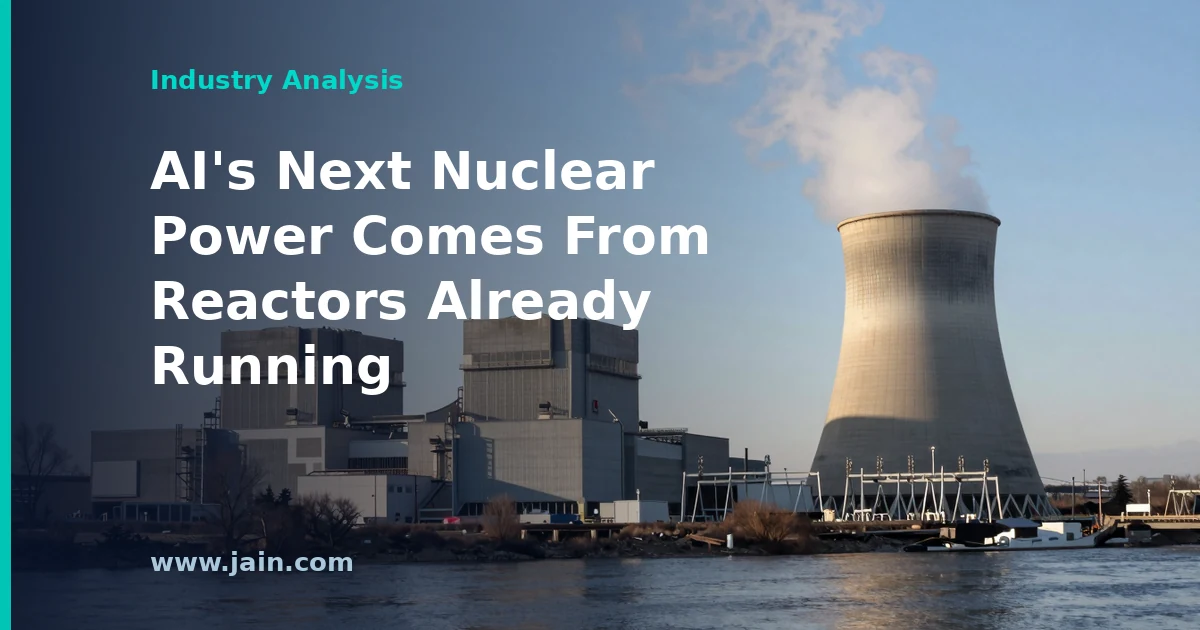
This month the US Department of Energy (DOE) offered Constellation Energy a conditional loan of up to $5 billion to finance about 1.1 gigawatts (GW) of nuclear “uprates” across eight of its existing plants, POWER Magazine and Bloomberg reported. An uprate is an approved increase in the maximum power a reactor is licensed to produce. Shaw Local reported that Byron Generating Station in northern Illinois is among the eight plants.
The commitment is conditional. In DOE lending, a conditional commitment means the agency has offered terms, but the loan closes and money is disbursed only after the borrower meets specified requirements. Constellation has not yet drawn any funds.
Executive Summary
The headline numbers are simple: up to $5 billion of federal debt for up to 1.1 GW of added nuclear capacity at eight sites. That is roughly the output of one large new reactor. It would be delivered as increments of about 140 megawatts per plant on average, at facilities that already have licenses, grid connections, cooling systems, security perimeters and trained staff.
The offer matters because it puts federal financing behind the quickest available way to add firm, carbon-free electricity. Firm means power that runs around the clock regardless of weather. Data center developers, and AI training clusters in particular, compete for that kind of supply. New large reactors take well over a decade, and small modular reactors are not yet operating commercially in the US. Uprates are the nuclear option that can arrive within a typical data center planning horizon.
Much is still undisclosed: the conditions for closing, the schedule, the split of megawatts across the eight plants, and who will buy the added power. The offer signals a policy direction. It does not yet deliver electricity.
Why the Next Nuclear Megawatts Come From Old Reactors
The case for uprates rests on what they skip. A new reactor needs a site, an environmental review, a construction and operating license, a new connection to the transmission grid and years of construction. The most recent new large US reactors, Vogtle Units 3 and 4 in Georgia, took well over a decade from licensing to commercial operation. An uprate uses an existing plant. The operator applies to the Nuclear Regulatory Commission (NRC) to amend an existing license, replaces or upgrades equipment such as turbines, generators, pumps and heat exchangers, and sends the extra output through a substation that already exists. The licensing step is an amendment, not a new license, and the plant is already in the grid’s planning models.
Spread over eight plants, 1.1 GW works out to an average of roughly 140 megawatts each. That is a meaningful amount: on the order of a large hyperscale data center campus phase. A hyperscaler is one of the giant cloud operators, such as Amazon, Microsoft or Google. Because the capacity comes in increments at multiple sites, it is less exposed to the single-point construction risk that has delayed new-build nuclear projects. For data center developers, the practical result is that the new nuclear capacity most likely to exist before 2030 comes from reactors that are already generating.
Uprates are not frictionless. Larger power increases require extensive engineering analysis and major equipment replacement. Added output may still need transmission studies to confirm the grid can absorb it. Long-lead components face the same supply constraints affecting the wider power sector. Even so, against the realistic alternatives for new firm, clean power, the timeline advantage is clear.
Adding Supply Rather Than Reallocating It
Recent nuclear-for-data-center deals have drawn scrutiny when they appeared to redirect existing plant output to a single large customer. Other utilities, regulators and consumer advocates have argued in such cases that power already serving the grid was being taken off it. Uprates largely avoid that objection because they create megawatts that do not exist today. A data center contract backed by uprate output adds supply to the system instead of reshuffling it.
That distinction matters most in regions where data center growth is already pushing up prices. Byron sits in the PJM Interconnection, the grid operator for much of the mid-Atlantic and Midwest. Data center load has been a central factor in PJM’s rising capacity prices, which are the payments that guarantee power will be available at peak. New firm supply at existing sites is one of the few resources that can reach that market quickly.
The Economics of a Federal Loan Ceiling
Dividing the ceiling by the capacity gives roughly $4.5 million of potential federal lending per megawatt of uprate. That is a loan limit, not a disclosed project cost. Constellation may borrow less, and the total budget may include company equity. The financing signal still matters. Federal loans typically carry lower interest costs than private debt, and on capital-heavy, multi-year projects the cost of money is a large share of the final price of each megawatt-hour.
For buyers, cheaper financing could eventually mean more competitive long-term contract pricing for uprate output, though nothing disclosed so far commits Constellation to pass savings through. For the wider sector, the offer suggests federal energy financing is willing to back incremental gains at existing nuclear plants, not just first-of-a-kind technology. If the loan closes, other owners of nuclear fleets will have a precedent to follow.
Background
Constellation Energy operates the largest fleet of nuclear power plants in the United States. It became an independent company in 2022 when it was spun off from Exelon. Since then it has become a leading supplier of firm, carbon-free power to technology companies. Most prominently, it signed a long-term agreement with Microsoft tied to restarting Unit 1 at the former Three Mile Island site in Pennsylvania, now renamed the Crane Clean Energy Center.
Uprates are not new. US operators have used them for decades to get more output from existing reactors. They range from small measurement-accuracy adjustments of a percent or two to extended uprates that require major equipment replacement. Data center electricity demand has renewed interest in them because they add capacity on a shorter timeline than any new-build nuclear option. Source: DOE Offers Constellation Up to $5B Loan for 1.1 GW of Nuclear Uprates at Eight Plants (POWER Magazine): the Department of Energy’s conditional loan offer to finance uprates at eight Constellation nuclear plants.Sources