
TL;DR · 30-second read
The Short Version
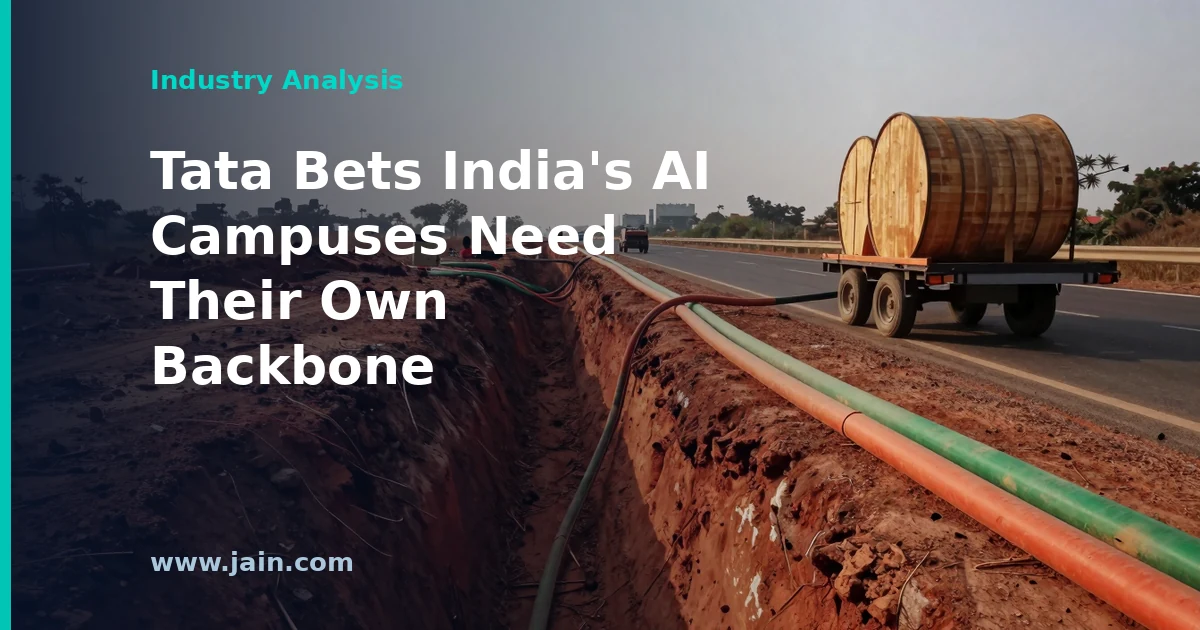
Tata Communications, one of India’s largest telephone and internet companies, plans to spend roughly $450 million laying about 10,000 kilometers of new fiber-optic cable. Fiber-optic cable is made of glass strands that carry internet traffic as light, and 10,000 kilometers is about a quarter of the way around the Earth.
The cable will connect the giant computer warehouses, called data centers, that run artificial intelligence services. It starts with Mumbai, Pune, Hyderabad and Chennai, and other cities come later.
Tata’s bet is that as these warehouses spread across India, the connections between them matter as much as the electricity inside them. The company has not given a finish date or named any customers.
Tata Communications announced on October 29, 2026, in a release distributed by PR Newswire, that it plans to invest between $400 million and $450 million (described in the body of the release as “close to USD 450 million”) to build roughly 10,000 kilometers of new long-haul fiber across India. Long-haul fiber is the intercity cable that carries traffic between regions. The company calls the network an “AI super highway”: a high-speed, low-latency fabric connecting the country’s main data center and AI hubs, integrated with its existing global network backbone.
The first phase covers the Mumbai–Pune–Hyderabad–Chennai corridor. Later phases extend to East Coast and Western India data center clusters, including Vizag, Bhubaneswar, Jamnagar and GIFT City. The network will also link to the international cable landing stations where subsea cables come ashore. Tata Communications gave no completion dates for any phase.
Executive Summary
Tata Communications is committing several hundred million dollars to a dedicated intercity fiber network built specifically around India’s data center corridors. The network sits alongside the company’s existing National Long Distance network, the domestic long-haul system it already sells to enterprises and data center operators, which it says it will keep scaling in parallel. The company’s stated rationale is that “connectivity is becoming as critical as compute power and energy availability” as India’s data center capacity grows.
The announcement matters because most public discussion of AI infrastructure in India centres on land, power and chips. Tata Communications is making a capital commitment on a different part of the problem: moving data between campuses in different cities, and between those campuses and the subsea cables that connect India to the rest of the world. The target customers it lists are hyperscalers (the largest cloud providers), neocloud providers (newer clouds that rent out AI computing capacity), Global Capability Centres (multinationals’ in-house technology and operations hubs in India), digital-native businesses and enterprises.
The headline figures are concrete: a dollar range, a route length and a named first corridor. The operating details that would let customers and investors judge the plan have not been disclosed. These include timelines, capacity specifications, anchor customers and how the build will be financed.
Why the Links Between Campuses Are Becoming the Product
India’s data center capacity is spread across several metros rather than concentrated in one. The first-phase corridor of Mumbai, Pune, Hyderabad and Chennai strings together four of the country’s principal hyperscale growth markets across roughly the width of the peninsula. A cloud provider or AI operator with capacity in more than one of these cities has to move data between them. Typical reasons are replicating datasets, failing over when one site goes down, spreading AI inference (the work of answering user queries) closer to users, and shuttling model data between training and serving sites. That traffic runs over intercity fiber, and its volume grows with every campus added to the map.
Two factors in the release sharpen that need. The first is data localisation. Tata Communications names it as a driver of data center growth, and it means more data must be stored and processed inside India. Redundancy and backup therefore have to be achieved between Indian sites rather than offshore. The second is international reach. India’s subsea cables come ashore at a limited number of coastal landing stations, so an AI campus in an inland city such as Hyderabad or Pune depends on domestic long-haul routes to reach global networks at all. The plan explicitly ties the new corridors to those landing stations.
The clearest signal is in how Tata Communications structured the investment. It is not simply adding capacity to its existing National Long Distance network, which it says it will continue to expand for current enterprise and data center demand. It is building a separate, purpose-built long-haul layer around data center corridors. That reflects a judgment that AI-era traffic between campuses differs in volume, pattern and performance requirements from the general-purpose traffic legacy routes were designed for. If the judgment is right, the parties most affected are hyperscalers and neoclouds planning multi-city footprints, data center developers whose campuses land on or off these routes, and competing carriers that will need a comparable answer.
What $450 Million Buys Across 10,000 Kilometers
Simple division gives an average of roughly $40,000 to $45,000 per kilometer across the full program. That is a blended figure for the whole multi-phase build, not a phase-one cost. Tata Communications has not said how the budget splits between corridors, how much goes to trenching and laying new cable versus optical equipment and network systems, or whether any routes use existing ducts or leased rights of way. Those choices drive the real cost per kilometer and the build pace, so the average is best read as an indication of scale rather than a unit cost.
The release also presents the figure in two ways: a $400–450 million range in the subheading and “close to USD 450 million” in the body. That is not unusual for a multi-year plan whose later phases are still being scoped, but it does suggest the budget is not yet fixed. Similarly, the claim that the network will be “one of the country’s largest AI-ready connectivity networks” comes without a comparison point. The company has not defined the term “AI-ready”, for example in fiber counts, wavelength capacity or guaranteed latency between named city pairs.
Who Gains, and Where the Execution Risk Sits
The most direct beneficiaries are large buyers of intercity capacity. Hyperscalers and neoclouds could get a single carrier’s end-to-end route from an Indian campus to a cable landing station and onward over Tata Communications’ global backbone, which simplifies contracting and fault management. The later-phase locations, Vizag and Bhubaneswar on the East Coast and Jamnagar and GIFT City in the west, gain most if the routes arrive on time. A site’s appeal to data center developers depends partly on whether high-capacity fiber already reaches it. For those regions, the phasing matters as much as the headline budget.
The risks are those of any large linear infrastructure project: right-of-way approvals across multiple states, construction pace, and the chance that demand arrives earlier or later than the build. A phased approach reduces the risk of building ahead of demand, but it also means the newer clusters wait. The commercial question is whether capacity on the first corridor is pre-sold to anchor tenants or built speculatively. That will determine how quickly the investment earns a return and whether later phases proceed on schedule.
Background
Tata Communications is part of India’s Tata Group. It began as the country’s state-owned international telecom carrier and today runs a global network backbone spanning subsea and terrestrial routes, alongside its domestic National Long Distance and metro networks in India. It has also separately announced AI-ready connectivity investments in the India–Singapore digital corridor.
India’s data center market has expanded with cloud adoption, AI deployment, data localisation requirements and enterprise demand for resilient digital infrastructure. That capacity is spread across several metro clusters, chiefly Mumbai and its surroundings, Pune, Hyderabad and Chennai, with newer hubs emerging on the East Coast and in Gujarat. International connectivity depends on a small number of coastal landing stations, so intercity fiber ties inland campuses to the global internet. Source: Tata Communications to Build India’s AI Super Highway. Tata Communications’ October 29, 2026 announcement of a planned $400–450 million, 10,000 km AI-ready fiber network linking India’s data center hubs.Sources