
TL;DR · 30-second read
The Short Version
A South Carolina site where computers once produced Bitcoin, a digital currency, shut down in June after the currency’s price fell. Its owner now plans to rebuild it as a computing center for artificial intelligence, rented for 12 years to Nebius, an Amsterdam company that sells that computing power.
The county has paused new data centers, meaning buildings packed with computers, for a year. Smaller ones on old industrial land can still go ahead, and this project is designed to stay under that limit. It would use enough electricity for tens of thousands of homes. A public hearing is set for November 3.
Data Center Dynamics reported on October 29 that AIB Data Centers plans to redevelop its former Bitcoin mining site at 389 Tyger River Industrial Drive in Moore, Spartanburg County, South Carolina, into an AI data center called CLT1. The campus has 50MW of critical IT capacity contracted to Amsterdam-based AI cloud provider Nebius. Critical IT capacity is the power available to the computers themselves, not to cooling or lighting. The lease runs 12 years with two five-year renewal options, and it is backed by a 15-year agreement for 65MW of utility supply. AIB’s October investor presentation targets delivery of two 25MW data halls in the fourth quarter of 2027.
A draft development agreement in Spartanburg County’s October 19 council papers says the roughly 16-acre project qualifies for an exemption from the county’s one-year data center moratorium. The draft caps the project at 50MW of IT capacity and 65MW for the whole facility, anticipates $1.2 billion of investment by AIB and its tenant, and commits to at least $400 million of capital investment, at least 28 full-time jobs and $12.6 million in community benefit payments over 12 years. A public hearing is scheduled for November 3.
Executive Summary
AIB is replacing 20 Bitcoin-mining equipment containers on a 16-acre industrial site with a purpose-built AI data center for Nebius, an AI cloud company. Firms of this kind, sometimes called neoclouds, rent out GPU computing, the specialised chips used to train and run AI models. The site’s previous 40MW mining hosting operation was switched off on June 5 after falling Bitcoin prices made it uneconomic. Nebius signed for the capacity on September 30, and its chief product and infrastructure officer, Andrey Korolenko, said that “time-to-power is the binding constraint on AI infrastructure today.”
The more telling detail is the arithmetic of local permission. In September, Spartanburg County paused new data centers for a year, but it exempted qualifying facilities of up to 65MW of IT capacity on named industrial parks or former industrial sites that generate no power beyond emergency backup. Every figure in AIB’s plan sits at or under that line: 50MW of IT, 65MW for the facility and 65MW of contracted utility supply. In this county the moratorium, not the tenant’s appetite, sets the project’s size.
Financing is still open on both sides. AIB says project financing has not been completed. Nebius disclosed in a 6-K filed October 22 that it has taken a $3.5 billion, 364-day secured bridge loan from Citi to fund data center development and GPU purchases, and it has not tied that facility to any specific site.
Sized to the Moratorium’s Line
Spartanburg County’s moratorium, adopted in September, does not stop all data center development. It routes development through an exemption with specific conditions. A qualifying facility can have no more than 65MW of IT capacity. It must sit in a named industrial park or on a former industrial site, and it cannot generate electricity beyond emergency backup. It also has to meet lighting, noise and landscaping requirements, respect limits on proximity to other data centers, and sign a development agreement with the county. AIB’s draft agreement states that CLT1 qualifies, and it writes the ceiling into the project: 50MW of IT capacity and 65MW for the whole facility. The 15-year utility supply agreement is also 65MW, and the two planned data halls are 25MW each.
That alignment is the mechanism behind this headline. Under a moratorium of this design, the largest project that can proceed is defined by the exemption, and the ban on on-site generation means all of the power must come from the utility. That makes the 65MW supply agreement more than an operating cost. It is part of what makes the project permissible. The contrast inside the same county is instructive. TigerDC, which shares its chief executive, Jerry Tang, with AIB, withdrew its separate $3 billion Project Spero proposal in February after officials rejected a tax incentive agreement. That plan envisaged a 100MW initial phase on a different site. The withdrawal came before the moratorium existed, so the two events are not cause and effect. Still, a 100MW first phase is larger than anything the current exemption allows.
Several groups are affected. Developers with campus-scale plans in counties that adopt similar rules may find capacity only in increments below the cap. Owners of idle industrial and mining sites hold an asset whose value now partly depends on how local ordinances define eligible land. Tenants such as Nebius get capacity in 25MW halls rather than in the hundreds of megawatts often discussed for AI campuses. There is also a definitional twist. The ordinance excludes cryptocurrency mining from its definition of a data center, so the mine operated outside the category entirely. Converting it to AI use brings the site under the rules it now relies on an exemption from.
A Rebuild, Not a Retrofit
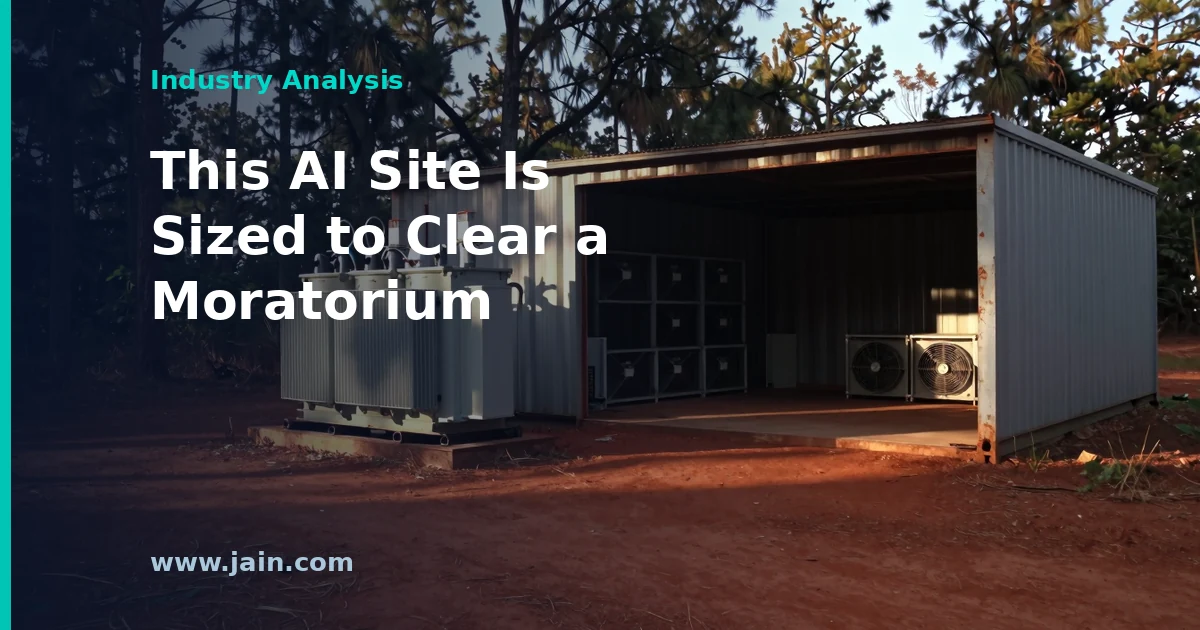
The conversion keeps very little of the mine’s hardware. The draft agreement describes replacing 20 equipment containers with a standalone data center building, and the anticipated $1.2 billion of combined investment is far beyond anything the containerised operation implied. What carries over is the land, its industrial character and its history as a large electrical load. The mining hosting business ran at 40MW. The new utility agreement covers 65MW, which is 25MW more than the site previously drew.
The economics change shape as well. Bitcoin hosting revenue tracked a volatile commodity price, and AIB’s second-quarter filing records that the operation was de-energized on June 5 because falling prices made it uneconomic. Hosting had not resumed as of August 13. The AI campus swaps that exposure for a 12-year contract with a single tenant, extendable to 22 years. Revenue becomes more predictable, but it is concentrated in one counterparty. The 15-year power agreement outlasts the initial lease by three years, though not the full renewal period.
Korolenko’s time-to-power argument is the commercial rationale, and the site does offer a head start on land, zoning context and a utility relationship. But the delivery estimate of the fourth quarter of 2027 comes roughly 13 to 15 months after the September 30 announcement, and it is still subject to a hearing and to financing. The project shows a plausible route to power. Neither company has published a comparison showing how much time this route saves against a greenfield alternative.
Two Balance Sheets Still Being Assembled
AIB expects customer prepayments, project debt and preferred equity to fund construction. Preferred equity ranks ahead of common shareholders but behind lenders. AIB also says project financing has not been completed. On the tenant side, Nebius’s October 22 filing describes a $3.5 billion senior secured bridge facility from Citi, signed October 17 and maturing October 16, 2027. It is priced at Term SOFR, a benchmark US short-term borrowing rate, plus a margin that starts at 2.75 percentage points and rises 0.25 points every 90 days to a maximum of 3.50. It is secured on substantially all of the borrowers’ assets.
The rising margin gives Nebius a built-in incentive to refinance, and the company says it can draw on asset-backed financing supported by more than $40 billion of investment-grade customer commitments on long-term contracts. Nebius lists customer prepayments as part of its own funding base, and AIB lists them as part of its construction financing. That points to a chain in which the end customer’s cash may help fund both the GPUs and the building around them. Neither company has said whether CLT1 is among the projects the Citi facility supports. Lenders to AIB’s project company will nonetheless be underwriting Nebius’s credit as much as the site itself.
Background
AIB Data Centers changed its name from BlockchAIn Digital Infrastructure on June 25, 2026, as it shifted from Bitcoin mining hosting toward AI and high-performance computing. Its Spartanburg operations sit within a wholly owned subsidiary, One Blockchain, and it formed AIB CLT1 LLC as the project company for the Nebius campus. Bitcoin miners have become a common source of AI data center sites because their facilities are already built around large industrial electrical loads. When mining profits fall, that grid access can become worth more to AI tenants than to the original use.
Nebius is one of a group of AI-focused cloud providers building GPU capacity quickly to serve developers and enterprises. It funds that buildout through a mix of customer prepayments, operating cash flow and external financing, including the $3.5 billion Citi facility disclosed in October. Spartanburg County, in South Carolina’s Upstate region, adopted a one-year data center moratorium in September 2026 but carved out exemptions for smaller projects on industrial land. Source: AIB plans 50MW AI data center at former Spartanburg cryptomine to serve Nebius (Data Center Dynamics) reports on AIB’s plan to convert its shuttered Spartanburg County Bitcoin mine into a 50MW AI campus leased to Nebius under a county moratorium exemption. Primary sources: Nebius Group N.V., Form 6-K filed October 22, 2026 (Credit Facility); Nebius Group N.V., Exhibit 99.1: “Nebius secures $3.5 billion financing facility with Citi”.Sources