
TL;DR · 30-second read
The Short Version
A small American nuclear company, NANO Nuclear Energy, has teamed up with Hyundai, the South Korean construction giant, to build a compact nuclear reactor in the United States.
The reactor, called KRONOS, is rated at 15 megawatts. That is a small fraction of a conventional nuclear plant, which produces about a thousand. Reactors this size are being pitched as on-site power for places like the huge data centers that run artificial intelligence.
The interesting part is that the question is shifting. It is no longer whether the design works on paper. It is whether anyone can actually build one on time and on budget. No date or price has been given yet.
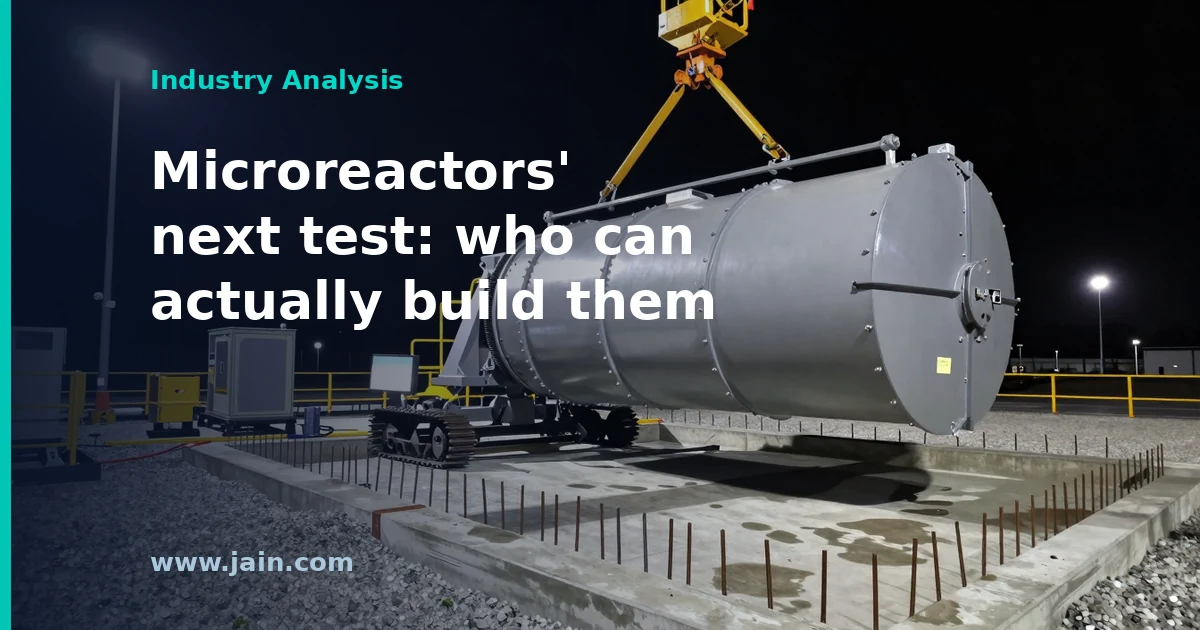
Traders Union reported that NANO Nuclear Energy (Nasdaq: NNE) and Hyundai have formed a partnership to build NANO’s KRONOS microreactor, a 15-megawatt advanced nuclear unit, in the United States. The companies describe the arrangement as a partnership to deliver advanced nuclear power, with KRONOS positioned as an American microreactor project.
No contract value, site, construction schedule or customer has been disclosed alongside the partnership.
Executive Summary
NANO Nuclear Energy has brought Hyundai, one of the world’s large engineering and construction groups, onto its KRONOS microreactor, a 15-megawatt design intended for deployment in the US. A microreactor is a nuclear reactor small enough to be largely built in a factory and installed at or near the site that uses its power, rather than at a utility-scale plant.
The significance lies less in the reactor than in the builder. Microreactor developers have spent years arguing that small, standardized units can avoid the cost overruns and delays that have dogged large nuclear plants. That is a promise about construction, and until now it has mostly been made by designers. With an engineering, procurement and construction (EPC) firm attached, the credible test for KRONOS becomes execution: whether a first unit can be built, licensed and fueled on a schedule a commercial buyer could plan around.
For data center operators and other large power users weighing on-site nuclear, this is a milestone to track rather than capacity to count on. The partnership has no disclosed timeline, cost or offtake customer, and one 15-megawatt unit is small next to the power demands of modern AI campuses.
Microreactors Were Always a Construction Promise
The core sales pitch for microreactors is not mainly about physics. It is that building many small, identical reactors in a factory will be faster and more predictable than building one giant reactor on site. That pitch is a direct response to the record of large first-of-a-kind nuclear builds in the US. Georgia’s Vogtle expansion, for example, came online years late and far over its original budget, largely because of construction and supply-chain problems rather than reactor design flaws.
For that reason, the most important variable for any microreactor is not its core design but whether someone can deliver the first unit as planned. Reactor designers rarely do this alone. The work of procuring components, managing contractors, pouring nuclear-grade concrete and commissioning the plant falls to EPC firms. When a developer names a large EPC partner, the project moves from an engineering argument to a delivery commitment. Watching that delivery is the real test for buyers and investors.
That is why Hyundai’s role changes how the KRONOS project should be judged. With a builder of Hyundai’s scale attached, the remaining doubts will center less on whether a 15-megawatt gas-cooled reactor can be designed and more on whether it can be built at a cost and pace that justify the factory-built premise. Those affected most directly include NANO’s shareholders, any utility or campus that hosts the first unit, and data center developers deciding whether on-site nuclear belongs in their plans this decade or the next.
What a Builder Solves, and What It Doesn’t
An experienced EPC partner addresses real risks: supply chain management, labor, quality control and the discipline of executing to a fixed scope. These are where many first-of-a-kind energy projects lose time and money. A large contractor can also give future customers and lenders more confidence that the project has institutional backing behind it.
A builder cannot solve the other two gates every new US reactor must pass. The first is licensing. The Nuclear Regulatory Commission must approve construction and operation, and no partnership speeds up that review on its own. The second is fuel. Advanced reactors of this type rely on specialized fuel forms whose US supply chain is still being built out. A reactor that is ready to build but lacks a license or a fuel delivery date does not generate power. The Hyundai partnership narrows one category of risk; it does not remove the others.
Fifteen Megawatts Against an AI-Scale Appetite
Scale matters for anyone reading this as an AI power story. Large AI data center campuses are now planned at hundreds of megawatts and up, while a conventional nuclear reactor produces around a thousand. A single 15-megawatt unit could serve a smaller facility, a university campus or an industrial site, but a large AI campus would need many such units. The microreactor case for data centers therefore depends on replication: the first unit has to show that the second, tenth and fiftieth can be built faster and cheaper.
Buyers should also note how the rating is stated. Reactors are often described by thermal output, the heat the core produces, and the electricity delivered after conversion is a substantial fraction lower. Data center planners care about delivered electrical megawatts. Whether the 15 megawatts refers to heat or to electricity affects how many units a given site would need.
Reading the Signal Without Overreading It
For investors, a named construction partner is a meaningful credibility step for a pre-revenue nuclear developer. It is still not a contract with a disclosed value, a firm schedule or a paying customer. The milestones that would turn the partnership into a buildable project are a defined site, a licensing decision, a fuel supply agreement and a financing structure. Until those come out, the partnership is best treated as a statement of intent from two capable parties, not as power capacity entering the market.
Background
NANO Nuclear Energy is a Nasdaq-listed US developer of microreactors and related nuclear fuel technology. In 2025 it acquired the KRONOS high-temperature gas-cooled microreactor design from the assets of Ultra Safe Nuclear Corporation, giving it a design with a longer development history than its earlier concepts. Like other microreactor developers, NANO markets small reactors for users who need dedicated, steady power, a group that increasingly includes data center operators facing long waits for grid connections.
Hyundai Engineering & Construction is one of South Korea’s largest construction groups, with long experience building power plants. Its arrival puts a major EPC contractor behind a US microreactor project at a time when the industry’s central question is shifting from which designs work to which can be built at commercial cost and speed. Source: Nano Nuclear Energy and Hyundai partner to build 15 MW KRONOS microreactor in U.S. (Traders Union) on NANO Nuclear Energy’s construction partnership with Hyundai for its KRONOS microreactor.Sources