
TL;DR · 30-second read
The Short Version
The world’s biggest maker of computer chips, the company that builds many of the processors behind artificial intelligence, appears to be scouting Sherman, a small city in north Texas, for two new factories worth about $45 billion.
The company hasn’t confirmed it. But Texas officials flagged Sherman as an ideal spot, largely because the city spent years buying water rights and is now building a 27-mile water pipe. Chip factories use enormous amounts of water, so the town that planned ahead is now first in line.
The Real Deal reported on October 30, 2026 that Taiwan Semiconductor Manufacturing Company (TSMC) appears to be the company behind a search for sites for two chip plants and a $45 billion investment in Texas. Texas state documents obtained by Bloomberg describe the search, and a state note identifies Sherman, a North Texas city about 15 miles from the Red River, as an ideal candidate. The documents do not name the company. TSMC CEO C.C. Wei said in early October that a Texas location was under consideration, according to the Dallas Business Journal.
Sites in Central Texas are also being evaluated, but the preference appears to be shifting toward North Texas. Sherman already hosts major semiconductor plants from Texas Instruments and GlobalWafers.
Executive Summary
A $45 billion, two-plant expansion would be TSMC’s largest move in the United States beyond its first fabrication plant in Phoenix, Arizona. TSMC has not confirmed that it is the company behind the Texas site search, and its most recent monthly filing with US market regulators shows no board-approved capital spending for September 2026. The project is best understood as an advanced site search, not a commitment.
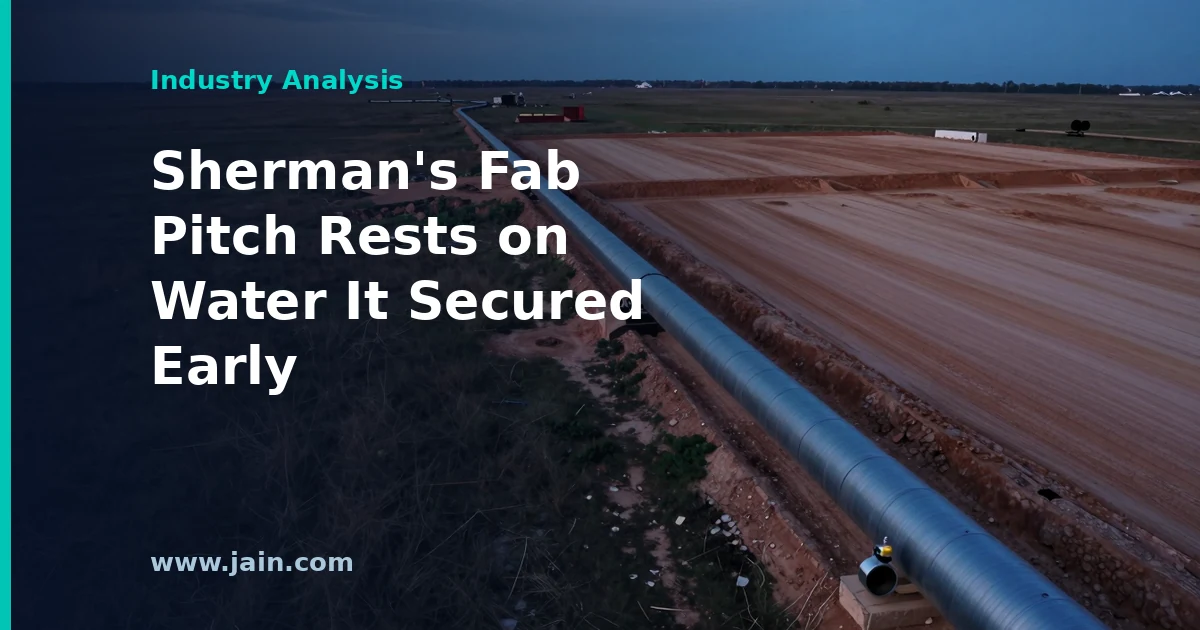
What makes the story significant is why Sherman leads. The city did not wait for a chipmaker to arrive before solving the hardest siting problem. It bought water rights, draws from the large Lake Texoma reservoir, and is preparing an 84-inch pipeline running 27 miles from the lake to a separate reservoir. That pre-built capacity, plus an existing chip cluster anchored by Texas Instruments, is what a state note points to in calling Sherman ideal.
For the AI hardware supply chain, which depends heavily on TSMC’s factories, the question is less whether Texas has land than whether it has the utilities a two-fab campus needs. On water, Sherman has an unusually concrete answer. On electricity, nobody has said anything yet.
Why Sherman Leads: The Water Was Secured Before the Fab
A semiconductor fab, the factory where circuits are printed onto silicon wafers, needs a large and dependable supply of water, much of it purified to extreme standards for rinsing wafers between manufacturing steps. That requirement has made water one of the most common objections to new chip plants. In Sherman’s case, the city has worked to take the objection off the table. Its supply comes from Lake Texoma, which is described as having the volume to absorb a fab’s demand, and the city has paid for additional water rights and is gearing up to build an 84-inch pipeline running 27 miles from the lake to a separate reservoir.
The mechanism matters for anyone siting heavy industrial load, including data center developers. Water rights and large-diameter pipelines take years to secure and permit. A city that has already done that work can offer a chipmaker a shorter, less risky path to operation than a site that would have to start from zero. The Texas state note calling Sherman an ideal candidate, set against competing Central Texas sites, is consistent with that logic: the community that invested ahead of demand is the one at the top of the list.
This reframes the usual worry. Water is often cast as the constraint that will limit US chip expansion. Here it is presented as Sherman’s competitive advantage. That claim rests on the city’s own investments and the lake’s described volume. Neither the city nor the prospective tenant has published how much water two fabs would draw against how much capacity Sherman holds, so the advantage is plausible but not yet quantified.
A Second Chip Cluster, Not a Lone Bet
Sherman would not be a pioneer site. Texas Instruments is building out a 1,200-acre complex there, with one plant complete and plans for four totaling 4.2 million square feet, supported by a $46 billion North Texas investment. GlobalWafers, which makes the silicon wafers that chips are built on, also operates a major plant in the city. A third major operator would deepen an existing cluster rather than create a new one.
Clusters lower costs that never appear in a headline price tag: specialized construction crews already on site, suppliers of industrial gases and chemicals with established logistics, a local workforce trained in clean-room operations, and utilities experienced with semiconductor-grade demand. For TSMC, whose US footprint so far centers on Phoenix, a Texas site with those features would diversify geography without starting a supply ecosystem from scratch.
What TSMC’s Filings Do and Do Not Show
TSMC’s monthly 6-K filed October 22, covering September 2026, reported no capital appropriations approved by its board and no acquisitions or dispositions of assets. That does not rule out a Texas project. It does mean that, as of September, TSMC’s board had not formally committed money to one, and the company had not bought land through any reported transaction.
The public record therefore consists of three pieces: Wei’s early-October remark that a Texas spot was under consideration, Bloomberg’s reporting on a Dallas-Fort Worth area search, and state documents describing an unnamed company’s $45 billion, two-plant plan. Together they make TSMC the most likely searcher. Investors should treat the $45 billion figure as a scale indicator from a site-selection process, not as a capital budget.
Power Is the Variable Nobody Has Priced
The siting conversation so far has centered on water. Electricity has not been addressed by TSMC, the State of Texas or the City of Sherman. A two-fab campus is a large, continuous electrical load, and it would sit in a region where Texas Instruments is already expanding. How the power would be supplied, what grid upgrades would be required, and on what schedule are open questions.
For AI infrastructure, this is the question to watch. TSMC manufactures many of the advanced processors used to train and run AI models, and more US fab capacity could shorten supply chains for that hardware. Whether a Texas campus would produce leading-edge AI chips at all has not been disclosed. If it does, its timeline will depend as much on electricity as on the water Sherman has already lined up.
Background
Taiwan Semiconductor Manufacturing Company is the world’s largest contract chipmaker: it manufactures chips designed by other companies, including many of the processors used in AI systems, smartphones and computers. Its first US fabrication plant is in Phoenix, Arizona, and the company has been evaluating further American expansion.
Sherman is a North Texas city about 15 miles from the Red River border with Oklahoma. It has become a semiconductor hub, with Texas Instruments building a multi-plant complex and GlobalWafers operating a wafer plant there. The city draws water from Lake Texoma and has invested in water rights and pipelines to compete for large industrial projects. Source: TSMC’s eyes Sherman for $45B Texas expansion, potentially adding to North Texas semiconductor hub (The Real Deal) on state documents describing a $45 billion, two-plant chip site search pointing to Sherman, Texas. Primary sources: Taiwan Semiconductor Manufacturing Company, Form 6-K filed October 22, 2026 (monthly report for September 2026).Sources