TL;DR · 30-second read
The Short Version
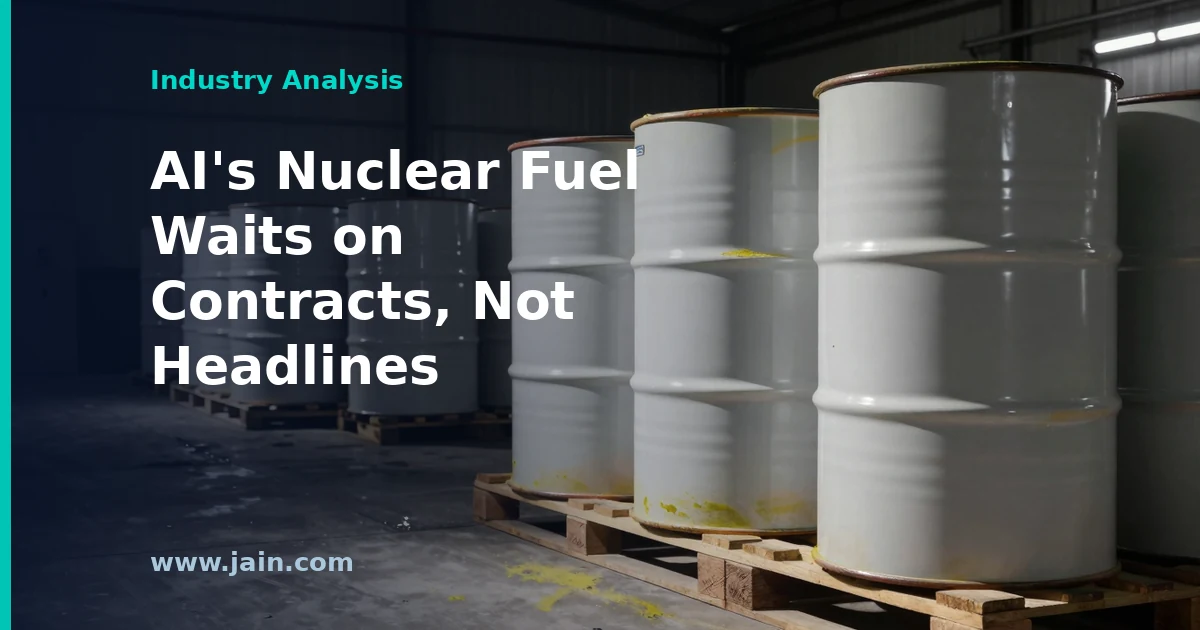
Tech companies want nuclear power for artificial intelligence, and the fuel price shows it. Uranium for future delivery reached about $96.50 a pound, near its highest level since 2011 once inflation is counted.
Cameco, one of the biggest uranium suppliers, said on October 30 that it will not dig more just because of the excitement. It wants signed, long-term orders first.
That means the nuclear-powered data centers, the warehouses of computers behind chatbots, depend on power companies locking in fuel years ahead.
Cameco Corporation (TSX: CCO; NYSE: CCJ) reported results for the third quarter ended September 30, 2026, in a release and management’s discussion and analysis filed with US regulators on a Form 6-K on October 30. Results for the quarter and the first nine months were lower than a year earlier. Cameco attributed the decline mainly to a planned, longer maintenance outage at its Key Lake mill, which began in the third quarter, and to the absence of a significant payment related to the Dukovany nuclear project in the Czech Republic. Westinghouse received that payment in 2025. The company also declared its annual dividend.
The more telling numbers were in the market update. In the third quarter, the average reported long-term uranium price rose to US$96.50. Cameco said that level is approaching the highest since 2011 in 2026 constant dollars. The spot price ended the quarter at US$89.63, and industry consultancy UxC reported about 9 million pounds of spot volume for the quarter, against 15 million pounds in the comparison period Cameco cited.
Executive Summary
Cameco’s quarter was weaker on paper, for reasons the company says it planned for. The commentary that came with the numbers is the more useful read on nuclear fuel. Cameco argues that buyers spent several years securing conversion and enrichment services, the processing steps that turn mined uranium into reactor fuel. It says that same security-of-supply concern is now moving upstream to uranium itself. As evidence, it points to public requests for proposals from utilities and to inbound requests for direct, long-term negotiations outside the open market.
The company was equally direct about artificial intelligence. CEO Tim Gitzel said growing electricity demand tied to AI and data centres ‘may provide additional upside’ for nuclear energy, but that Cameco’s investment thesis ‘does not depend on any single demand driver.’ He added that Cameco ‘will not advance production, commit capital or pursue growth simply in response to headlines, short-term price movements or market enthusiasm surrounding any single theme.’
For anyone who builds, powers or finances AI infrastructure, the practical point follows from that. A long-term fuel price near a 15-year inflation-adjusted high signals tightening. Cameco’s stated discipline means new supply will follow signed commitments, not announcements. AI’s appetite for nuclear power therefore has to turn into long-term fuel contracting before it moves the supply side.
The Long-Term Price Is Doing the Talking
Uranium trades in two ways. The spot market covers delivery within a year. Long-term contracts, which utilities use for most of their needs, set prices for deliveries years out. In the third quarter, the reported long-term price averaged US$96.50 and the spot price closed at US$89.63. When buyers pay more for future delivery than for near-term material, they are paying for certainty. That is the price signal of a market more worried about future availability than about the next shipment.
Thin spot activity points the same way. UxC reported about 9 million pounds of spot volume for the quarter, compared with 15 million pounds in the comparison period Cameco cited. Lighter spot trading alongside a firm long-term price fits Cameco’s account that procurement is shifting toward direct, longer-dated deals. Cameco says buyers had prioritised conversion and enrichment, the steps that turn uranium concentrate into a gas and then raise its share of fissile material. According to the company, that focus ‘delayed a meaningful return’ to uranium procurement, and the same priority is now reaching uranium itself.
Readers should separate the measured from the asserted. The prices and volumes are industry data. The claims of a ‘growing long-term nuclear fuel supply deficit’ and of fuel-cycle capacity that ‘remains constrained in many parts of the western market’ are Cameco’s view, and Cameco sells into that market. The price data supports the direction of the argument. The size of any deficit remains a forecast, which Cameco itself labels forward-looking information.
Why AI Demand Needs a Signature Before It Gets a Mine
The headline claim rests on how Cameco says it makes supply decisions. Its stated strategy is to ‘pursue disciplined contracting’ and to ‘use those commitments to inform our supply decisions.’ It explicitly rules out advancing production in response to ‘market enthusiasm surrounding any single theme.’ In plain terms, an announcement that a tech company wants nuclear power does not, by itself, lead the largest listed western supplier to produce more uranium. A long-term contract for fuel deliveries does.
Data-center nuclear deals typically involve buying electricity, not fuel. The reactor operator, usually a utility, carries the fuel procurement. So the chain from AI power demand to new uranium supply runs through utilities signing long-term fuel contracts. Cameco’s own description of the newest demand shows how early that chain is. It says several non-utility, non-traditional potential customers in energy-intensive and hard-to-abate sectors have ‘begun proactively engaging with nuclear fuel providers to better understand procurement practices.’ Learning how to buy fuel is a long way from having bought it.
Three groups are most exposed. Developers and hyperscalers counting on reactor restarts, life extensions or new builds depend on fuel being contracted years ahead. Small-reactor developers will compete for the same constrained conversion and enrichment capacity. Utilities face a long-term price near its highest inflation-adjusted level since 2011. If the reactor deals keep coming, contracting is the step to watch, because Cameco has said that is what moves supply.
Weaker Quarter, Stronger Claimed Fundamentals
Cameco presents its year-over-year decline as mostly a matter of timing and comparison. The extended Key Lake mill outage was planned for projects meant to ‘ensure flexibility and sustainable operations,’ and it reduced production and raised costs in the quarter. The 2025 Dukovany payment to Westinghouse also flattered last year’s equity earnings. Inflationary pressure is a real headwind that Cameco acknowledges without quantifying in its commentary. Self-imposed lower output also tightens the supply picture at the margin, which is consistent with the company’s emphasis on discipline.
Cameco’s broader demand case draws on figures from the International Atomic Energy Agency (IAEA): 438 operable reactors, 417 of them operating, and 78 under construction worldwide. It also notes that 39 countries have pledged to triple nuclear capacity by 2050. Reactors under construction are concrete demand. Pledges to 2050 are not, and Cameco’s argument leans more on the existing fleet, uprates, life extensions and restarts, which consume fuel now. Its ownership interest in Westinghouse gives it exposure to reactor services and to future deployments, which is the part of the business most directly tied to any AI-driven new build.
Background
Cameco, headquartered in Saskatoon, Saskatchewan, is one of the largest publicly traded uranium suppliers and is listed in Toronto (CCO) and New York (CCJ). Its operations include the Key Lake mill in northern Saskatchewan, and it holds an ownership interest in Westinghouse, the reactor designer and services company. Cameco reports under International Financial Reporting Standards and states most financial figures in Canadian dollars, while uranium prices are quoted in US dollars.
Nuclear fuel moves through several stages: mining and milling, conversion, enrichment and fabrication. Utilities usually buy it years ahead under long-term contracts. Interest in nuclear energy has grown with energy-security concerns, reactor life extensions and restarts, and new electricity demand that includes data centers. That puts the fuel supply chain under closer scrutiny from both utilities and technology companies. Source: What Did Cameco’s (TSX:CCO) Latest Results Say About Nuclear Fuel? (Kalkine Media), coverage of Cameco’s third-quarter 2026 results and what they indicate for nuclear fuel. Primary sources: Cameco Corporation Form 6-K, filed October 30, 2026 (SEC EDGAR); Exhibit 99.1: Cameco reports third quarter results (October 30, 2026); Exhibit 99.2: Cameco management’s discussion and analysis for the quarter ended September 30, 2026.Sources