
TL;DR · 30-second read
The Short Version
Babcock & Wilcox, an Ohio company that makes power plant equipment, sold about $200 million of new shares in May. One stated goal was supplying electricity for artificial intelligence data centers, the giant computer warehouses behind chatbots.
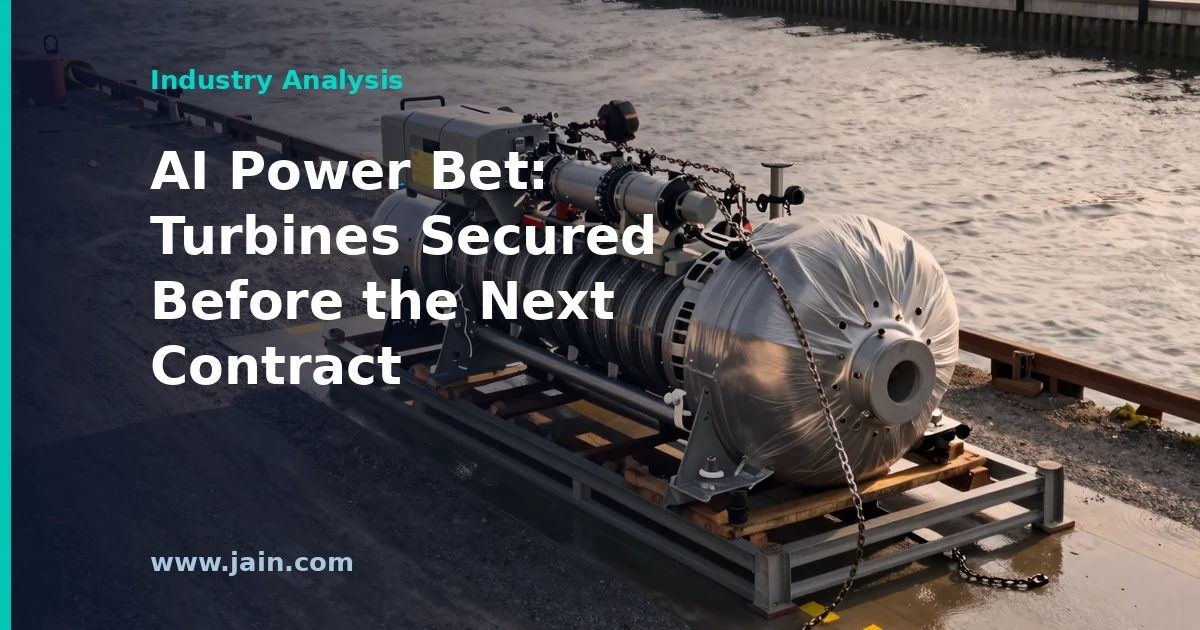
It has since ordered more steam turbines, machines that turn heat into electricity, with combined output similar to one large power plant. It has not named the customer.
The bet is simple: companies racing to build these centers will pay for power equipment that can arrive soon, so getting in line early is worth the risk.
Babcock & Wilcox Enterprises (NYSE: BW) priced an underwritten public offering of 10,810,811 common shares at $18.50 each on May 15, 2026, for gross proceeds of approximately $200 million before underwriting discounts, commissions and expenses. B&W also gave underwriters a 30-day option to buy up to 15% more shares, and it expected the offering to close on May 18.
Second-quarter results released on August 10 show what followed. B&W reported revenue of $319.7 million and backlog of $2.6 billion, and said it had secured an additional 1 gigawatt of Siemens Energy steam turbines “in anticipation of our next data center project.”
Executive Summary
The May offering was a capital raise with a specific industrial purpose. B&W said net proceeds would first prepay amounts under its Credit Agreement, then be reborrowed as needed to fund steam turbine and boiler capacity, AI data center power projects, BrightLoop commercialization, potential acquisitions, balance sheet strength and general corporate purposes.
It matters because B&W is positioning itself as a supplier of on-site generation for AI data centers, a market where its chief executive stresses “speed to markets.” Its August disclosures show equipment commitments moving ahead while further data center opportunities remain in “active discussions.”
The results give that strategy some support: revenue rose 130% from a year earlier, and B&W returned to quarterly net income. They also show concentration in a single large project, narrower adjusted margins and a backlog that still has to be delivered.
Turbines First, the Next Contract Later
B&W’s May release names project-related capital and working capital “to influence steam turbine and boiler production capacity” first among its intended uses, ahead of growth initiatives such as AI data center power projects. That wording puts manufacturing access near the center of the funding case. Steam turbines and boilers are long-lead items, meaning equipment that can take many months to build, so a place in the production schedule can shape when a power project can start up.
The August results release, furnished with an 8-K, shows the same logic in practice. B&W said it had placed additional orders with Siemens Energy for 1 gigawatt of steam turbines, to be delivered in the next 12 to 15 months “to secure speed to markets.” It described the purchase as being in anticipation of its next data center project, while Chairman and CEO Kenneth Young said talks on other AI data center opportunities were active. The results release does not tie the order to offering proceeds, and cash is fungible, so the established point is the sequence: capital raised, then supply secured, with the next project still ahead.
The trade-off is clear. Developers that need power quickly may value a supplier with turbines already on order, and B&W calls rapid deployment “a key differentiator.” Shareholders take on the timing risk. B&W’s August investor presentation says it generally adds contracts to backlog when customers confirm work in writing and commit to pay for it, so a project still under discussion would not count. If that project slips, the exposure depends on order terms B&W has not detailed in its results release.
What the $200 Million Does for the Balance Sheet
The prepay-and-reborrow structure works much like paying down a credit line and drawing on it again. Debt falls at first, while the money stays available for projects and other uses. The May release also warned of possible conditions that could raise substantial doubt about B&W’s ability to continue as a going concern, “which has occurred in the past,” and of its obligation to refinance or repay its 6.50% Senior Notes due 2026. That context makes the raise a balance sheet event as well as a growth one.
By August, B&W had announced the repurchase of its remaining $61.8 million of bonds due December 2026, which removes a near-term maturity. Its board also authorized a share repurchase program of up to $50 million in July, which Young said reflects confidence in the balance sheet. Together those two figures equal more than half of the May offering’s gross proceeds, although the buyback is a ceiling rather than a commitment to spend.
Authorizing a buyback about two months after selling 10.8 million new shares at $18.50 is not contradictory in itself, since a company’s needs and share price can change quickly. It does invite a fair question about how B&W ranks turbine commitments, debt reduction, possible acquisitions and shareholder returns.
A Strong Quarter on a Narrow Base
Second-quarter revenue rose to $319.7 million from $138.9 million a year earlier, and B&W attributed the increase primarily to large project volume, including $100.7 million from Base Electron. That single customer accounted for nearly a third of the quarter’s revenue. Young said the project is ahead of expectations and on budget, with permitting underway. Those are management’s assessments, and the permitting process has yet to finish.
Profit grew more slowly than sales. Adjusted EBITDA, a measure of earnings before interest, taxes, depreciation and certain other items, rose 57% to $21.8 million, which works out to a margin of about 6.8% compared with about 10.0% a year earlier. Young describes parts and services as the higher-margin business, so a heavier mix of large projects is a plausible explanation, though B&W’s summary does not state that link. Net income of $14.3 million included a $5.9 million benefit from a change in the fair value of customer warrants, and adjusted net income was $9.1 million.
The forward numbers need similar care. Backlog of $2.6 billion is up 533%, but second-quarter bookings of $151.0 million were less than half of revenue, so the quarter drew on earlier awards. The pipeline of more than $14.0 billion is over five times backlog, and it represents identified opportunities rather than committed work. B&W’s raised 2026 adjusted EBITDA target of $80.0 million to $105.0 million will test how well that activity converts into earnings.
Background
Headquartered in Akron, Ohio, Babcock & Wilcox supplies energy and environmental products and services to power and industrial markets, including boilers, emissions controls and replacement parts. Its website now lists AI data centers among its core offerings, alongside BrightLoop, which it presents as an emerging technology. The company’s 10-Q filed August 10 accounts for 2025 disposals of businesses including Vølund, Diamond Power and Allen-Sherman-Hoff.
AI data centers have become a major new source of electricity demand, and B&W’s chief executive cites them alongside utilities, industrial customers and expanding economies as drivers of investment in generating capacity. B&W’s approach pairs its gas-fired boilers with steam turbines from Siemens Energy, placing it among the equipment suppliers seeking a role in on-site data center power. Source: Babcock & Wilcox Enterprises Announces Pricing of Common Stock Offering, the company’s May 15, 2026 announcement of its approximately $200 million share sale. Primary sources: 10-Q filed 2026-08-10; 8-K filed 2026-08-10; Exhibit to 8-K filed 2026-08-10: Babcock & Wilcox Enterprises Reports Second Quarter 2026 Results; Exhibit to 8-K filed 2026-08-10: Company Overview, August 2026.Sources