
TL;DR · 30-second read
The Short Version
Google says its $15 billion artificial intelligence complex in the Indian city of Visakhapatnam will be cooled with air instead of water. Residents in the area, which already faces water shortages, have objected to the project.
The computers inside give off enormous heat, and removing it takes either lots of water or lots of electricity.
Air cooling often needs more electricity, especially in warm places. So easing the water worry may sharpen the power question, and Google does not reveal how much power individual sites use.
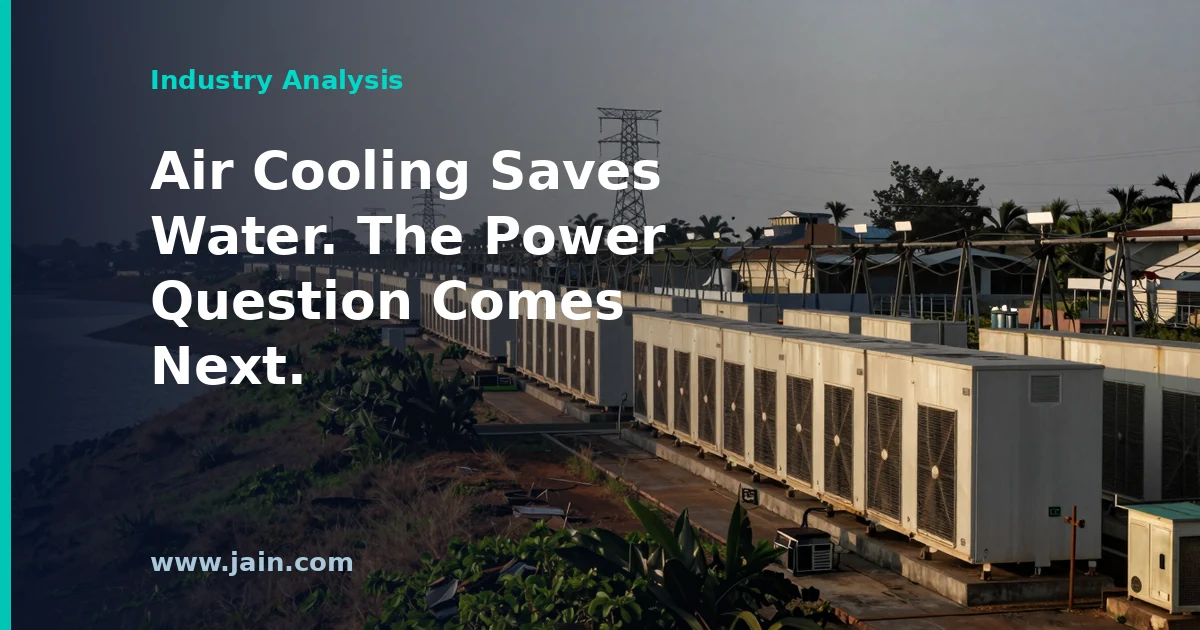
Google told AFP, in a report published by Kuwait Times on October 11, 2026, that its AI data center hub in Visakhapatnam, in the southern Indian state of Andhra Pradesh, will use “advanced air cooling” instead of water cooling. The “gigawatt-scale” facility is part of a $15 billion investment, is set to open in 2028, and will be Google’s biggest AI hub outside the United States.
Residents have objected to the project’s effect on the environment and their lives in an area already facing water shortages. Activists are demanding a moratorium on new data centers across Andhra Pradesh until there is more evidence of their effects on the environment and local communities.
Executive Summary
Alexander Smith, Google’s head of infrastructure and energy for the Asia-Pacific region, said the company’s water assessment for Visakhapatnam “pointed to pressure on the local watershed” and that the finding “shaped our choice of cooling configuration from the outset.” It is a clear example of a local resource constraint influencing the engineering of a major AI facility.
The decision addresses the most visible objection, but it does not remove the underlying physics. Heat from a site of this scale has to go somewhere, and systems that use less water often use more electricity, particularly in warm weather. Google has not published the site’s power capacity or expected cooling efficiency, so the size of that trade-off cannot yet be measured.
The announcement also leaves other disputes open. Opponents’ concerns extend to power demand and whether local residents benefit, and a cooling choice alone does not settle either issue.
Why Saving Water Can Shift the Burden to Power
Data centers turn nearly all the electricity they consume into heat. Evaporative cooling, one common water-based approach, removes that heat efficiently by letting water evaporate, much as sweat cools skin. The drawback is that the evaporated water is consumed. Dry, air-based systems avoid most of that loss, but they rely on fans and, when outside air is too warm, may also need energy-hungry chillers.
That is the mechanism behind the trade-off in Visakhapatnam. A coastal city in southern India is a demanding setting for rejecting heat into outside air, because the warmer the air, the less easily it absorbs heat from equipment. Because Google describes the campus as gigawatt-scale, even a modest cooling overhead could translate into substantial additional electricity demand. Grid planners, power suppliers and other energy users in the region would have the most direct interest in that figure.
Water may also not disappear from the equation entirely. Some power plants consume water to generate electricity, so higher electricity demand can move part of the water burden from the data center to its energy supply. How much depends on where the power comes from. Smith said Google plans to invest in new clean energy projects in Visakhapatnam, which could reduce that effect, but no size or schedule was given. The net result will depend on details Google has yet to disclose.
What “Advanced Air Cooling” Does and Does Not Settle
The phrase itself leaves important engineering questions open. Many high-density AI systems use closed liquid loops to pull heat away from chips, then release that heat to the outside air through dry coolers. A facility built this way could be described as avoiding water cooling while still using liquid inside the building. Google has not said whether this is the design it has chosen, and the distinction affects both efficiency and water use.
Google’s broader water pledge is a separate matter. The company has committed to replenishing 120 percent of the freshwater it uses across its operations by 2030. That is a company-wide target, while watershed stress is local, and water restored elsewhere would not ease pressure on supplies around Visakhapatnam. This is why the site-level cooling choice is the more relevant commitment for residents.
The sequence also deserves clarity. The decision has been presented alongside residents’ objections, while Smith said the water assessment shaped the design from the outset. Those accounts are not necessarily in conflict, but the timeline matters to how the choice is understood: as early engineering diligence, a response to public concern, or some combination of the two.
Fair Questions for Both Sides of the Moratorium Debate
Google’s position rests on process and economic benefit. Smith said independent assessments covering power supply, water risk, ecology and noise take place 12 to 24 months before a project begins, and that Google will either develop more power or not build where a data center would take power from a community. Those are meaningful statements of policy, but outsiders can test them only if the assessments and site-level power data are available. The noise review may also take on added weight, since air-based systems depend on fans.
The economic claims call for similar care. Smith said a development of this kind is projected to generate about $688 million a year in local economic activity and that each job inside a Google data center supports nine more nearby. The first figure is framed around a type of development rather than as a site-specific audit, and a multiplier means little without a direct job count.
The moratorium proposal raises questions as well. Activists have asked for more evidence before further projects proceed, which is a reasonable demand, particularly with several tech projects planned for Visakhapatnam and the combined effect of those projects a legitimate concern. Its strength will depend on specifics: what evidence would be sufficient, who would judge it, how long a pause would last, and whether a water-saving design would be treated differently from a water-intensive one. Elsewhere, Finnish authorities recently ordered work to stop at two Google data center sites pending mandatory environmental assessments, a reminder that such reviews can directly affect construction timelines, though the two cases arise under different legal systems.
Background
AI computing is driving rapid data center construction worldwide, especially in Asia. These facilities need large, continuous supplies of electricity and a way to remove the heat their equipment produces. Critics say they add demand to power grids that still rely heavily on fossil fuels and strain local water supplies, making cooling design a community issue as well as an engineering one.
Visakhapatnam, a coastal city in Andhra Pradesh, is the site of several planned tech projects, with Google’s $15 billion investment among them. Google says it carries out independent assessments of power supply, water risk, ecology and noise 12 to 24 months before a project begins. Source: Google says India data center will use air cooling amid water fears, Kuwait Times: Google’s cooling plans for its $15 billion AI hub in Visakhapatnam and the local opposition to the project.Sources