
TL;DR · 30-second read
The Short Version
Protesters climbed the fence of a building site in Amsterdam where Microsoft is putting up a data center, a warehouse full of computers that runs online services and artificial intelligence. Some scaled a crane and lit flares. Police detained 150 to 200 people.
It was one of many protests planned across 15 European countries that weekend, by campaigners worried about the electricity and water these buildings use.
Why it matters: the fight is no longer only about whether these buildings get approved. People are now showing up while construction is under way.
Protesters broke into the construction site of a new Microsoft data center in Amsterdam on Friday, Nov. 6, 2026, the Associated Press reported. Some climbed a crane and set off flares while others clashed with police. Dutch police said they detained 150 to 200 people suspected of trespassing. Nathan Timmer of the group Geef Tegengas (“Push Back”) told local broadcaster AT5 that protesters were occupying the site to stop construction.
The action was part of the “Stop Dirty Data Centres” campaign, which dozens of civil society and grassroots groups planned to join across 15 European countries on Nov. 6–7. The campaign demands a moratorium on large-scale developments. Microsoft said it respects the right to protest peacefully but does not condone unlawful actions or actions that put people’s safety at risk.
Executive Summary
The Amsterdam occupation shifts where opposition to data centers can bite. Objections raised during planning arrive on a legal timetable. An occupation of an active construction site lands after land, contractors, cranes and capital are already committed. Every lost day there costs money.
The scale was notable. Police detained 150 to 200 people at a single site, and protesters vowed to keep going until construction stops. The same weekend, protests were planned in 15 countries, from a dozen people outside a data center near Berlin to around 100 outside the Polish parliament. They followed an Oct. 10 rally in Milan that drew more than 1,000 people from about 40 local committees.
For developers, contractors and the cloud customers waiting on new capacity, the takeaway is practical. Community opposition now has to be planned for through the build, not just through the permit. Microsoft has not said whether work at the Amsterdam site was interrupted.
Why the Construction Fence Is the New Exposure
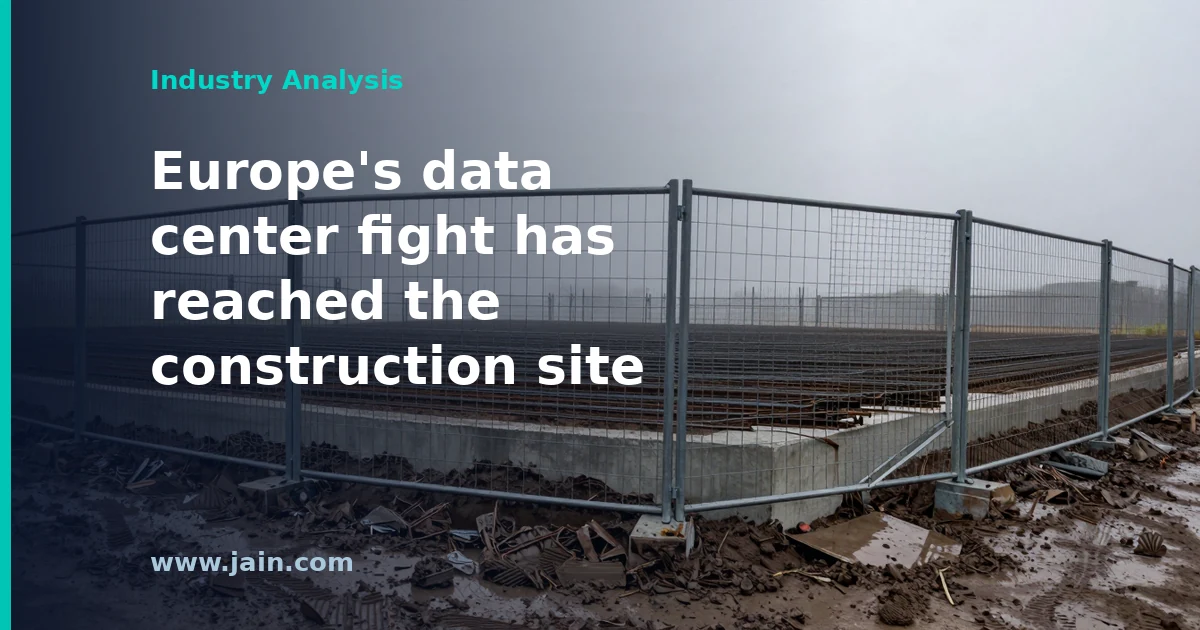
Opposition fought through planning, meaning objections, hearings and appeals, runs on a calendar a developer can model and price. Friday’s action in Amsterdam worked differently. Protesters went over the temporary construction fence at a site where Microsoft’s data center is already being built. They climbed a crane, set off flares and clashed with police. Dutch police said they detained 150 to 200 people on suspicion of trespassing, and some protesters were still on site late in the afternoon.
The timing is what matters operationally. By the construction phase, a project’s fixed commitments are in place: contractors on the clock, leased heavy equipment and financing accruing interest. Lifting work cannot safely continue while people are on a crane, and clearing a site takes a police operation. Timmer said the aim was to stop construction and vowed to continue until it is halted. If that happens, community opposition stops being a one-time approval hurdle and becomes a recurring site-security and schedule risk. That risk falls on general contractors, site insurers, and the cloud and AI customers waiting on the capacity.
The actual impact is still unknown. Neither Microsoft nor Dutch police have said whether work stopped, for how long, or at what cost. One occupation does not make a trend. But this one was coordinated with protests in 15 countries, and its organizers say they will return. That combination is what turns an incident into a planning assumption for anyone building in Europe.
A Coordinated Network With Local Roots
The campaign is openly organized. StopDirtyDataCentres.eu coordinated the weekend, and its coordinator, Owen Espley, described “a gulf” between elected leaders who buy into AI hype and the public. Coordination alone does not answer whether a movement is organic. The local evidence does. In Warsaw, about 100 people represented communities near planned sites, under a banner warning of two data centers 35 metres from homes. In Lombardy, Italy’s main digital-infrastructure hub, around 40 local committees joined the Milan rally after a series of growing protests in nearby towns.
Turnout also varied widely. A dozen people near Berlin is a very different signal from 150 to 200 detentions at one Amsterdam site. The movement’s demands also mix concrete local concerns, such as water, power and proximity to homes, with broader objections to AI. That mix matters for developers. Site-specific grievances can often be negotiated. Objections to the technology itself cannot be resolved at the project level.
Testing the Claims on Both Sides
Several protest claims deserve scrutiny. A Warsaw sign equated one data center’s water consumption with that of 3,000 people, but gave no basis for the figure. Water use depends heavily on a facility’s size, climate and cooling design, so no single ratio fits every site. Timmer’s assertion that the Amsterdam facility will be used only for “AI slop,” warfare, surveillance and genocide is a claim about end uses. It was not tied to any evidence about this specific project. “Nobody needs it” is hard to square with the investment forecasts the industry is planning around.
The industry side has gaps too. Microsoft’s statement addressed lawfulness and safety, which are legitimate concerns. It did not engage with energy, water or public consultation, the issues the protesters actually raised. The activists’ central process argument is that construction is outpacing consultation and environmental oversight. That claim can be tested, and developers are best placed to rebut it, by publishing site-level power, water and consultation records.
What $5.6 Trillion of Planned Spending Is Exposed To
PwC’s Global Data Centre Outlook 2026–50 projects $5.6 trillion in cumulative data center capital expenditure in Europe from 2026 through 2050. That is about 18% of global investment, against $15.1 trillion forecast for the U.S. Spending on that scale depends on large sites being built on schedule. Large sites are exactly what the moratorium demand targets.
Microsoft’s own business description shows why scale is central to its strategy. Its annual-report business section says its cloud benefits from datacenters that deploy computational resources at significantly lower cost per unit than smaller ones. Separately, an 8-K filed Nov. 4 shows Microsoft sold $25 billion of senior unsecured notes on Oct. 29, with maturities from 2028 to 2066. The filing does not tie the proceeds to any project. It does illustrate the long time horizon of the capital in this industry, which stands in contrast to the short-notice disruption a site occupation can create.
The backdrop is not only European. The protests came days after U.S. midterm elections brought in a wave of Democrats promising to clamp down on data centers. Developers that can document their community engagement, water plans and power sourcing will likely face less friction. Those that cannot may find the construction phase has become the most exposed stretch of the project.
Background
Microsoft, founded in 1975, describes itself as a technology company committed to making AI broadly available. Its cloud business depends on large datacenters, which the company says deploy computing at significantly lower cost per unit than smaller facilities. That scale logic has driven construction of very large sites across Europe, including in Amsterdam, one of the continent’s established data center markets.
Opposition has grown alongside the buildout. In Italy, grassroots resistance is concentrated in Lombardy, the country’s main digital-infrastructure hub, and culminated in what organizers called Italy’s first national demonstration against data centers on Oct. 10. Campaigners across Europe now demand a moratorium on large-scale developments. PwC nonetheless forecasts $5.6 trillion of European data center capital expenditure through 2050. Source: Protesters break into Microsoft data center site in Amsterdam as Europe’s backlash spreads (AP News): Associated Press report on the Nov. 6, 2026 Amsterdam site occupation and coordinated protests across Europe. Primary sources: Microsoft 8-K filed 2026-11-05 (board director notice); Microsoft 8-K filed 2026-11-04 ($25 billion senior notes offering); Microsoft 8-K filed 2026-10-28; Exhibit 99.1 to Microsoft 8-K filed 2026-10-28 (business description).Sources