
TL;DR · 30-second read
The Short Version
The computer chips that run artificial intelligence change how much electricity they draw almost instantly. One moment they are coasting, and a thousandth of a second later they are running flat out.
Power companies have to plan for those spikes, so data centers often reserve far more electricity than they use on an ordinary day. Ampt, a Colorado power-equipment maker, has built a box that lets a battery cover the spikes instead.
If it works at scale, a data center could run more computers on the same power line without waiting years for a bigger one.
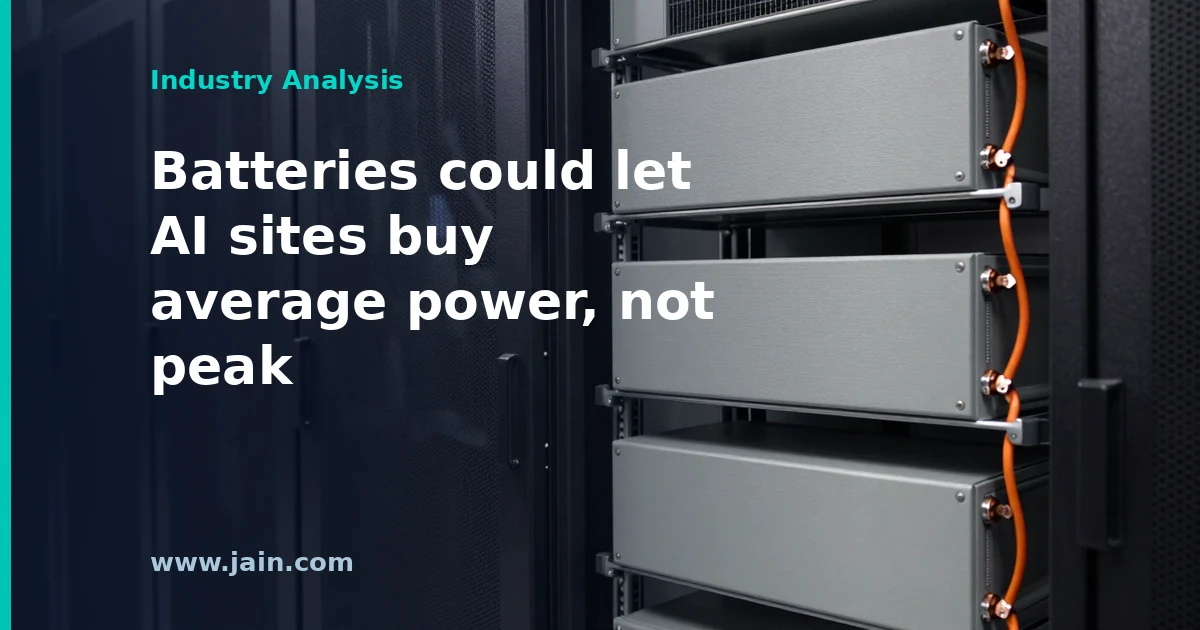
On November 11, 2026, Fort Collins, Colorado-based Ampt announced a Battery Converter for AI data centers that use 800-volt direct-current (800 VDC) power distribution. Each 2U rack-mountable unit (about 3.5 inches tall) delivers 80 kW at 100 amps. It converts a shared DC bus, fed by batteries, the grid and any on-site generation, into regulated 800 VDC for GPU racks, and it responds to load changes in under 1 millisecond.
Units can be paralleled from a single rack to an entire GPU cluster. The product is in partner pilots now, and Ampt targets general availability in the third quarter of 2027.
Executive Summary
Ampt’s central claim is operational rather than electrical. If a battery absorbs the millisecond-scale power spikes of AI training and inference, the GPUs can run without power capping and the site’s grid connection can be sized for average demand instead of peak demand. Power capping is a software limit that holds chips below their maximum draw. Where grid capacity is the scarcest input to an AI data center, that shift would mean more compute from the same interconnection.
The product sits at the intersection of two trends. One is the industry move toward 800 VDC rack power, which NVIDIA projects will support 1 MW racks and improve end-to-end efficiency by up to 5% over today’s 54-volt systems. The other is the recognition, in NVIDIA’s own white paper as quoted by Ampt, that energy storage must reconcile what the grid wants (steady load) with what GPUs need (a highly dynamic source).
The engineering numbers are specific: under 1 ms response, up to 99.2% peak efficiency, and a 1,100–1,500 VDC battery bus. Ampt has not yet published the economics that would prove the average-not-peak thesis. Those missing figures include how much battery each megawatt of compute needs, what the system costs, and whether utilities will grant smaller interconnections on the strength of it.
Why GPU Power Swings Inflate the Grid Connection
AI workloads can swing a rack’s power draw between 30% and 100% within milliseconds, according to NVIDIA figures cited in Ampt’s release. A grid connection, and the transformers and switchgear behind it, has to be rated for the highest load it will see, not the typical one. An operator facing that swing has two conventional options. The first is to reserve grid capacity for the peak, which pays for headroom that sits idle much of the time. The second is to cap GPU power, which keeps the load predictable but leaves performance on the table.
Ampt proposes a third option. A battery sits on the same DC bus as the grid feed, and a converter fast enough to react inside a millisecond lets the battery supply the spikes and soak up the dips. Upstream, the grid sees something closer to the average. That mechanism supports the claim in the headline. If the peak-to-average gap is covered by storage, the interconnection, the medium-voltage transformer and the power conversion equipment can be sized nearer to average load, and the freed headroom can carry additional GPUs. Ampt also argues that a steadier load profile can help sites secure timely grid access. That is plausible, because utilities plan around predictable demand, but the release does not show it with a utility example.
The size of the prize depends on a number Ampt does not give: the real ratio of average to peak draw for a given workload mix. A cluster that runs near full load most of the time gains less than one with frequent, deep swings. Until pilot data are published, the average-not-peak benefit is a well-reasoned engineering thesis rather than a demonstrated result.
The Value of a Megawatt You Do Not Have to Wait For
The reason this matters is that grid capacity, not chips, increasingly sets the pace of AI buildout. Developer disclosures show how expensive and slow that capacity is. TeraWulf, which leases AI data center capacity to tenants including Anthropic, told investors in its November 6 third-quarter results that its Lake Mariner build is tracking $8 million to $10 million per megawatt of critical IT capacity. Critical IT capacity is the power available to the servers themselves. The same release said TeraWulf’s expanded 1 GW power agreement for its Muskie campus in Kentucky remains subject to state utility commission approval, with a second 500 MW phase anticipated in 2029. The company’s investor presentation lists the availability and cost of power and electrical infrastructure equipment among its risk factors.
Against that backdrop, any technology that lets an operator put more compute behind an existing or already-approved connection is buying time as well as hardware. The trade-off is that battery systems and converters are capital equipment too. Ampt has not disclosed pricing or a cost per megawatt, so buyers cannot yet compare the cost of storage-backed headroom with the cost, and the wait, of a larger interconnection.
What the Efficiency Numbers Do and Do Not Establish
Ampt quotes up to 99.2% peak efficiency for the converter. Peak efficiency is measured at the most favorable operating point. Weighted efficiency across a real load profile is typically the more useful figure for operators, and the release does not provide it. The structural efficiency arguments are sound in principle. Keeping stored energy in DC avoids the DC-to-AC-to-DC conversions of AC-coupled storage. Running the distribution bus at 1,100 to 1,500 VDC carries the same power at lower current, which cuts conductor losses or allows thinner cables.
Two distinctions are worth keeping clear. First, the up-to-5% efficiency gain over 54-volt systems is NVIDIA’s projection for 800 VDC architectures generally, not a measured result for Ampt’s product. Second, Ampt’s point that every lost kilowatt is paid for twice, once as electricity and again as cooling, is correct as a matter of physics, but the release does not quantify the savings for a reference site.
Utility-Scale Parts, Data Center Timelines
One of the more practical aspects of the design is its supply chain. Ampt says the medium-voltage transformers, power conversion systems and batteries are the same equipment used in utility-scale storage today. Its own background is nearly two decades of DC conversion for large solar and storage plants, where it describes itself as the leading DC optimizer company for large-scale systems. That could reduce reliance on scarce data center-specific gear. A grid-forming power conversion system would also let the battery support grid voltage and frequency, which is a selling point when negotiating with utilities.
Timing is the main constraint. General availability is targeted for Q3 2027, and the product is in unnamed partner pilots today. Operators planning first-generation 800 VDC halls will need certification, field reliability data and integration with rack vendors well before then. The modular design does give buyers flexibility. The same 80 kW building block scales from a rack to a hall, and adding a single unit provides N+1 redundancy, meaning full power is maintained if one unit fails.
Background
AI data centers are increasingly limited by electricity rather than chips. New grid connections can take years and require regulatory approval, and rack power densities are climbing toward 1 MW per rack. To handle those densities more efficiently, the industry is moving from roughly 54-volt rack power toward 800 VDC architectures, a transition NVIDIA has outlined in a white paper that also identifies energy storage as the bridge between steady grid supply and volatile GPU demand.
Ampt, founded in Fort Collins, Colorado, built its business on DC optimizers and power conversion for large solar plants and DC-coupled battery storage, with sales and support in North America, Europe, Japan and Australia. The Battery Converter applies that utility-scale DC expertise to the data center power chain. Source: Sub-Millisecond Battery Converter Gives 800 VDC AI Data Centers More Compute from the Same Grid Connection. Ampt’s November 11, 2026 announcement of its 80 kW rack-mountable Battery Converter for 800 VDC AI data centers. Primary sources: TeraWulf Form 10-Q for the quarter ended September 30, 2026; TeraWulf Form 8-K filed November 6, 2026; TeraWulf Reports Third Quarter 2026 Results (Exhibit 99.1); TeraWulf Q3 2026 Investor Update (Exhibit 99.2); TeraWulf Form 8-K filed November 4, 2026; TeraWulf Secures Google Credit Backstop for Project Financing in Support of $19 Billion Anthropic Lease (Exhibit 99.1). TeraWulf documents are cited for industry context on AI data center power and build costs. TeraWulf is not a party to Ampt’s announcement.Sources