
TL;DR · 30-second read
The Short Version
Applied Materials makes the giant machines that factories use to build computer chips. In the three months to late October, its sales jumped 53 percent from a year earlier, to a record of about $10.4 billion.
The company says artificial intelligence is the reason. Every chatbot and image tool runs on chips, and those chips can only be made once factories buy machines like these.
So when these machine sales spike, it is an early signal that a wave of new artificial intelligence computing power is on its way.
Applied Materials, the largest US maker of semiconductor manufacturing equipment, reported record revenue of $10.41 billion for its fiscal fourth quarter ended October 25, 2026, up 53 percent year over year, in results attached to an 8-K filed November 12. Full-year revenue reached a record $34.45 billion, up 21 percent. Chief executive Gary Dickerson said AI “continues to fuel strong incremental demand for semiconductors” and that the company is on track to grow its Semiconductor Systems business more than 40 percent in calendar 2026.
Gross margin rose to 50.4 percent (GAAP), adjusted earnings per share climbed 92 percent to a record $4.16, and Applied returned $2.42 billion to shareholders in the quarter. The company also opened its EPIC Center research facility in Silicon Valley and named Intel, KIOXIA, Besi and UCLA as new partners.
Executive Summary
Applied Materials’ fourth quarter was its strongest on record by every headline measure: revenue, operating income, adjusted earnings per share and free cash flow. The more telling number is the shape of the year. A quarter that grew 53 percent inside a year that grew 21 percent means spending on chipmaking tools accelerated sharply in the company’s final months, and Applied’s own management attributes that demand to AI.
That matters well beyond the semiconductor industry. Wafer-fab equipment (the deposition, etching and measurement machines that turn bare silicon wafers into finished chips) is bought before the chips are made, and the chips are made before any AI server reaches a data center. Applied’s results are therefore one of the earliest hard readings available on how much AI computing capacity is being prepared, months before it shows up as racks, power demand and cooling load.
The release also points to where the engineering work is heading: memory stacking, advanced packaging and the precise measurement needed for next-generation lithography, all areas named in Applied’s new EPIC Center partnerships.
The AI Data Center Starts at the Fab Tool
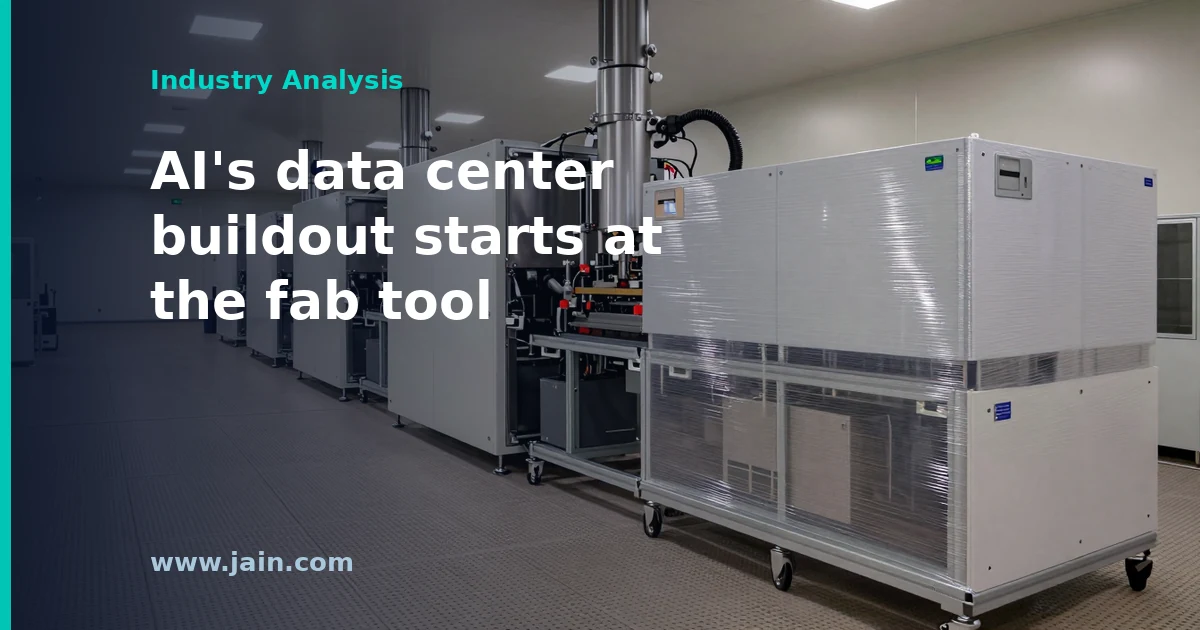
Before a data center operator can install an AI accelerator, a chipmaker has to manufacture it, and before a chipmaker can manufacture it, it has to buy and install the tools that deposit, etch and inspect each layer of the chip. Applied Materials sits at that first step. When its revenue rises, it is because chipmakers are paying for production capacity they intend to fill, which makes Applied’s results a leading indicator for the AI hardware that data centers will receive later.
The arithmetic in Applied’s earnings release shows how sharply that step accelerated. Fourth-quarter revenue of $10.41 billion was about 30 percent of the full year’s $34.45 billion, against an average of roughly $8.0 billion across the first three quarters. A 53 percent year-over-year jump implies a year-ago fourth quarter of about $6.8 billion. Full-year growth of 21 percent, in other words, understates the pace the business finished at. Dickerson’s guidance that the Semiconductor Systems business, the equipment segment, will grow more than 40 percent in calendar 2026 points the same way, and he credits AI for the incremental demand.
For the people who build, power and cool AI infrastructure, the implication is practical: chip supply for future deployments is being decided now, at the tool stage. Data center developers, utilities planning interconnections and cooling vendors sizing their pipelines are all downstream of these purchases. The caveat is equally important. Applied does not say how much of its revenue is directly AI-driven, and equipment shipped is not the same as chips produced or servers deployed. The result is a strong directional signal, not a capacity forecast.
Margins Show Leverage, Not Just Volume
Revenue growth alone could mean Applied simply shipped more machines. The margin line suggests more than that. GAAP gross margin (the share of each sales dollar left after the direct cost of making the product) rose 240 basis points, or 2.4 percentage points, to 50.4 percent. GAAP operating income reached a record $3.66 billion, 35.1 percent of revenue. Adjusted earnings per share rose 92 percent on 53 percent revenue growth, which is what operating leverage looks like: costs grew more slowly than sales.
Investors should note the gap between measures. GAAP earnings per share, the figure prepared under standard accounting rules, rose 43 percent to $3.40, while the adjusted (non-GAAP) figure rose 92 percent to $4.16. Applied provides a reconciliation in its release tables, and anyone modeling the business should work from both rather than the more flattering number alone.
Memory, Packaging and Patterning Are Where the Work Is Moving
Applied’s new EPIC Center partnerships read as a map of where AI chip performance is expected to come from next. KIOXIA will work on memory-cell structures and multi-chip stacking to raise memory density. Besi extends its collaboration beyond hybrid bonding, a technique for joining chips directly to one another, into new interconnect architectures. Intel joins as a founding partner focused on next-generation transistors, interconnects and advanced packaging. UCLA’s engineering school rounds out the four, bringing the total of announced EPIC engagements to 15.
The common thread is that AI processors increasingly gain performance by stacking and connecting chips, and by feeding them memory faster, not only by shrinking transistors. The new VeritySEM 20 system, a scanning electron microscope that measures the tiny features printed on a wafer, targets patterning control for high-NA EUV, the newest generation of extreme-ultraviolet lithography. Each of these is a step where precision, not just tool count, will govern how quickly AI chip output can scale.
Record Cash, Record Buyback
Applied generated record quarterly free cash flow of $2.6 billion and returned $2.42 billion to shareholders, including $2.00 billion in share repurchases that CFO Brice Hill called the largest quarterly buyback in more than eight years. For the full year the company produced $8.87 billion in cash from operations and returned $4.75 billion.
A buyback of that size signals management confidence in near-term cash generation. It is also a reminder that equipment is a cyclical business: the same lead-time dynamics that make Applied an early indicator on the way up make it an early indicator on the way down. The company’s claim of “multi-year revenue and profit growth” is an expectation, not a contracted backlog, and the release does not quantify it.
Background
Applied Materials, headquartered in Santa Clara, California, is one of the world’s largest suppliers of semiconductor manufacturing equipment. Its tools handle core steps in chipmaking, including depositing thin films of material, etching circuit patterns and measuring features on the wafer. Its customers are chipmakers such as foundries, memory manufacturers and integrated device makers, and its fiscal year ends in late October.
The wafer-fab equipment market is historically cyclical, rising and falling with chipmakers’ capacity plans. Because tools are ordered and installed before new chips can be produced, equipment makers’ results are often read as an early indicator of where chip supply, and the data center buildout that depends on it, is heading. Source: Applied Materials Q4 FY 2026: AI Chip Demand Lifts Equipment Sales, The Futurum Group’s coverage of Applied Materials’ fourth-quarter results. Primary sources: Applied Materials Form 8-K, filed November 12, 2026; Exhibit 99.1: Applied Materials Announces Fourth Quarter and Fiscal Year 2026 Results.Sources