
TL;DR · 30-second read
The Short Version
The computers behind artificial intelligence run so hot that many are now cooled with liquid, piped past the chips much like coolant in a car engine. A pump keeps that liquid moving. If it stops, the chips overheat.
A Virginia company, Aviemore, has launched a pump with no seal around its spinning shaft, the part that usually wears out or leaks first. It is built to plug straight into the higher-voltage electricity these computer cabinets are switching to. The bigger lesson: as the wiring inside data centers changes, even a humble pump has to be designed around it.
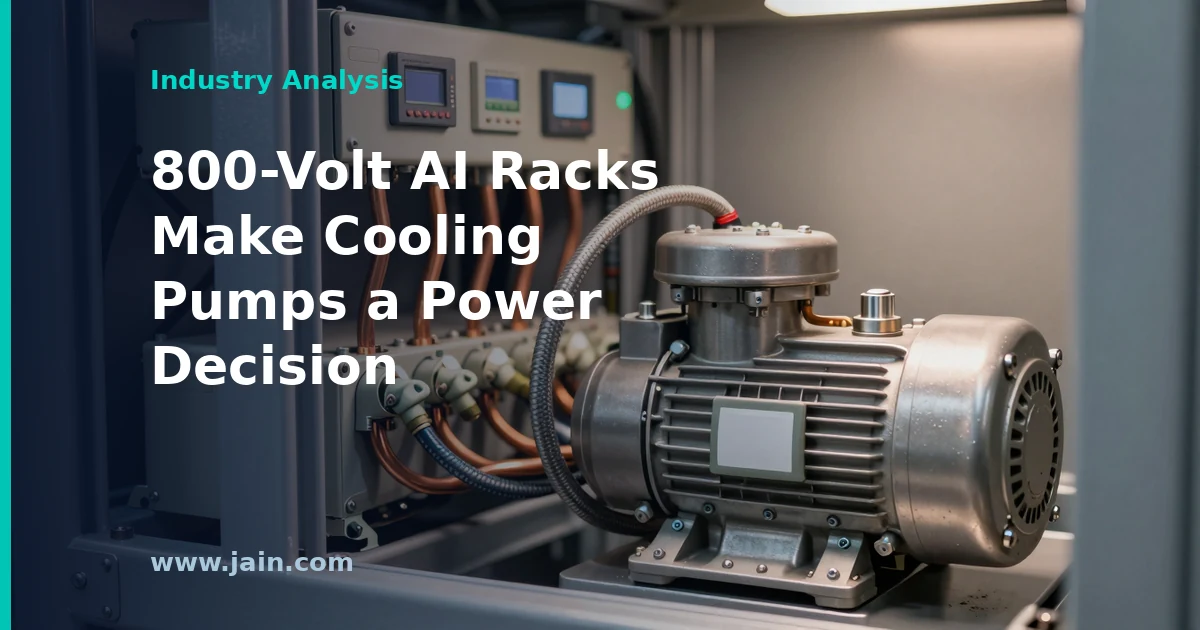
On November 16, 2026, Aviemore Motion Technologies announced in a PR Newswire release that it has launched a line of seal-less magnetic coupling pumps for liquid-cooled AI and high-performance computing, unveiled at the SC26 supercomputing conference in Chicago. Each pump ships with its motor and drive as one assembly under a single part number, covering 0.10 to 5.0 kW of output across a 12 to 800 V DC power range.
The Radford, Virginia company is offering rack coolant distribution unit (CDU) pumps rated 0.10 to 2.0 kW, row and facility pumps rated 1.0 to 5.0 kW, and co-engineered OEM versions. It says the design is patent-pending and is aimed at AI racks moving from 54 V DC to 800 V DC power, with the first commercial 800 V DC systems expected in the second quarter of 2027.
Executive Summary
Aviemore is entering the data center cooling market with a pump that removes the shaft seal, the point where a spinning shaft passes into the coolant and where wear and leaks typically begin. Torque instead crosses a sealed barrier through a magnetic coupling, and a slotless brushless DC motor and drive are built into the same unit. The company’s pitch is that CDU builders source, qualify and service one component instead of three.
The more consequential part of the launch is the voltage range. Aviemore says AI racks draw 140 kW today, with 240 kW racks close behind and 600 kW to megawatt-class racks in planning, and that power inside the rack is moving to 800 V DC. Pumps that sit in or beside those racks draw from the same electrical supply, so the shift in power architecture reaches the cooling hardware too. Aviemore is betting that a pump able to run natively on an 800 V DC bus becomes a requirement rather than a feature.
What the release establishes is the product range, the design approach and the company’s manufacturing footprint. What it does not establish is field reliability for the new pump line, efficiency data, pricing, named customers or shipment volumes, so the launch is best read as a credible design thesis that buyers will still need to qualify.
Why 800 Volts Reaches All the Way to the Pump
The case for higher rack voltage is basic electrical physics. For a fixed amount of power, current falls as voltage rises, and moving from 54 V DC to 800 V DC cuts current by roughly fifteen times. Lower current means thinner conductors and less energy lost as heat in the wiring, which matters when Aviemore expects racks to climb from 140 kW today toward 240 kW and eventually megawatt-class designs. The release says the first commercial 800 V DC systems are expected to ship in the second quarter of 2027.
That transition does not stop at the servers. In-rack and sidecar CDUs, the units that circulate coolant between the chips’ cold plates and the building’s water loop, sit inside or beside the rack and need power from somewhere. If the rack’s native supply is 800 V DC, a pump motor can run on it directly, sit behind a converter that steps the voltage down, or be fed from a separate supply. Each option changes the space required, the number of parts, the conversion losses and how the system behaves when something faults. That is the mechanism behind the headline: the pump’s electrical specification gets fixed when the rack power architecture is chosen, not after the cooling loop is designed.
The people affected are CDU manufacturers, who must qualify pumps against a voltage their earlier designs never saw, and the integrators and operators who will have to service them. The scale also deserves perspective. Aviemore’s rack pumps top out at 2.0 kW, under 1.5 percent of a 140 kW rack, so the argument for native 800 V operation rests less on energy savings than on space, parts count and simpler integration. Aviemore has not published efficiency figures comparing native operation with a converter-fed alternative, which is the data that would settle how much the approach is worth.
Removing the Seal Targets a Known Wear Point
A shaft seal is the component that keeps fluid from escaping where a rotating shaft enters a pump’s wet end, and Aviemore calls it the most common point of wear in a coolant pump. Its design passes torque through a magnetic coupling across a non-contact barrier, leaving no dynamic seal and no wear item in the fluid path. The company also says the pumps can run dry during commissioning or after a loss of prime, two situations it identifies as common causes of early pump failure. For closed cooling loops, where the same coolant circulates continuously, eliminating a leak path supports the goal of keeping that loop sealed.
The design logic is sound, but the reliability evidence offered is indirect. The release cites more than 15,000 of the company’s slotless motors shipped with zero motor defects and two decades of earlier pump designs still in service at hyperscale operators. Those figures describe the team’s track record and its motor technology, not the field performance of this new pump line. Buyers will also want data on the trade-offs specific to magnetic couplings, such as torque limits under transient loads, alongside the mean time between failures figures the release does not provide.
A Speed Argument Against an Established Supply Base
Aviemore’s sharpest competitive claim concerns development speed. It argues that most data center pumps come from manufacturers that adapted designs from other industries, still pairing a shaft seal with a bolt-on motor and a third-party drive, on development cycles measured in years while AI rack designs change annually. Aviemore says it can turn custom changes in weeks because winding, machining, assembly and test all happen in its 156,000 square foot Radford facility.
Vertical integration can plausibly shorten iteration cycles, and a single part number does reduce the qualification burden for CDU builders. The claim to weigh is whether weeks-long turnaround holds once volumes rise and multiple OEM programs run in parallel. Established suppliers bring installed bases, global service networks and long qualification histories, advantages that matter to operators for whom a pump failure means throttled or idle compute. The release describes products as UL and Intertek certifiable on request rather than listing certifications already granted, so compliance timing is another variable for early adopters.
Background
Liquid cooling has moved from niche to necessity in AI data centers because modern accelerators concentrate so much power in a small space that air cannot carry the heat away efficiently. Supercomputing was among the first fields to adopt direct liquid cooling, and the rack densities it pioneered are now reaching AI facilities. In these systems, coolant distribution units and their pumps run continuously, making the pump a component every rack depends on.
Aviemore Motion Technologies is a Radford, Virginia manufacturer whose team, by its account, has worked together for more than 25 years and designed patented pumps for the past 20. It works with Intertek on testing, Virginia Tech on research, and the Virginia Economic Development Partnership and GO Virginia on regional industry growth. The launch arrives as the industry prepares for 800 V DC rack power, a transition that affects every component drawing electricity inside the rack. Source: Aviemore Launches Seal-Less Magnetic Coupling Pump Platform for Liquid-Cooled AI Data Centers — Aviemore Motion Technologies’ announcement of its pump, motor and drive platform for 800 V DC and megawatt-class AI racks.Sources