
TL;DR · 30-second read
The Short Version
Core Scientific, a company best known for bitcoin mining that now builds and rents out data centers (warehouses full of computers), has asked for permission to put up a $1.3 billion building near Dallas.
Chipmaker AMD plans to rent space on the same site using 110 megawatts of electricity, roughly what tens of thousands of homes draw.
The paperwork went in just before a local freeze. In the race to build for artificial intelligence, getting permits filed early is now part of winning the customer.
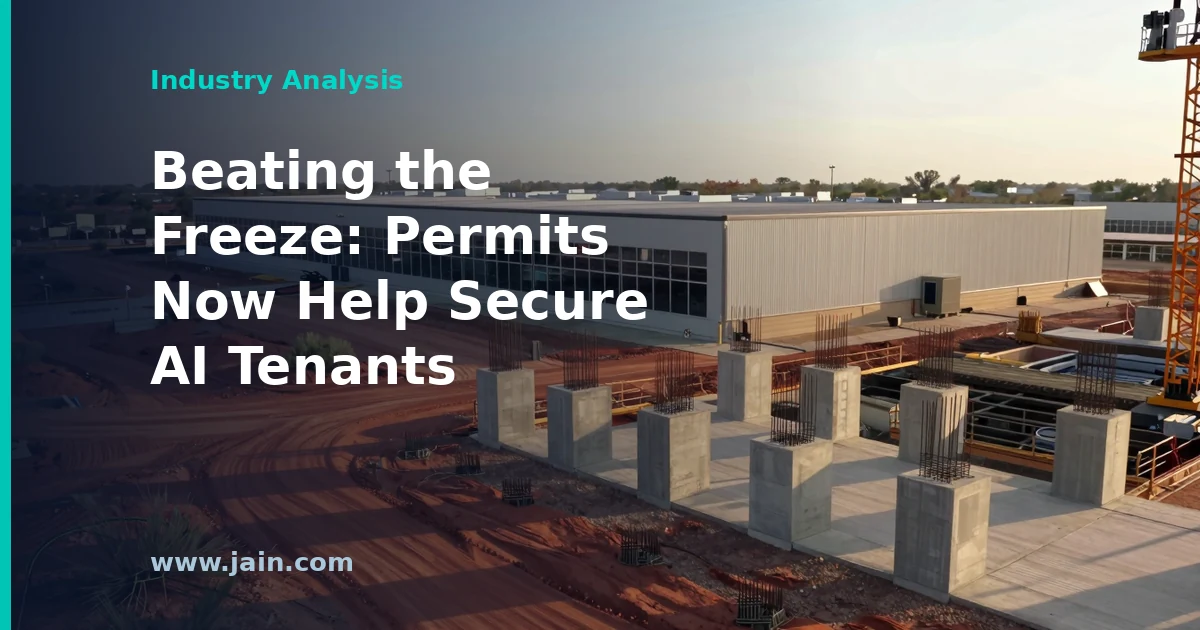
Core Scientific has filed for a $1.3 billion data center building near Dallas at the campus where AMD plans to lease 110 megawatts of capacity, FourWeekMBA and MLQ.ai reported. FourWeekMBA said the filing was made before what it called the Hinojosa freeze, a local freeze affecting the area.
The filing lands days after a separate AMD milestone: in an 8-K/A filed November 16, AMD told investors it closed its roughly $8.2 billion all-stock acquisition of World Labs Technologies on November 13, issuing 14,978,322 shares of common stock to World Labs’ former stockholders.
Executive Summary
Core Scientific, the Nasdaq-listed bitcoin miner turned AI hosting provider (ticker CORZ), has put a $1.3 billion data center building into the approval process near Dallas. The site is the campus where AMD plans to lease 110 megawatts (MW), a scale that places it among the larger single-tenant AI deployments a chip company has taken on directly rather than through a cloud provider.
The detail that matters most is timing. The application went in ahead of a local freeze, which means the project entered the system under the rules that existed before the freeze. For a developer trying to land and hold an AI tenant, that is not paperwork; it is part of the product. A tenant like AMD is buying a delivery date, and a filed application is evidence the date is achievable.
What the filing does not do is settle the larger questions: whether AMD’s lease is signed, how the $1.3 billion is financed, and how 110 MW of power will be delivered on the Texas grid. Those remain open and are the variables that will decide whether this becomes a working AI campus on schedule.
The Permit Has Become Part of the Lease
AI tenants do not lease buildings so much as dates: the quarter when capacity is energized, cooled and ready to accept racks of accelerators. Every step between a signed term sheet and that date runs through local approvals, and a freeze halts the clock for any project that has not yet filed. Core Scientific’s $1.3 billion application, lodged ahead of the freeze, keeps its building in the queue that AMD’s planned 110 MW depends on. A competing site without a filed application, in the same jurisdiction, could not make the same promise until the freeze lifts.
Texas law generally reinforces the value of filing first. Chapter 245 of the Texas Local Government Code ties most development projects to the regulations in force when the first permit application is filed, a principle developers call vesting. How much protection that provides here depends on how the freeze is written, and Core Scientific has not publicly said whether it views the project as vested. Still, the commercial logic is clear: a filed application converts a tenant’s risk from “will this be allowed?” to “how fast can it be built?”
That is the operational conclusion for anyone developing AI capacity. Permitting is moving from a back-office task to a commercial term that sits beside power and price in tenant negotiations. Temporary local pauses on large data center approvals have appeared in several US communities in recent years, and one filing in one jurisdiction is not proof of a statewide trend. But developers holding land near Dallas without filed applications now carry a timing risk that Core Scientific, on this building, appears to have reduced.
A Chipmaker Becomes a Tenant
AMD is best known for selling chips, including its Instinct accelerators, to the cloud providers and AI labs that fill data centers. Planning to lease 110 MW itself puts AMD on the other side of the table, as a direct buyer of the power and floor space its own products consume. That is a meaningful shift in how a chip vendor participates in AI buildout: owning or controlling compute rather than only supplying it.
AMD’s recent filings give context, though not an explanation. Its November 16 8-K/A confirms the closing of the World Labs acquisition, priced at roughly $8.2 billion in stock and settled with 14,978,322 new shares on November 13. Acquiring an AI developer gives AMD in-house workloads that need compute. AMD has not connected World Labs to the Dallas-area capacity, and readers should not assume the two are linked. The narrower, supportable point is that AMD now has more than one reason to want capacity under its own control.
For Core Scientific, a second marquee AI name would matter. Its first large AI hosting contracts, signed in 2024, were with CoreWeave, and a single dominant customer is a concentration risk. A signed lease with AMD would diversify that base; a planned one that slips would not.
What $1.3 Billion Buys, and What It Does Not
If the $1.3 billion building were to house the full 110 MW, the arithmetic would work out to roughly $11.8 million per megawatt. Neither company has said the building covers all of AMD’s planned capacity, however, and campuses of this size are often delivered in several structures and phases. The figure is best read as the value of one approved-for-review building, not the total cost of AMD’s deployment.
A permit application also says nothing about electricity. A site near Dallas sits on the ERCOT grid, and Texas Senate Bill 6, enacted in 2025, added interconnection requirements for new large loads of 75 MW or more, a threshold 110 MW clears comfortably. Securing that grid connection, and the substation and transmission work behind it, is a separate timeline from the building permit and frequently the longer one.
The risk profile, then, is uneven. Core Scientific appears to have secured its place under pre-freeze rules for the building. Power delivery, financing and the final shape of the AMD lease are the variables that still determine whether the capacity arrives when an AI tenant needs it.
Background
Core Scientific built its business as one of the largest bitcoin miners in the United States, filed for Chapter 11 bankruptcy protection in December 2022 and emerged in January 2024. That year it signed 12-year contracts to host AI computing for CoreWeave, beginning a shift from mining toward high-performance computing hosting. CoreWeave later agreed to acquire Core Scientific in an all-stock deal, but Core Scientific shareholders voted it down in October 2025, leaving the company independent and seeking additional AI tenants.
AMD, based in Santa Clara, California, designs processors and AI accelerators that compete for spending from cloud providers and AI labs. In September 2026 it agreed to acquire World Labs Technologies for approximately $8.2 billion in stock, a deal it closed on November 13, 2026. Texas, and the Dallas area in particular, has become one of the most active US markets for large data center development, which has also drawn closer scrutiny from local governments and grid planners. Source: Core Scientific Files $1.3B AMD Build Before Hinojosa Freeze (FourWeekMBA), on Core Scientific’s $1.3 billion building filing ahead of a local freeze; and Core Scientific files for a $1.3 billion data center building near Dallas at the campus where AMD plans to lease 110 megawatts (MLQ.ai). Primary sources: Advanced Micro Devices, Form 8-K/A filed November 16, 2026, confirming the November 13 closing of the World Labs acquisition and the issuance of 14,978,322 shares.Sources