
TL;DR · 30-second read
The Short Version
Amazon is selling three-quarters of 13 brand-new data center buildings in Indiana and Mississippi to an investment fund run by Blackstone. The deal values the buildings at $5 billion, and Amazon will rent them back for at least 12 years.
The buyer collects about $350 million in rent in the first year, roughly 7 cents for every dollar the buildings are worth. That matters for Digital Realty and Equinix, the two biggest data center landlords on the stock market. Their shares are priced as if investors will accept much smaller returns, so they now have to keep growing fast to justify that price.
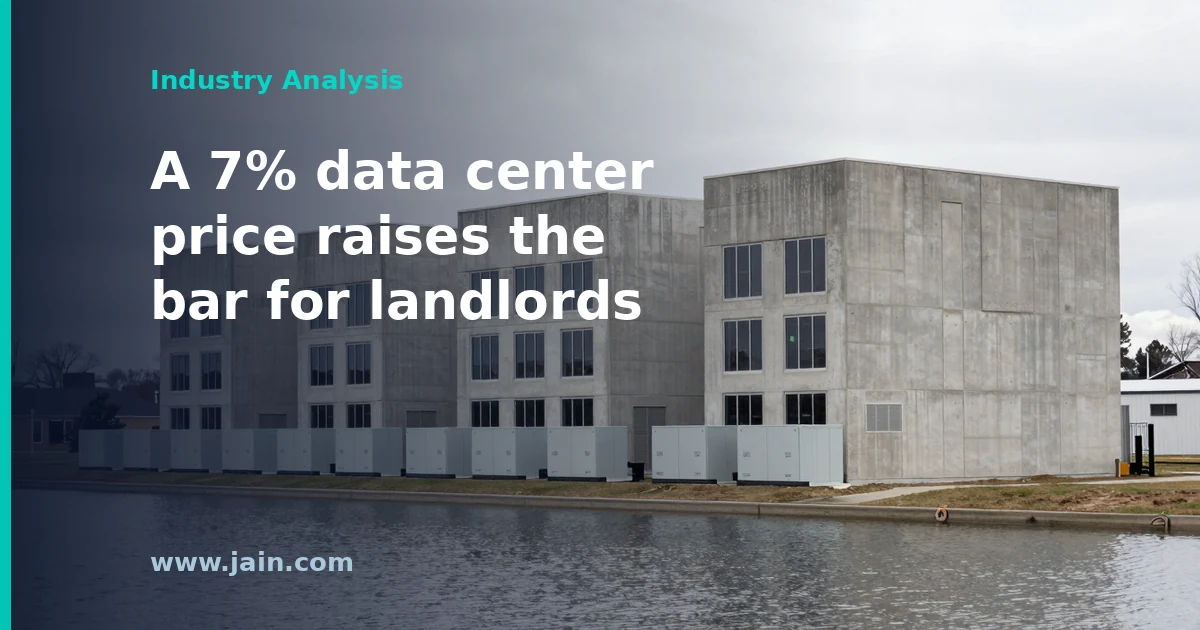
Blackstone Digital Infrastructure Trust (BXDC) announced on November 16 that it had agreed on November 11 to buy 75.1% of two joint ventures that own 13 newly built “powered shells” (data center buildings with their power connections in place) on Amazon Web Services campuses in northern Indiana and Mississippi. The portfolio is valued at $5 billion at a 7.0% initial cap rate, TIKR reported. Amazon keeps 24.9% and leases all 13 buildings back for 12 years, extendable to 32, with rent rising 2.75% a year and guaranteed by Amazon.com.
BXDC is contributing $1.9 billion, and the joint ventures are borrowing about $2.5 billion of non-recourse debt, meaning lenders can claim only the buildings, not the owners behind them. Amazon will receive an undisclosed minimum payout at closing.
Executive Summary
The transaction gives Amazon a way to fund its data center build-out without issuing more bonds: sell most of a finished building, keep a minority stake, and rent it back. Amazon expects roughly $220 billion of capital spending this year, has sold more than $92 billion of bonds in 2026, and analysts expect its free cash flow to swing from a positive $11.2 billion in 2025 to a $40.5 billion outflow in 2026, staying negative through 2027.
The larger consequence lands on listed data center landlords. A 7% cap rate means a buyer pays about $14.30 for every dollar of first-year net rent. Digital Realty trades at 22.8 times forward adjusted funds from operations (AFFO, a cash-earnings measure used for real estate investment trusts), a far richer multiple. The deal gives investors a reference price for hyperscaler-leased data center real estate, and the gap between that price and the landlords’ share prices has to be covered by growth.
The comparison is less severe than the headline 7% suggests, because a cap rate is measured before debt and these shells are simpler assets than the fully operated facilities Digital Realty and Equinix run. Even on a like-for-like basis, though, a gap of roughly 12% to 20% remains.
Amazon Turns Finished Buildings Into Funding
A sale-leaseback converts an owned building into cash plus a rent obligation. Here, the obligation is concrete: 7% on $5 billion implies roughly $350 million of first-year rent, escalating 2.75% a year for at least 12 years and guaranteed by Amazon.com. In exchange, Amazon recycles capital out of buildings it has already finished and into the ones it has not. Because it retains a 24.9% stake, it also keeps exposure to the buildings’ value.
Measured against Amazon’s spending, the deal is small: $5 billion is the portfolio’s value, not Amazon’s proceeds, and the whole portfolio equals about 2% of this year’s expected capital expenditure. The significance is the channel rather than the size. Amazon has already sold more than $92 billion of bonds in 2026, and a sale-leaseback taps a different pool of capital, real estate investors seeking long, creditworthy leases. With an AWS backlog of $578 billion cited by CEO Andy Jassy on October 29, the company has a long runway of buildings that could be financed this way.
Why Digital Realty and Equinix Now Have to Out-Grow a 7% Benchmark
The mechanism is yield comparison. Digital Realty’s 22.8x forward AFFO multiple, near its five-year average of 22.4x, equates to an AFFO yield of about 4.4%. Short seller Jim Chanos argued on X that a 7% cap rate would value both landlords “all materially lower than where they trade today.” That straight comparison overstates the gap, because a cap rate is calculated before borrowing costs. The fairer yardstick is the one BXDC CEO Nick Pell supplied: a going-in AFFO yield in the low-to-mid-5% range. Applied to Digital Realty, a 5.0% to 5.5% yield implies a multiple of about 18x to 20x, or 12% to 20% below where the stock trades.
That residual gap is what growth has to justify, and so far growth has been there. On October 29, Digital Realty raised its 2026 core FFO guidance to $8.30 to $8.35 a share, nearly 13% above 2025. A day earlier, Equinix raised guidance for the third straight quarter, to AFFO of $43.71 to $44.11 a share, up 14% to 15% as reported. Compare that with the Amazon leases’ 2.75% annual escalator: investors are paying a premium for the landlords because their earnings compound several times faster than a fixed-escalator lease.
The pressure point is what happens if that growth slows. Before this deal, there was no clean public price for a long, hyperscaler-guaranteed data center lease. Now there is one. If either landlord’s growth decelerates, investors can point to a 12-year, Amazon-guaranteed asset yielding low-to-mid 5% after debt and ask why they should accept 4.4%. That affects more than shareholders: a REIT’s share price is also its cost of equity, which governs how cheaply it can fund new campuses. Fairness requires the other side too. Powered shells are buildings and power hookups, while Digital Realty and Equinix operate complete facilities with many customers, interconnection services and operating expertise, which can reasonably command a different multiple.
Two Funding Routes, One Capital Market
The landlords are also active borrowers. In an 8-K filed November 9, Equinix disclosed that a subsidiary had issued €2.5 billion of senior notes in four tranches maturing from 2028 to 2038, at coupons from 4.150% to 5.450%, guaranteed by Equinix and earmarked for eligible green projects. After hedging, Equinix said the 2035 notes carry an effective all-in rate of 4.91%. The filing illustrates the conventional route: a landlord borrows in the bond market and builds or buys. Amazon’s deal illustrates the alternative: the tenant builds, then sells most of the building to a financial owner that borrows against the lease.
The supply of the second kind of deal could be large. Of 586 gigawatts of planned North American data center capacity reviewed by Bernstein, it counted 199 gigawatts as credible, with Amazon’s 33 gigawatts the most of any company, more than eight times Digital Realty’s 4 gigawatts. Pell told Bloomberg the transaction “creates a roadmap to do more such deals with hyperscalers or developers,” and BXDC sees hyperscaler-leased data centers as a $1 trillion market by 2030. If even part of that pipeline comes to market, investors would have a growing set of transaction prices against which to measure listed landlords.
One Price, Thirteen Buildings
A single transaction does not set a market. This is one portfolio, on two campuses, with one tenant, structured as a joint venture in which the seller keeps a stake and provides the lease guarantee. Those features likely shaped the price, and a different tenant, location or lease length could clear at a different number.
The tests are near-term and observable. BXDC’s next transactions will show whether 7% is a repeatable price or a one-off, and both landlords’ 2027 guidance will show whether their growth premium is holding. Until then, the deal is best read as a new reference point, not a verdict.
Background
Digital Realty and Equinix are the two largest publicly listed data center landlords. Both are real estate investment trusts (REITs), companies that own income-producing property and distribute most of their earnings to shareholders. They lease space, power and connectivity to cloud providers, enterprises and network operators, and investors value them on multiples of AFFO, the cash-earnings measure used for REITs.
Hyperscalers, the largest cloud operators such as Amazon Web Services, increasingly build their own campuses. A sale-leaseback lets such a company sell a finished building to a financial investor and rent it back, turning a completed asset into cash for the next project. Blackstone Digital Infrastructure Trust’s agreement with Amazon applies that structure to newly built AWS data center shells. Source: Amazon Sold $5 Billion of Data Centers at a “7% Cap Rate.” That’s a Big Problem for Digital Realty and Equinix (TIKR.com) — details of Blackstone Digital Infrastructure Trust’s $5 billion AWS data center shell transaction and its valuation implications for listed data center landlords. Sources