
TL;DR · 30-second read
The Short Version
Intel says its new data center chip, the D270, ran certain financial calculations up to 5.9 times faster than a rival card from Nvidia, the company that dominates chips for artificial intelligence.
The catch: Intel ran the tests itself, on early versions of the chip, against an Nvidia card that was never built for that kind of math. On the artificial intelligence tasks it tested, Intel’s edge was about 12 percent.
The stronger pitch is plentiful, easier-to-get memory and a card rated to draw about 40 percent less electricity. Intel has not said what it costs or when it ships.
MLQ.ai reported that Intel on November 16 published the first benchmark results for the GPU D270, its data center accelerator code-named Crescent Island, at the SC26 supercomputing conference in Chicago. Intel says a single 350-watt D270 delivered up to 5.9 times the throughput of Nvidia’s 600-watt RTX PRO 6000 Blackwell Server Edition on double-precision financial workloads, and 1.12 times the output tokens on an AI inference test using the Qwen3-30B-A3B model.
The results are Intel’s own, measured on pre-production silicon. Customer sampling began in October; Intel has not announced pricing or general availability.
Executive Summary
Intel’s headline claim is a 5.9x lead over Nvidia’s RTX PRO 6000 on a European Monte Carlo options-pricing test, with 5.6x on European Black-Scholes, 4.6x on binomial pricing and 1.92x on American Black-Scholes. All four run in FP64, or double precision: 64-bit arithmetic used when small rounding errors would compound into wrong answers, as in financial and scientific simulation. On the two AI inference tests, which run in the far lower-precision FP8 format, the gains narrowed to 1.12x more output tokens on Qwen3-30B-A3B and up to 29% lower latency on a workload Intel identifies as Drex v2.0.
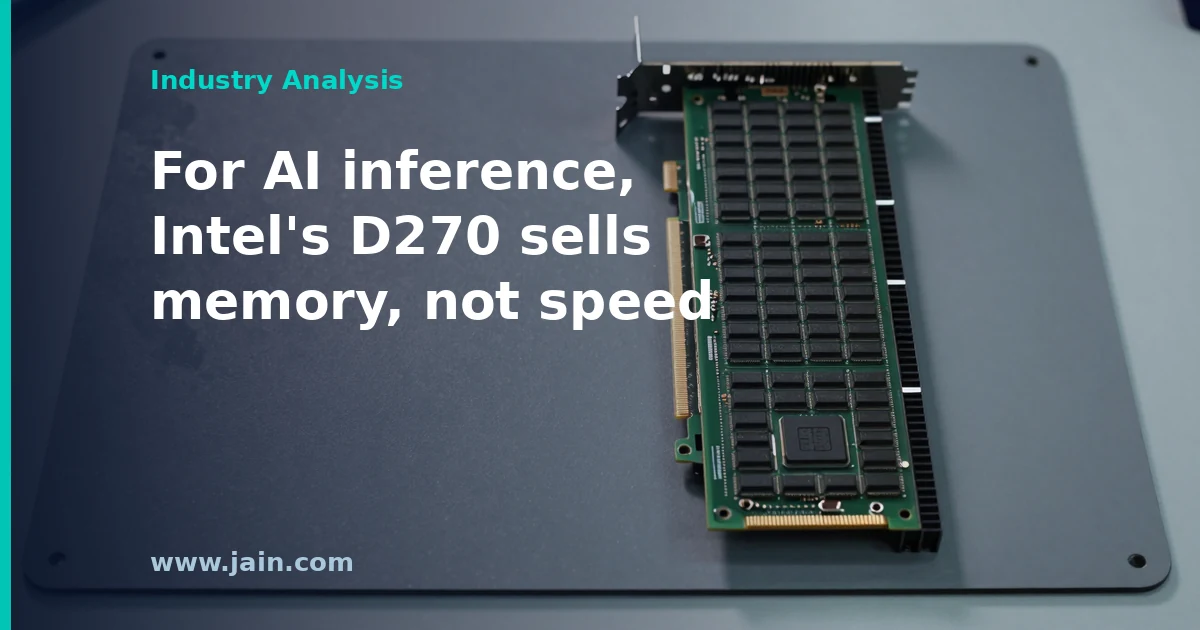
That split matters for anyone buying hardware to serve AI models. The big multiples come from an architectural choice — Intel built the D270 for full-rate double precision, while the Nvidia card it chose as a comparison runs FP64 at a small fraction of its single-precision speed. For inference, the more consequential specifications are memory and power: 160GB of LPDDR5X memory instead of the scarce stacked HBM on most AI accelerators, in an air-cooled PCIe card rated at 350 watts.
Whether that is enough to pull inference buyers toward a second supplier depends on things Intel has not yet disclosed, starting with price, shipping dates and performance on production silicon.
The 5.9x Is a Double-Precision Story
The largest numbers in Intel’s post all come from options-pricing workloads — the kind of math banks and trading firms use to value derivatives — run in FP64. Intel says each of the D270’s 32 Xe cores performs 64 FP64 fused multiply-add operations per cycle (a fused multiply-add is a multiplication and addition done as one step, the basic unit of most numerical work), which it calls full-rate double precision. The RTX PRO 6000, by contrast, uses the same GB202 chip as the GeForce RTX 5090 gaming card, which runs FP64 at a small fraction of its single-precision rate.
So the 5.9x figure largely measures a design priority rather than a general speed advantage. It is a legitimate result for quantitative-finance and high-performance computing (HPC) buyers who need double precision and want it in a 350-watt, air-cooled card. But Intel did not test against Nvidia’s dedicated HPC and data center parts, which are the products those buyers would actually weigh the D270 against. The comparison establishes that the D270 beats a graphics-derived workstation card at FP64; it does not establish where the D270 ranks among HPC accelerators.
The test setup adds further caveats. Intel’s footnotes describe one D270 in a single-socket Xeon 6741P server against an Nvidia server holding eight RTX PRO 6000 cards, without saying how many of the eight were used or whether results were normalized per card. The financial tests compared Intel’s SYCL code with the better of Nvidia’s CUDA or SYCL versions, which is a reasonable attempt at fairness, but how much each code path was tuned is not described.
For AI Inference, the Number Is 1.12x — and the Pitch Is Memory and Power
On the workloads that matter to AI buyers, Intel’s own numbers are modest: 1.12 times the output token throughput on Qwen3-30B-A3B in FP8, and up to 29% lower latency on Drex v2.0. Intel ran the Nvidia card for both inference tests on an Amazon Web Services EC2 g7e virtual machine rather than on bare metal, a configuration that can add overhead to the comparison card. A 12% throughput edge, measured that way, on pre-production silicon, is not by itself a reason to re-platform an inference fleet.
The D270’s stronger case for inference sits in its specification sheet. Most AI accelerators use HBM, or high-bandwidth memory — DRAM dies stacked directly beside the processor, which is fast but supply-constrained. The D270 instead carries 160GB of LPDDR5X, the low-power memory used in laptops and phones, with 1.5 TB/s of bandwidth, and Intel says partner boards can carry up to 480GB. Large memory capacity determines how big a model, and how many simultaneous user sessions, a single card can hold. Intel’s recent 23-company Korean alliance pitches the D-Series on exactly that basis: an inference card that avoids scarce HBM.
The trade-off is bandwidth, which HBM-based parts generally offer in greater measure, and Intel’s SC26 demo reflects it. Intel is showing D270 cards handling prefill — the compute-heavy first stage of inference, where the model reads the user’s prompt — while SambaNova SN50 chips handle decode, the token-by-token generation stage that leans hardest on memory bandwidth. Add a 350-watt rating against the RTX PRO 6000’s 600 watts, an air-cooled PCIe 5.0 form factor, and Jon Peddie Research’s description of the D270 as putting inference in ordinary racks, and the operational audience comes into focus: enterprises and colocation operators with conventional air-cooled racks and fixed power budgets, and buyers whose plans are gated by HBM supply rather than by peak speed.
Benchmarks Alone Will Not Move Inference Buyers
For an organization weighing a second supplier, the decisive variables are performance per dollar, performance per watt on production silicon, delivery dates and software effort. Intel has supplied a rated power figure but none of the rest: no price, so cost per token cannot be estimated, and no general availability date. Vendor-run results on pre-production chips routinely move once production parts reach independent testing, in either direction.
Software is the larger switching cost. Nvidia’s CUDA programming platform is the default for AI and HPC code, and moving off it is where diversification efforts usually stall. Intel’s most concrete evidence on this front is a seismic imaging mini-application with Viridien, which Intel says was ported from HIP and CUDA to SYCL in less than a month, with 90% of kernels running well without Intel-specific tuning and complex kernels reaching up to 70% of theoretical peak on the first port. That is a useful porting data point, though Intel gave no speed comparison for it.
Buyers are also reading this week’s news about the incumbent. In an 8-K filed November 12, Nvidia disclosed that Jensen Huang resigned as president, chief executive and director effective November 11, with CFO Colette Kress named interim CEO while the board searches for a successor and Harvey C. Jones appointed the board’s first-ever chair. Nvidia’s announcement said the board expects the company’s “operations, customer commitments and product roadmap to continue without interruption,” and kept its third-quarter fiscal 2027 results on schedule for November 17. Neither development changes the benchmark arithmetic above; procurement decisions on accelerators turn on roadmaps, supply and software over multi-year horizons.
Background
Nvidia dominates the market for data center accelerators, the specialized chips that train and run AI models, helped by its CUDA software platform, which most AI and scientific code is written for. Intel, best known for Xeon server processors, has been working to establish a competing accelerator line. It named the D270 at the OCP Global Summit in October 2026, began customer sampling that month, and recently formed a 23-company Korean alliance to promote its D-Series as an inference card that avoids HBM.
Inference — running a trained model to answer queries — is a growing share of AI computing, and it rewards different trade-offs than training: memory capacity, power efficiency and cost per answer often matter more than peak speed. Nvidia, meanwhile, is in a leadership transition following Jensen Huang’s November 11 resignation, with CFO Colette Kress serving as interim CEO. Source: Intel says its D270 data center GPU beats Nvidia’s RTX PRO 6000 by up to 5.9 times in first benchmarks — MLQ.ai’s report on Intel’s first published D270 benchmark results at SC26. Primary sources: NVIDIA Corporation Form 8-K, filed November 12, 2026 (CEO resignation and board appointments); NVIDIA Announces CEO Transition, Exhibit 99.1 to Form 8-K, November 12, 2026.Sources