
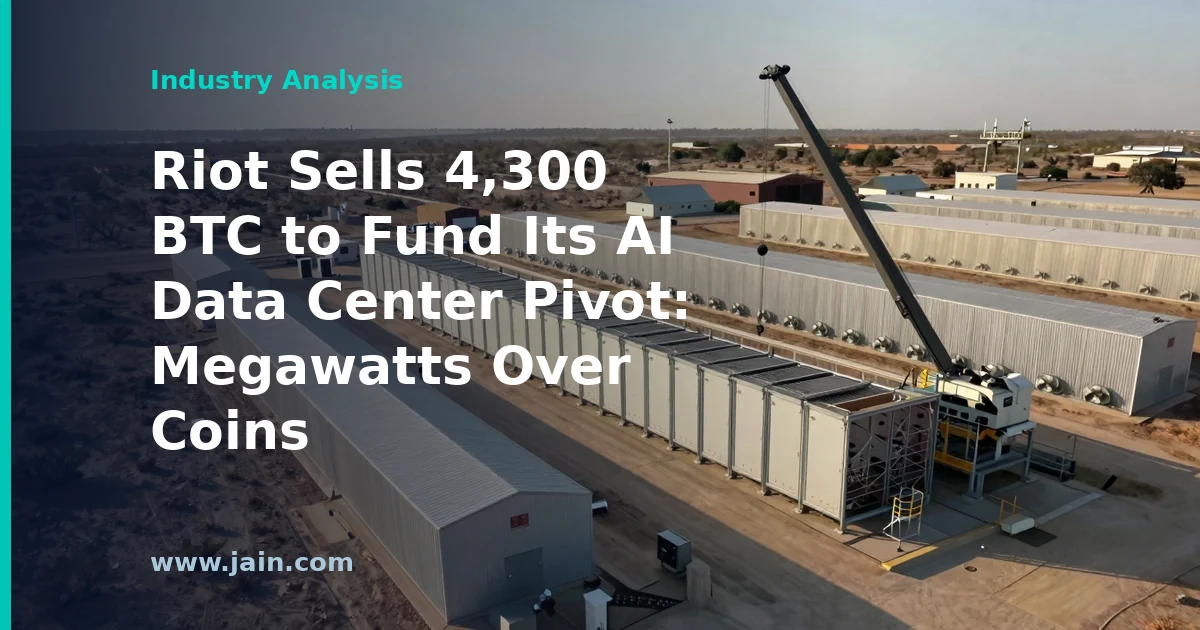
Bitcoin miner Riot has sold 4,300 BTC from its treasury to help fund the buildout of AI data center capacity, according to an April 20, 2026 report carried by TradingView. The sale converts a large slice of the company’s signature asset — its Bitcoin hoard — into construction capital for high-performance computing infrastructure.
Executive Summary
The reported transaction is notable less for its mechanics than for what it says about priorities. For years, large public Bitcoin miners treated their mined coins as a strategic reserve — a balance-sheet bet that holding Bitcoin would outperform selling it. Liquidating 4,300 BTC to pour concrete and energize halls for AI workloads inverts that logic: the scarce, appreciating asset Riot is now accumulating is powered data center capacity, not cryptocurrency.
If the report is accurate, Riot joins a growing cohort of miners redeploying their most valuable holdings — power contracts, land, substations, and now treasury coins — toward AI and high-performance computing (HPC) hosting, where demand from AI developers has made grid-connected megawatts one of the most sought-after assets in technology infrastructure.
From Strategic Reserve to Construction Budget
Bitcoin miners’ treasuries were long marketed to investors as a leveraged way to own Bitcoin: the company mines coins, holds them, and shareholders benefit if the price rises. Selling 4,300 BTC to fund a buildout is a deliberate break from that playbook. It says management believes a dollar invested in AI-ready data center capacity will return more than a dollar left sitting in Bitcoin — a striking assessment from a company whose core business is producing Bitcoin.
It is also a pragmatic financing choice. Data center construction is brutally capital-intensive, and the alternatives — issuing new shares, which dilutes existing holders, or borrowing, which adds interest costs and covenants — both carry real drawbacks. A treasury sale is the one funding source that requires no one else’s permission and creates no ongoing obligation. The trade-off is equally real: coins sold today cannot participate in any future Bitcoin rally, and shareholders who bought the stock as a Bitcoin proxy are now holding something different.
Megawatts Are the Scarce Asset Now
The deeper story is why miners are so well positioned for this pivot. AI training and inference clusters need enormous amounts of reliable electricity, and utility interconnections — the formal grid hookups that let a site draw hundreds of megawatts — can take years to secure. Bitcoin miners spent the last decade quietly assembling exactly those assets: large power contracts, energized substations, and industrial sites with cooling and fiber already in place.
That inheritance means a miner can offer AI tenants something hyperscale cloud builders often cannot: capacity that is available soon rather than after a multi-year interconnection queue. In that market, a company’s Bitcoin stack is incidental; its megawatts are the franchise. Riot converting coins into capacity is the cleanest expression yet of that repricing.
The Economics Behind the Pivot
Mining economics have tightened structurally. Bitcoin’s periodic “halvings” cut the block reward — the number of new coins miners earn — in half, which squeezes revenue per unit of computing power unless the Bitcoin price doubles to compensate. AI and HPC hosting offers a very different profile: multi-year contracts with creditworthy tenants, revenue in dollars rather than a volatile asset, and returns tied to utilization instead of a global hash-rate arms race.
But the pivot is not free money. AI hosting is a different business — different cooling densities, different reliability guarantees, different customers with demanding technical requirements — and miners must execute a conversion while incumbents like established colocation providers and hyperscalers expand aggressively. A miner that sells its Bitcoin, builds capacity, and then struggles to sign anchor tenants would have traded a volatile asset for an idle one. Execution, not vision, will decide who wins this transition.
Background
Riot Platforms grew into one of North America’s largest public Bitcoin miners by building power-hungry facilities in Texas, where it locked in substantial electricity capacity — an asset originally acquired to run mining rigs. Beginning around 2024, surging demand for AI computing collided with a shortage of grid-connected data center sites, and miners across the sector began converting or leasing their facilities to AI and high-performance computing tenants. Several of Riot’s peers struck high-profile hosting deals or announced conversions, establishing a template in which a miner’s power portfolio, rather than its coin production, drives its valuation. Riot’s reported treasury sale extends that industry-wide repositioning to the balance sheet itself.
Source: AI Over Bitcoin: Mining Giant Riot Cashes Out 4,300 BTC for Data Center Buildout — TradingView report, April 20, 2026, on Riot’s treasury sale to fund AI data center construction.