
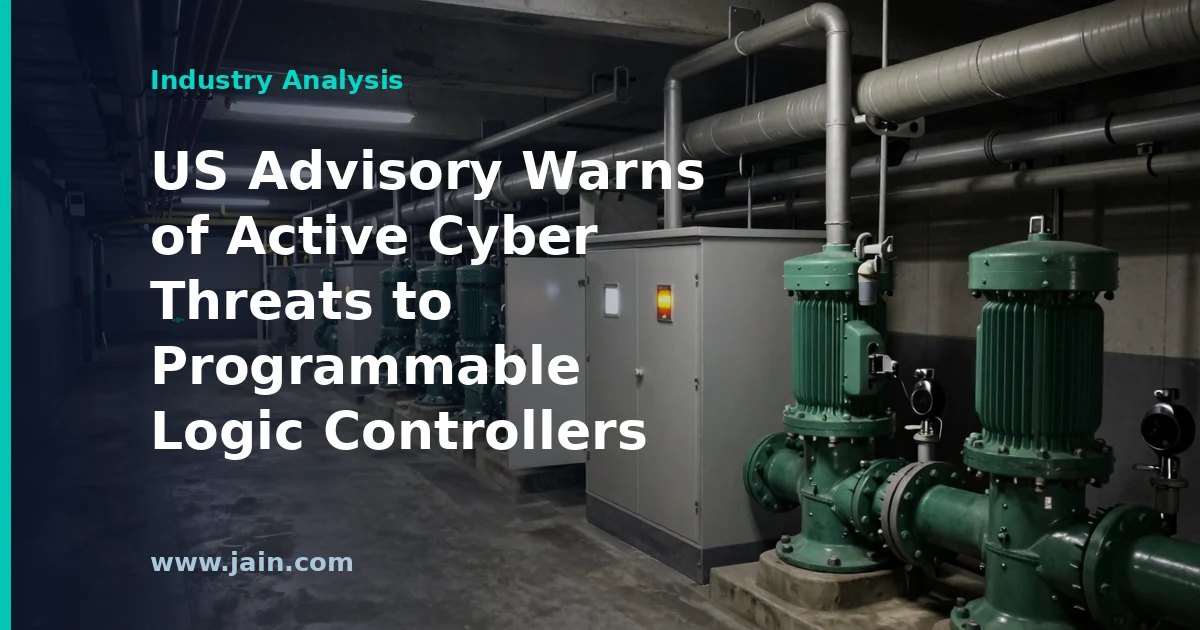
An advisory circulated in the United States on April 24, 2026 — and relayed to the healthcare sector by the American Hospital Association — warns of active cyber threats targeting programmable logic controllers (PLCs), the ruggedized industrial computers that automate physical processes in power systems, water treatment, manufacturing, and building plants.
“Active” is the operative word: the alert concerns ongoing threat activity against operational technology (OT), not a theoretical vulnerability disclosure. Details on specific vendors, exploits, and attributed actors were not included in the headline-level report available at publication time.
Executive Summary
The advisory puts PLCs — devices most executives have never seen but every facility depends on — back at the center of the critical-infrastructure security conversation. A PLC is a small industrial computer that reads sensors and drives equipment: it opens valves, starts pumps, switches breakers, and modulates chillers. When a PLC is compromised, the consequence is not stolen data but altered physical behavior in a plant.
The fact that the American Hospital Association amplified the warning underscores how broad the exposed population is. Hospitals, water utilities, factories, and data centers all run on the same classes of controllers, often installed years ago, sometimes reachable from the internet, and frequently protected by default or weak credentials. For infrastructure operators, the practical significance is less about any single exploit and more about the recurring pattern: US agencies keep finding real adversaries probing the industrial control layer.
Because the underlying advisory text was not available in the source report, this article treats the specifics as open questions and focuses on the well-established context: what PLCs do, why they are attacked, and what asset owners can verify today.
Why PLCs Are the Soft Underbelly of Critical Infrastructure
PLCs were engineered for reliability in harsh environments, not for hostile networks. Many speak industrial protocols such as Modbus that were designed decades ago with no authentication — any device that can reach the controller on the network can often issue it commands. Patch cycles are slow because taking a controller offline can mean halting a production line or a treatment process, so known vulnerabilities persist in the field far longer than in the IT world.
Compounding this, a meaningful number of controllers end up directly exposed to the internet — connected for remote maintenance convenience and then forgotten. Public search engines for connected devices make finding them trivial. That combination of weak-by-design protocols, slow patching, and accidental exposure is why advisories about PLC threats recur: the attack surface changes slowly even as attacker interest grows.
The Data Center Angle: Power and Cooling Run on OT
Data center operators sometimes assume OT warnings are a problem for utilities and factories. They are not. Behind every raised floor sits an industrial control layer — building management systems, chiller plants, cooling towers, computer-room air handlers, switchgear, generator controllers, and fuel systems — much of it orchestrated by PLCs and similar controllers. An attacker who manipulates cooling setpoints or power transfer logic can take down IT workloads without ever touching a server.
The economics cut both ways. Defending OT is genuinely hard: segmentation projects are disruptive, and controller replacement is capital-intensive. But the cost of an OT-driven outage — thermal shutdown, breached availability SLAs, damaged equipment — dwarfs the cost of the basics: knowing what controllers you have, removing them from direct internet reachability, and changing default credentials. Advisories like this one tend to shift that calculus inside customer security questionnaires, so providers with mature OT programs gain a quiet competitive edge.
From Stuxnet to Water Utilities: A Track Record, Not a Hypothetical
PLC attacks have a documented history. Stuxnet demonstrated in 2010 that manipulating controllers can physically destroy equipment. More recently, in late 2023, US agencies warned that attackers had compromised internet-exposed Unitronics PLCs at multiple US water utilities — opportunistic intrusions that exploited exposure and default passwords rather than exotic zero-days. That precedent matters when reading a 2026 alert about “active” threats: history suggests the most common path to a PLC is not sophisticated exploitation but an exposed device with a guessable credential.
The healthcare distribution channel is telling in its own right. Hospitals depend on building automation for air handling, medical gas, and backup power — the same controller ecosystem as everyone else. Sector-agnostic device threats increasingly get sector-specific amplification, which is a reasonable model: the device population is shared, but the operational consequences and remediation resources differ by industry.
Background
Programmable logic controllers date to the late 1960s, when they replaced racks of electromechanical relays in factories, and they remain the workhorse of industrial automation worldwide. Because they were designed for closed plant networks, many industrial protocols carry no authentication or encryption — a legacy that became a liability as plants, buildings, and utilities connected to corporate networks and the internet.
US government warnings about controller-level threats have grown steadily more frequent, spanning water systems, energy, manufacturing, and building automation, with the 2023 wave of attacks on internet-exposed water-utility PLCs a notable recent precedent. For infrastructure operators — including data centers, whose power and cooling plants sit atop this same control layer — the April 2026 advisory is best read as another data point in a sustained trend: the industrial control plane is now a contested space, and basic OT hygiene is the price of admission.
Source: Advisory warns of active cyber threats to programmable logic controllers — American Hospital Association report on a US advisory concerning active threats to industrial PLCs, published April 24, 2026.