
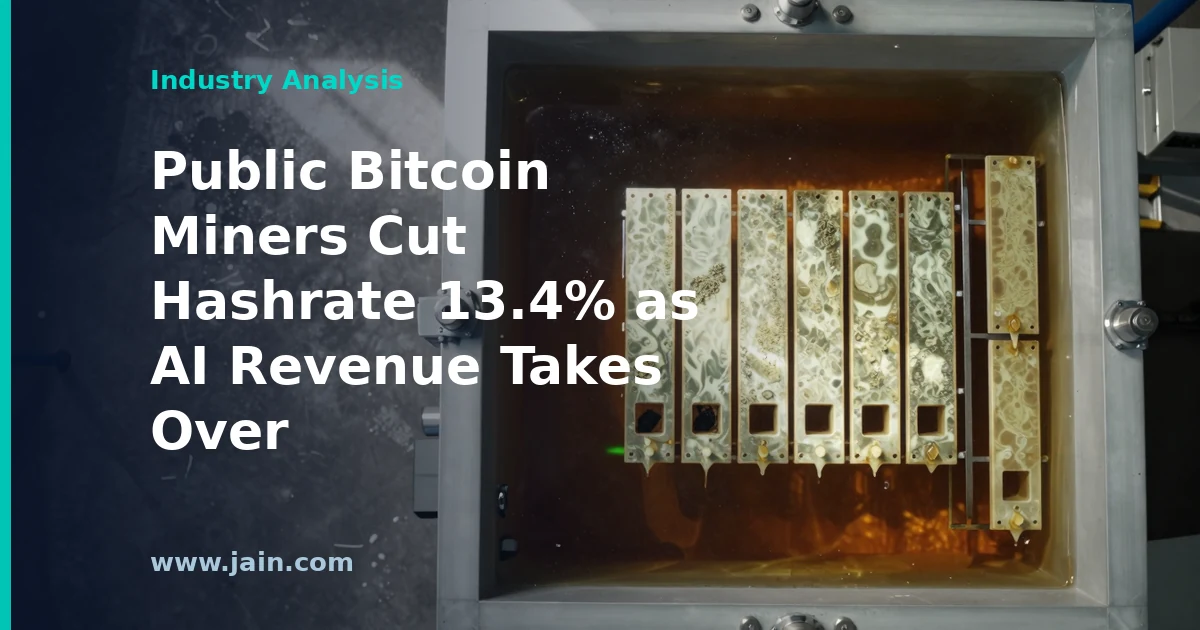
Publicly traded bitcoin mining companies have reduced their collective hashrate — the computational power they dedicate to mining bitcoin — by 13.4%, according to an April 21, 2026 report from Bitbo, a bitcoin data and analytics outlet. The report frames the decline not as distress but as a strategic shift: AI revenue is “taking over” as these companies redirect their power capacity and facilities toward artificial-intelligence computing workloads.
Executive Summary
The headline number is striking because hashrate has historically been the metric public miners competed on. Growing it signaled health; shrinking it signaled trouble. A double-digit collective cut across the public-miner cohort, presented alongside rising AI revenue, suggests the industry’s scoreboard is changing: megawatts under contract to AI customers now matter more to these companies than exahashes pointed at the bitcoin network.
Why it matters: public miners control something AI companies desperately need — large, energized data center sites with utility-scale power already connected. If miners are voluntarily retiring or redirecting 13.4% of their mining compute, that is among the clearest quantitative signals yet that the economics of AI hosting are outcompeting bitcoin mining for the same electrons. The caveat: the source is a single headline figure, and the report as circulated does not detail which companies cut how much, over what window, or how much AI revenue is actually flowing.
The Scoreboard Is Changing From Exahashes to Megawatts
For most of the public mining sector’s history, hashrate growth was the core investor pitch — more machines, more chances to win bitcoin block rewards. A 13.4% collective cut would once have read as capitulation. In 2026 it reads differently: mining rigs are single-purpose machines, but the infrastructure around them — high-capacity grid interconnections, substations, cooling, and permitted industrial sites — is exactly what AI data center developers spend years trying to assemble. Redirecting that capacity to AI tenants converts a volatile commodity business into something closer to contracted data center leasing.
The economic logic is straightforward. Bitcoin mining revenue is unpredictable: it depends on bitcoin’s price, on network difficulty (which rises as competitors add machines), and on halving events — the roughly four-yearly programmed cuts to mining rewards, most recently in April 2024. AI compute hosting, by contrast, is typically sold under multi-year contracts to creditworthy counterparties. Companies in this cohort, including TeraWulf and Riot Platforms, have spent the past two years publicly repositioning themselves as power-rich data center platforms rather than pure-play miners.
Why AI Tenants Want Mining Sites
The binding constraint on AI infrastructure buildout is not chips but power — specifically, energized capacity available now rather than after a five-plus-year utility interconnection queue. Bitcoin miners are among the few industrial operators holding hundreds of megawatts of already-connected capacity that can be reallocated quickly. That scarcity is what makes a miner’s site more valuable as an AI campus than as a mine, at least at the margin the 13.4% figure captures.
Conversion is not free, however. Mining facilities are typically air-cooled sheds built for cheap, fault-tolerant hardware; AI training and inference clusters demand far higher reliability, denser networking, and increasingly liquid cooling. The winners in this transition will be the miners whose sites justify that retrofit capital — large contiguous power blocks, strong fiber routes, cooperative utilities — and who can finance the conversion. Sites without those attributes may find the AI pivot is easier to announce than to execute.
What a Shrinking Public Hashrate Means for Bitcoin
A 13.4% cut by public miners does not mean the bitcoin network shrank by that amount — public companies are only a portion of global hashrate, and private and overseas operators can absorb the share they give up. If total network difficulty holds or falls, remaining miners actually earn slightly more per machine, partially offsetting the exodus. The more durable implication is structural: the best-capitalized, most transparent operators are signaling that the marginal megawatt earns more serving AI workloads than mining bitcoin. If that spread persists, capacity will keep migrating, and bitcoin mining could increasingly concentrate among operators with the very cheapest power and nothing better to do with it.
Background
Public bitcoin miners emerged as a listed-equity sector during the 2020–2021 bull market, raising billions to build warehouse-scale facilities whose defining asset was cheap, large-scale power. The April 2024 halving cut mining rewards in half just as AI demand exploded, and the sector discovered its grid connections were worth more than its mining rigs: Core Scientific’s landmark hosting agreements with AI cloud provider CoreWeave in 2024 established the template, and peers including TeraWulf, Riot Platforms, Hut 8, and Iren followed with AI and high-performance-computing strategies of their own.
By early 2026 the question was no longer whether miners would pivot but how fast and how completely. Aggregate statistics like a 13.4% public-miner hashrate reduction offer one of the first sector-wide measurements of that migration actually showing up in mining capacity, rather than just in investor presentations.
Source: Public Miners Cut Hashrate 13.4% as AI Revenue Takes Over — Bitbo report, April 21, 2026, on the public bitcoin-mining cohort’s shift toward AI compute revenue.