
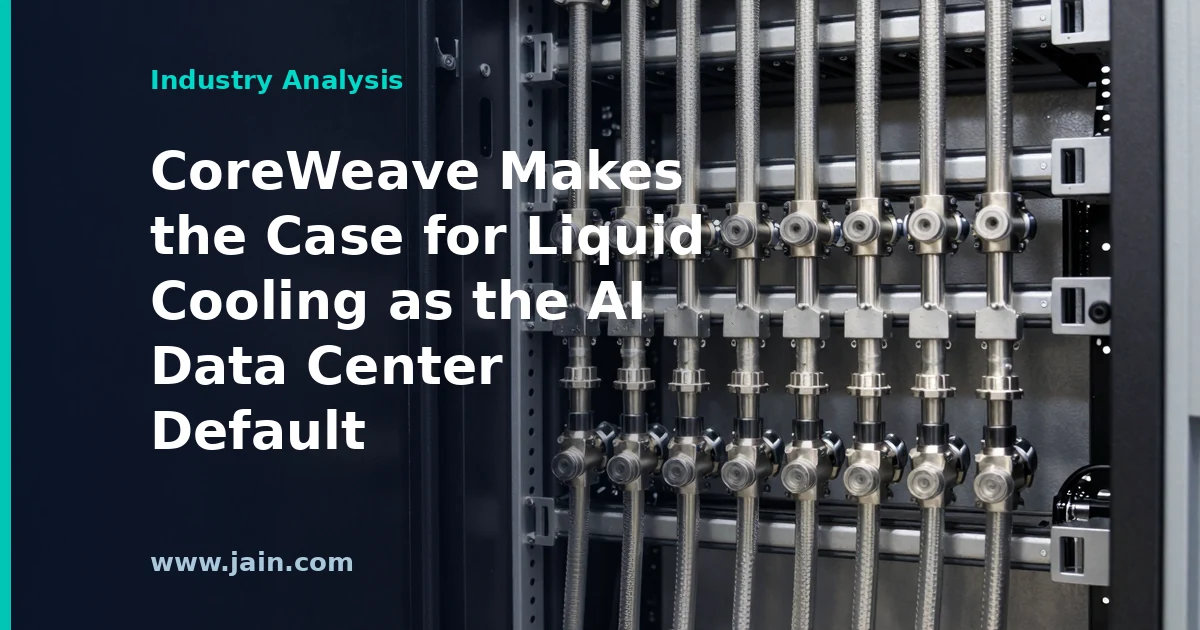
CoreWeave, the AI-focused cloud provider, published a piece titled “Liquid Cooling for AI Data Centers: Run Cold, Act Bold,” making the argument that liquid cooling — circulating fluid directly to or near the chips rather than relying on chilled air — should be treated as the default engineering choice for dense AI training and inference clusters, not a specialty option.
The post, surfaced in early May 2026, is a vendor thought-leadership piece rather than a product or facility announcement: no new sites, capacity figures, or customer commitments accompany it. Its significance lies in who is saying it — one of the largest dedicated AI cloud operators publicly framing liquid cooling as table stakes.
Executive Summary
The core claim is architectural: modern AI accelerators are being packed into racks at power densities that air cooling struggles to serve economically, so operators who standardize on liquid cooling now will deploy the newest hardware faster and run it more efficiently than those who retrofit later. That position aligns with the direction of the hardware itself — flagship AI rack systems from the leading accelerator vendors are increasingly designed around liquid cooling from the outset.
Why it matters: cooling has quietly become one of the binding constraints on AI buildout, alongside power availability and chip supply. A data center designed for traditional air-cooled racks often cannot accept the densest AI systems without significant rework of its mechanical plant, piping, and floor layout. When a major AI cloud provider says liquid cooling is the default, it is effectively telling the colocation and construction ecosystem what the demand side now expects.
For buyers and investors, the practical takeaway is less about CoreWeave specifically and more about the signal: the market for AI capacity is bifurcating between facilities that can support liquid-cooled density and those that cannot, and the gap affects deployment speed, efficiency, and ultimately the cost of delivered compute.
Why Cooling Became the Bottleneck
For most of the data center industry’s history, air cooling was sufficient: racks drew a few kilowatts, and moving enough cold air through the room was a solved problem. AI changed the arithmetic. Training clusters concentrate power-hungry accelerators as tightly as possible to shorten the distances data travels between chips, because interconnect latency and bandwidth directly affect training performance. That pushes rack densities far beyond what conventional air handling was designed for, and at some point the physics favors liquid — water and engineered fluids carry heat far more effectively than air.
CoreWeave’s framing of liquid cooling as a default rather than an exception reflects where the hardware roadmap already points. The densest current-generation AI rack systems are engineered for direct liquid cooling, meaning operators who want the newest silicon at full density have limited choice. In that sense the post is less a prediction than a description of a constraint the industry is already living with — but stating it as doctrine matters, because much of the world’s existing data center stock was not built for it.
The Economics: Efficiency Versus Retrofit Cost
The business case for liquid cooling rests on two ledgers. On the operating side, liquid systems can reduce the energy spent on cooling itself — a meaningful lever, since cooling is typically one of the largest non-IT loads in a facility, and every watt saved on cooling is a watt available for revenue-generating compute in power-constrained markets. On the capital side, however, liquid cooling requires piping, coolant distribution units, leak management, and often structural changes, which is straightforward in a new build and expensive in a retrofit.
That asymmetry is the strategic subtext of a piece like this. Operators that standardized early on liquid-ready designs can absorb each new accelerator generation with incremental changes; operators with large air-cooled footprints face a harder choice between costly conversion and ceding the densest workloads. CoreWeave, which built its business specifically around GPU infrastructure for AI, has an obvious interest in emphasizing a criterion where purpose-built AI clouds hold an advantage over general-purpose incumbents — which does not make the underlying engineering argument wrong, but readers should recognize the alignment between the message and the messenger.
Winners, Losers, and the Supply Chain Ripple
If liquid cooling is the default, the beneficiaries extend well beyond AI clouds. Suppliers of coolant distribution units, cold plates, piping, and heat-rejection equipment see their addressable market expand from a niche to a standard line item in every AI facility. Colocation providers with liquid-ready halls gain pricing power for AI tenants; those without face pressure to invest. Engineering and construction firms with liquid-cooling experience become scarcer resources in an already stretched buildout.
The risk side deserves equal attention. Liquid cooling adds mechanical complexity — leaks, coolant chemistry, maintenance procedures — into environments that prize uptime above almost everything. Standardization across vendors is still maturing, which raises the possibility of stranded investment if designs shift between hardware generations. And efficiency gains at the rack level do not eliminate the larger constraint: many AI projects today are gated by grid power availability, a problem no cooling technology solves on its own.
Background
CoreWeave began as a cryptocurrency mining operation before pivoting to GPU cloud computing, and rode the generative AI boom to become one of the largest providers of dedicated AI infrastructure, going public in 2025. Its business model — building or leasing data centers purpose-designed for dense GPU clusters and renting that capacity to AI developers — makes facility engineering choices like cooling central to its competitive position.
The broader industry context: for decades, air cooling dominated data centers because rack power draws were modest. The AI era reversed that, with accelerator racks reaching power densities that favor liquid-based heat removal, and the latest flagship AI rack systems are designed for liquid cooling from the factory. That has turned cooling from a back-of-house mechanical detail into a strategic differentiator in the race to deploy AI capacity.
Source: Liquid Cooling for AI Data Centers: Run Cold, Act Bold — CoreWeave, a vendor blog post arguing for liquid cooling as the default architecture for dense AI clusters.