
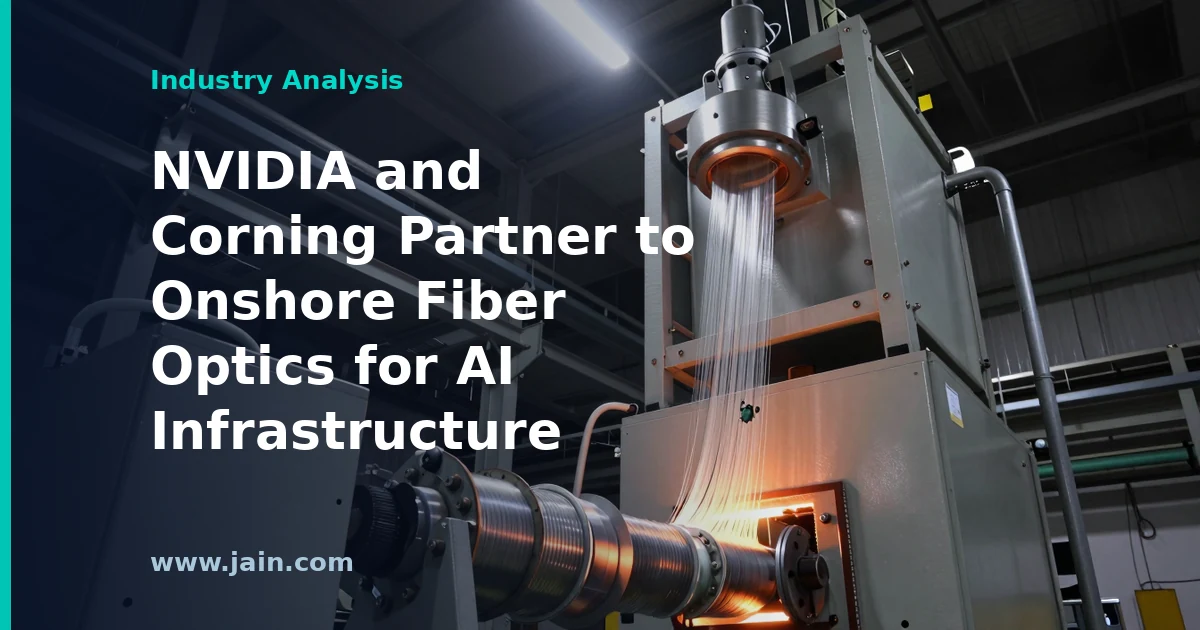
NVIDIA and Corning announced a long-term partnership on May 5, 2026, aimed at strengthening US manufacturing for AI infrastructure, according to a release published through the NVIDIA Newsroom. The tie-up pairs the dominant supplier of AI accelerator chips with the company that invented low-loss optical fiber and remains America’s leading producer of it.
The announcement, as distributed, is headline-level: it frames the partnership around domestic manufacturing capacity for the optical components AI data centers consume, but the source text does not disclose financial terms, volumes, or specific facilities.
Executive Summary
The partnership signals something the AI build-out has made increasingly clear: the constraint on giant GPU clusters is no longer just chips. Modern AI data centers are, in a real sense, optical networks with computers attached — tens of thousands of processors stitched together by fiber links, each rack consuming far more optical connectivity than a traditional cloud facility. A chipmaker locking arms with a glass and fiber manufacturer is a recognition that the network fabric is now part of the product.
For Corning, a long-term relationship with the largest buyer-influencer in AI infrastructure offers the kind of demand visibility that justifies factory investment. For NVIDIA, it extends a broader pattern of shoring up US-based supply for the components its platforms depend on. For everyone else — data center operators, competing optics suppliers, and policymakers pushing domestic manufacturing — the deal is a marker of where the AI supply chain is consolidating.
What it is not, at least based on what the release makes public, is a quantified commitment. Without disclosed dollars, volumes, or timelines, the announcement is directionally significant but not yet measurable.
Why AI Data Centers Are Suddenly a Fiber Story
Training and running large AI models requires connecting thousands of GPUs so tightly that they behave like one machine. Every one of those connections — between chips, between servers, between rows of racks — increasingly runs over optical links, because light through glass fiber carries far more data over distance than copper wire can. The result is that an AI facility consumes multiples of the fiber, optical transceivers, and cable assemblies of a conventional data center of the same size.
That is why an announcement between a semiconductor company and a materials manufacturer makes strategic sense. NVIDIA sells not just chips but entire cluster architectures, and those architectures are only as deliverable as their weakest supply line. Optical connectivity has repeatedly been a pinch point during the AI build-out, and securing it upstream is cheaper than discovering a shortage downstream.
Onshoring the Optical Supply Chain
The release’s framing — “strengthen US manufacturing” — places the deal squarely in the broader push to bring strategic component production back to American soil. Optical fiber and cable production is a global industry, and US policymakers have treated domestic capacity for critical infrastructure inputs as a national priority. A long-term partnership with an anchor customer is the classic mechanism for making onshoring economics work: manufacturers hesitate to build domestic capacity without demand certainty, and buyers hesitate to depend on capacity that does not yet exist. Pairing off resolves both hesitations at once.
The trade-offs are real, though. Domestic manufacturing can carry higher costs than established overseas supply chains, and new capacity takes time to ramp. Whether this partnership changes the market depends on execution details the announcement does not provide — how much capacity, where, and by when.
What It Means for Corning and the Competitive Field
Corning brings unusual credibility to this role: it invented low-loss optical fiber in 1970 and has manufactured it in the United States for decades. A durable relationship with the central player in AI infrastructure gives it a privileged position in the fastest-growing segment of the optical market, and demand visibility that can underwrite capital spending shareholders might otherwise question.
For competing fiber and optical component makers, the signal is more mixed. When anchor customers and suppliers pair off, remaining demand becomes more contestable but also more volatile. And for data center operators and enterprises buying connectivity, the second-order effect is worth watching: supply assurance for NVIDIA-aligned deployments could tighten availability elsewhere if overall capacity does not grow as fast as the partnership implies.
Reading the Announcement Critically
Corporate partnership announcements span a wide spectrum — from binding, take-or-pay purchase agreements to memoranda of understanding with no enforceable commitments. The source material here, distributed as a headline through a news aggregator, does not establish where on that spectrum this deal sits. No dollar figures, product mix, facility plans, or hiring numbers are cited in what was published.
That does not make the announcement empty; both companies have reputations and existing US manufacturing footprints that lend it weight. But readers should treat the strategic direction as substantiated and the scale as unproven until either company attaches numbers — in capital expenditure disclosures, earnings commentary, or facility announcements — that can be verified against it.
Background
Corning, founded in 1851, is one of America’s oldest materials-science companies; its researchers invented low-loss optical fiber in 1970, the breakthrough that made modern telecommunications and the internet physically possible. It remains the leading US manufacturer of optical fiber, cable, and connectivity solutions for telecom carriers and data centers. NVIDIA, whose graphics processors became the workhorses of the AI boom, has grown into the central supplier of AI computing platforms and has increasingly emphasized building out US-based manufacturing for the infrastructure surrounding its chips.
The partnership lands amid a historic wave of AI data center construction, in which optical networking — once a background utility — has become a recognized bottleneck, and amid a sustained US policy push to onshore manufacturing of strategically critical technology components.
Source: NVIDIA and Corning Announce Long-Term Partnership to Strengthen US Manufacturing for AI Infrastructure — NVIDIA Newsroom release, May 5, 2026, announcing a long-term US manufacturing partnership for AI infrastructure optics.