
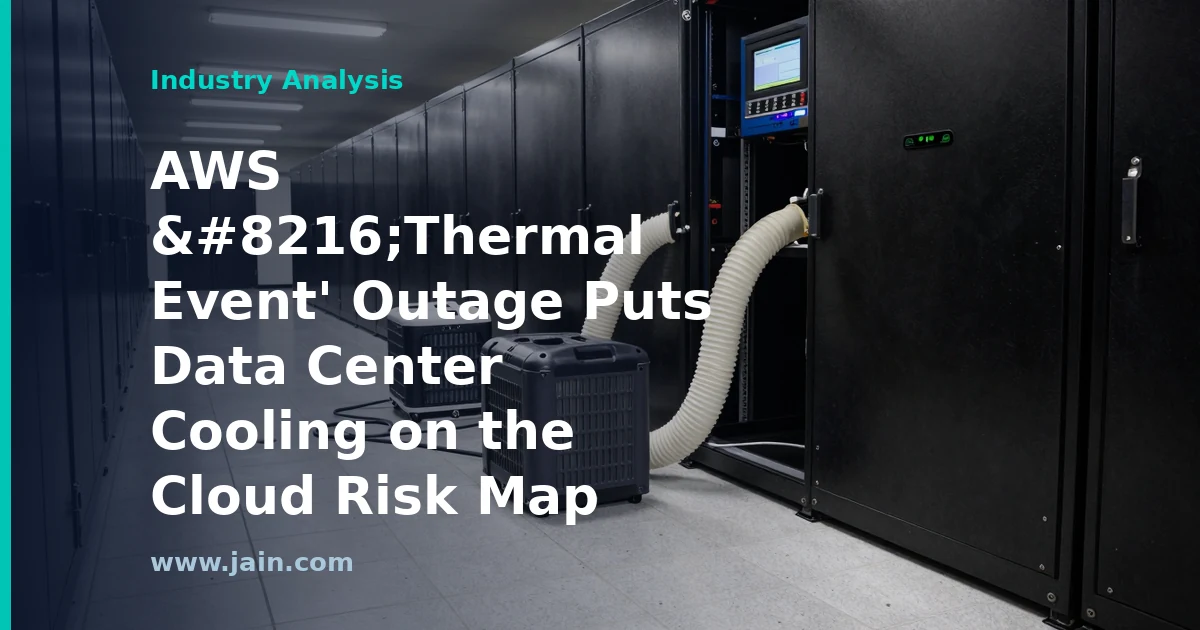
Amazon Web Services suffered a data center outage that the company attributed to a “thermal event,” according to a May 9, 2026 report from CRN. At the time of the report, some AWS services were still impacted, indicating recovery was ongoing rather than complete when the cause was disclosed.
The disclosure was notably spare: the phrase “thermal event” confirms a cooling- or heat-related failure inside an AWS facility, but the public reporting available at publication did not detail which region was hit, how many customers were affected, or how long full restoration would take.
Executive Summary
The world’s largest cloud provider experienced a facility-level outage traced not to software, networking, or a cyberattack, but to heat. A “thermal event” is industry shorthand for a situation in which a data center’s cooling systems can no longer remove heat as fast as the IT equipment produces it, forcing servers to throttle or shut down to protect themselves. That this occurred at AWS — an operator with deep engineering resources and decades of operational experience — is the story.
It matters because the physics of cloud computing are changing. Modern servers, especially those built for artificial intelligence workloads, draw far more power per rack than the equipment data centers were designed around a decade ago, and every watt consumed becomes heat that must be removed. Cooling has quietly moved from a background utility to one of the most consequential single points of failure in cloud infrastructure.
For enterprises, the incident is a prompt to treat facility-level physical risk — cooling and power, not just software bugs — as a first-class input to cloud architecture and continuity planning. For the industry, it is a data point in a pattern: as densities rise, thermal margins shrink, and the cost of a cooling failure grows with every server packed into the room.
What a ‘Thermal Event’ Actually Means
Data centers are, at their core, heat-management machines. Every server converts electricity into computation and, unavoidably, into heat; chillers, cooling towers, air handlers, and increasingly liquid-cooling loops carry that heat away. When any link in that chain fails — a chiller trips, a pump loses power, a control system misbehaves, or outside conditions exceed design assumptions — temperatures inside the data hall can climb within minutes. Servers respond by throttling performance and then shutting down to avoid permanent damage.
The phrase “thermal event” confirms the failure mode without revealing the failure cause. It could reflect mechanical breakdown, a power interruption to cooling equipment, a controls fault, or environmental stress. Each has different implications for how preventable the incident was, and the public reporting at the time did not say which applied. What the phrase does establish is that physical infrastructure, not code, took cloud services down — a category of failure that no amount of software redundancy inside a single facility can fully paper over.
Why Cooling Is Now a Top-Tier Reliability Risk
For most of the cloud era, the outages that made headlines were logical: configuration errors, DNS problems, cascading software failures. Cooling rarely featured because thermal margins were generous — racks drawing a few kilowatts left plenty of headroom. That headroom is disappearing. AI accelerators and dense compute have pushed rack power demands up sharply across the industry, and higher density means a cooling interruption becomes critical faster, with less time for operators to respond before equipment protection kicks in.
The economics cut both ways. Operators pack facilities densely because space, power, and capital are expensive, but density concentrates risk: one cooling plant now underpins far more revenue-generating compute than it once did. The industry’s shift toward liquid cooling addresses heat removal at the chip level yet introduces new mechanical dependencies — pumps, loops, coolant distribution units — each a component that can fail. The engineering trend line points one direction: thermal management is becoming more complex precisely as the tolerance for its failure shrinks.
The Customer’s Dilemma: Redundancy Is a Design Choice, Not a Default
Cloud providers, AWS included, architect their platforms around Availability Zones — physically separate facilities within a region — precisely so that a single-building failure like a thermal event need not become a customer outage. But that protection only applies to workloads customers have deliberately architected to span zones, and the fact that “some services” remained impacted when CRN reported suggests the blast radius extended beyond any one customer’s choices.
The practical lesson for buyers is uncomfortable but familiar: the shared-responsibility model extends to physical risk. Enterprises that treat a single cloud region — or a single zone — as infinitely reliable are making an implicit bet on someone else’s chillers. Incidents like this one argue for testing failover paths rather than assuming them, and for asking providers harder questions about facility-level dependencies that sit beneath the abstractions. It also strengthens the case, for the most critical workloads, of multi-region or hybrid designs whose costs were once hard to justify.
Transparency as a Competitive Variable
Two words — “thermal event” — carried the entire public explanation at the time of the report. That is consistent with how hyperscalers typically communicate mid-incident, and there are defensible reasons for early caution: root causes genuinely take time to establish. But the information asymmetry is real. Customers making architecture and procurement decisions cannot weigh a risk they cannot see, and cooling-plant design, maintenance posture, and thermal headroom are precisely the details cloud providers disclose least.
How AWS follows up matters more than the initial phrasing. The company has historically published detailed post-event summaries for major incidents, and a substantive account of what failed and what will change would convert this outage into usable information for the market. Absent that, enterprises are left to price the risk blind — and the industry loses a chance to learn from a failure at one of its most sophisticated operators.
Background
Amazon Web Services, launched in 2006, is the largest cloud infrastructure provider in the world, operating dozens of regions composed of multiple Availability Zones — physically separate data center facilities engineered so that a failure in one need not take down the others. Enterprises, governments, and a large share of the consumer internet run on its platform, which is why even partial AWS disruptions ripple widely and draw immediate scrutiny.
Data center cooling, meanwhile, has shifted from a background utility to a strategic constraint across the industry. Rising rack power densities — accelerated by the AI buildout — have pushed operators toward higher-capacity cooling designs, including liquid cooling, while simultaneously narrowing the time margin between a cooling interruption and equipment shutdown. Facility-level physical failures now sit alongside software faults among the principal threats to cloud availability.
Source: AWS Data Center Outage Caused By ‘Thermal Event,’ Some Services Still Impacted — CRN’s May 9, 2026 report on an AWS facility outage attributed to a cooling-related failure, with some services still recovering at publication.