
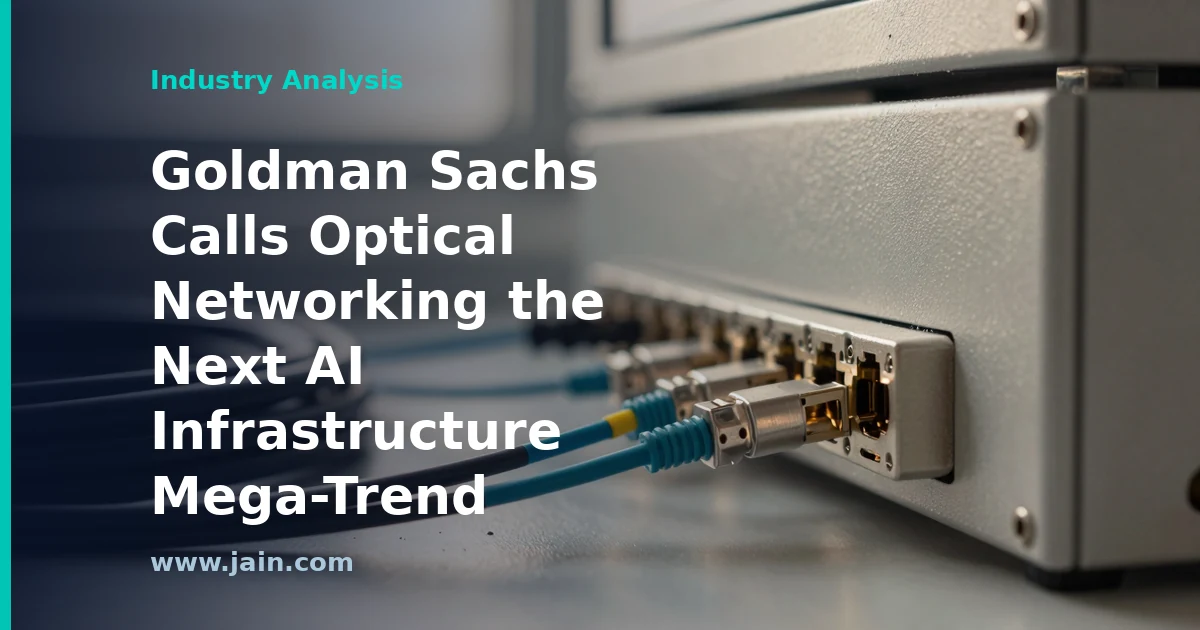
Goldman Sachs has identified optical networking as the next mega-trend in AI infrastructure, according to a report headline published May 12, 2026. The thesis, as framed in the headline, is that the networks stitching together AI compute clusters are becoming a defining investment theme as those clusters scale beyond what traditional electrical interconnects handle comfortably.
Executive Summary
The announcement itself is brief: a major investment bank is elevating optical networking — moving data as light over fiber rather than as electrical signals over copper — from a component-level niche to a headline infrastructure theme. That framing matters because analyst ‘mega-trend’ designations tend to shape where institutional capital, corporate strategy decks, and procurement attention flow next.
The underlying engineering logic is well established even where the report’s specifics are not public. Modern AI training clusters connect thousands of accelerators that must exchange enormous volumes of data continuously; interconnect bandwidth, latency, and power draw increasingly gate cluster performance as much as the chips themselves. Copper’s practical reach shrinks as data rates climb, which pushes more of the network — potentially including links inside the rack, not just between racks — toward optics. If Goldman Sachs is correct that this transition is a durable trend rather than a cycle, it has implications for component suppliers, network equipment makers, data center designers, and the operators who buy from all of them.
Why Copper Runs Out of Road
Inside a data center, data moves over two broad media: copper cables carrying electrical signals, and fiber-optic cables carrying light. Copper is cheap, mature, and power-efficient over short distances, which is why it has dominated in-rack connections for decades. But as link speeds climb from 400 gigabits per second toward 800G, 1.6 terabits and beyond, electrical signals degrade over ever-shorter distances — a physics problem, not a manufacturing one. Each speed generation shrinks copper’s usable reach, until links that once comfortably spanned a row of racks struggle to span a single rack.
AI clusters make this acute. Training a large model is a collective effort across thousands of GPUs that must synchronize constantly, so the network is not a peripheral — it is part of the computer. When interconnects bottleneck, expensive accelerators sit idle. That is the structural argument behind treating optical networking as a trend that compounds with AI buildout rather than a one-time upgrade cycle.
Who Stands to Benefit — and Where the Value Concentrates
An optics-heavy buildout touches a long supply chain: laser and photonic component makers, optical transceiver manufacturers (the pluggable modules that convert electrical signals to light and back), switch and networking equipment vendors, fiber and connectivity providers, and the test-and-measurement firms that validate all of it. Emerging architectures such as co-packaged optics — placing the optical conversion directly beside the switch or accelerator silicon instead of at the faceplate — and silicon photonics, which fabricates optical components using chip-manufacturing techniques, could shift value toward semiconductor players if they mature on schedule.
For data center operators and connectivity providers, the trend cuts both ways. Optics can reduce network power per bit at high speeds, a meaningful lever when power is the scarcest resource in the industry. But optical components have historically been a cyclical, margin-volatile business, and transitions between module generations have repeatedly caught suppliers with the wrong inventory. A mega-trend label does not repeal that cyclicality.
Reading an Analyst Call for What It Is
It is worth being clear about what this news is: an investment bank’s thematic designation, as conveyed by a headline, not a technology breakthrough or a customer commitment. The engineering pressures behind the thesis are real and independently observable — hyperscalers have been discussing optical scale-up interconnects publicly for years. But the report’s specifics, including any market-size estimates, timelines, or named beneficiaries, are not in the public source material, and analyst themes can outrun deployment reality. Investors and buyers should treat the designation as a prompt to examine the underlying demand signals — accelerator shipment trajectories, switch port speed transitions, transceiver order books — rather than as evidence in itself.
Background
Goldman Sachs is one of the world’s largest investment banks, and its research designations — from ‘BRICs’ onward — have a history of shaping how institutional investors frame emerging themes. Optical technology, meanwhile, has followed a steady march inward: light replaced copper first in ocean-crossing and long-haul telecom routes, then in links between data centers, then between racks inside them. The open question for the AI era is how far that march continues — whether optics displaces copper inside the rack and eventually alongside the processors themselves.
The backdrop is the largest data center construction wave in history, driven by AI training and inference demand. As hyperscalers and cloud providers commit unprecedented capital to GPU clusters, each layer of the infrastructure stack — power, cooling, silicon, and networking — has taken its turn as the perceived bottleneck and, consequently, as an investment theme.
Source: Optical Networking: The Next Mega Trend in AI Infrastructure — Goldman Sachs, a report headline published May 12, 2026, identifying optical networking as the next mega-trend in AI infrastructure.