
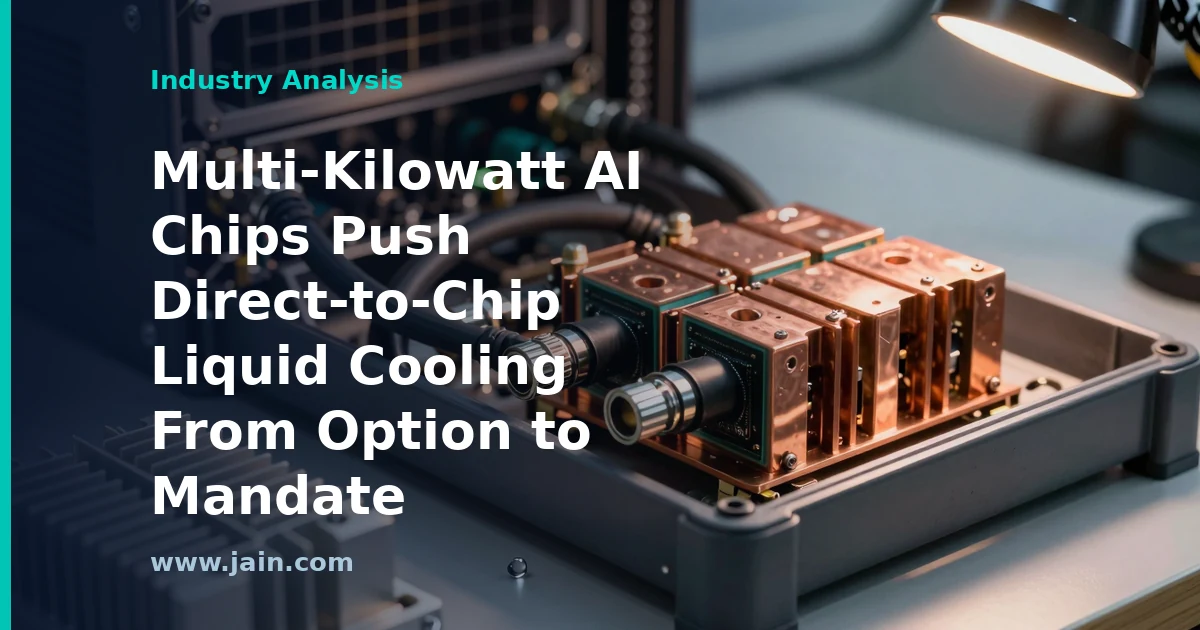
Engineering trade publication Electronics360 published an analysis on May 24, 2026 arguing that direct-to-chip (D2C) liquid cooling — circulating coolant through cold plates mounted directly on processors — has crossed from a design option to a practical requirement, driven by AI accelerator chips whose power draw has reached the multi-kilowatt range per device.
The piece frames this as the end of an era: air cooling, the default thermal strategy for data centers since the industry’s beginning, can no longer keep pace with the heat that flagship AI silicon produces in the small area of a single chip package.
Executive Summary
The core claim is thermodynamic rather than commercial: individual AI processors now dissipate thousands of watts each, and moving that much heat out of a dense rack with air alone requires airflow volumes and temperature differentials that become impractical or impossible at the densities AI clusters demand. Direct-to-chip liquid cooling, which places a liquid-filled cold plate against the chip itself, removes heat far more efficiently because liquids carry heat orders of magnitude better than air.
Why it matters: if D2C is genuinely mandatory rather than optional, every layer of the data-center stack changes — facility design, plumbing, power distribution, rack architecture, maintenance skills, and capital budgets. Operators of existing air-cooled facilities face retrofit decisions, and new builds are being designed liquid-first. For an industry that standardized on air handling for decades, this is a foundational transition, not an incremental upgrade.
Physics Ended the Debate Before the Market Did
Air cooling persisted as the default not because it was elegant but because it was cheap, simple, and universally understood. Its limitation is fundamental: air is a poor heat conductor, so cooling a hotter chip means moving more air, faster, across larger heatsinks. As AI accelerators pushed past one kilowatt per device — with roadmaps pointing well beyond — the heat concentrated in a few square centimeters of silicon began to exceed what any realistic airflow can absorb. Water and engineered coolants transfer heat dramatically more effectively, which is why cold plates bolted directly onto the chip package have become the pragmatic answer.
The word ‘mandatory’ in the source’s framing is worth taking seriously but precisely. Air cooling is not disappearing from data centers generally — the vast installed base of conventional enterprise and cloud workloads runs at rack densities air handles fine. The mandate applies to the frontier: dense AI training and inference clusters built around multi-kilowatt accelerators. That distinction matters for anyone budgeting a transition.
The Retrofit Question Splits the Market
Liquid-first design is straightforward in a new build: coolant distribution units, manifolds, leak detection, and higher floor loading are engineered in from day one. Retrofitting an existing air-cooled facility is harder. Piping must be routed through spaces never designed for it, water supply and heat-rejection capacity must be added, and operations teams must learn to manage a system where a leak — rare but nonzero — sits inches from expensive silicon.
This creates a divergence in asset value across the industry. Facilities that can economically accept liquid cooling — because of their power capacity, structure, and location — become more valuable as AI demand grows. Older facilities that cannot may be relegated to lower-density workloads. Colocation providers, hyperscalers, and enterprise operators are all making that assessment now, and the answers will shape which real estate wins the AI buildout.
A New Supply Chain Rises Around the Cold Plate
A shift of this scale redraws the vendor landscape. Demand moves toward cold plates, coolant distribution units, quick-disconnect fittings, dielectric and water-based coolants, leak-detection systems, and rear-door or facility-level heat exchangers — categories that were niche a few years ago. Established thermal-management and precision-cooling vendors are competing with newer specialists, and chip and server makers increasingly ship liquid-ready designs, effectively deciding the question for their customers.
There is also an efficiency dividend. Because liquid captures heat at the source, less energy is spent on fans and air handling, and the warm coolant leaves at temperatures useful for heat reuse in some settings. For operators facing scrutiny over data-center energy consumption, D2C offers a genuine efficiency story — though it introduces its own considerations around water use and coolant handling that deserve equally honest accounting.
Background
For most of computing history, data centers were cooled the same way: chilled air pushed through raised floors or ducts, across finned metal heatsinks, and back to air-handling units. That model worked because individual chips drew tens or hundreds of watts. The AI era broke the assumption — training and running large models rewards packing the most powerful accelerators as densely as possible, and each generation of AI silicon has raised per-chip power substantially, crossing the kilowatt mark and continuing upward.
Liquid cooling itself is not new; mainframes and supercomputers used water cooling decades ago before commodity air-cooled servers displaced them on cost. What has changed is that the physics that once made liquid cooling a supercomputing niche now applies to mainstream AI infrastructure, pulling a once-specialist discipline back to the center of data-center design.
Source: Multi-kilowatt chips make D2C cooling mandatory — Electronics360 analysis (May 24, 2026) on why multi-kilowatt AI processors are forcing data centers from air cooling to direct-to-chip liquid cooling.