
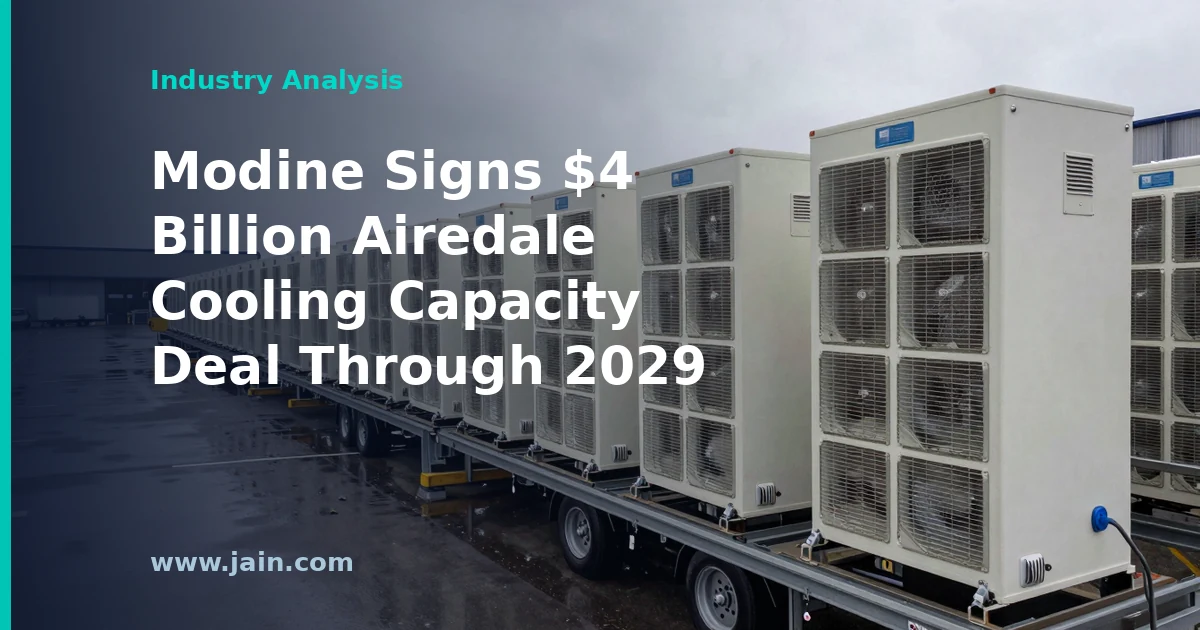
Modine Manufacturing announced a long-term capacity agreement valued at $4 billion, running through 2029, with an unnamed strategic data-center customer for its Airedale by Modine cooling solutions. The announcement was made May 26, 2026 via PR Newswire, which Modine itself characterized as a landmark deal.
Executive Summary
Modine, the Wisconsin-based thermal-management company behind the Airedale precision-cooling brand, says it has secured a long-term capacity agreement worth $4 billion through 2029 with a single strategic data-center customer. “Capacity agreement” is the operative phrase: rather than a conventional purchase order for a defined set of equipment, the customer is effectively reserving a share of Modine’s future manufacturing output for years in advance.
That structure matters more than the headline number alone. Reserving cooling capacity years ahead is the kind of behavior the industry previously reserved for scarce inputs like advanced chips, transformers, and grid interconnection. If cooling equipment now warrants the same treatment, it confirms that thermal management — the systems that remove the enormous heat generated by dense AI computing — has moved from a routine line item to a strategic bottleneck in data-center construction.
Cooling Joins the Reservation Economy
AI data centers concentrate far more electrical power — and therefore heat — into each rack than traditional facilities, and every watt that goes in must be removed as heat. That has strained the supply chains for chillers, computer-room air handlers, coolant-distribution units, and related gear, with lead times for major thermal equipment stretching well beyond what developers were accustomed to. In that environment, a developer that cannot lock in cooling deliveries risks having a building, power, and chips ready with no way to keep the hardware from overheating.
A multi-year capacity agreement is the rational response: the customer trades flexibility for certainty of supply, and the manufacturer trades some future pricing freedom for guaranteed volume. The fact that a single data-center customer is willing to commit at a reported $4 billion scale through 2029 is itself a market signal — it implies that the buyer expects its own construction pipeline to remain heavy for years and considers cooling supply a risk worth paying to retire early.
What Locked-In Volume Does for a Manufacturer
For Modine, the appeal of an agreement like this is visibility. Industrial manufacturers typically expand factories cautiously because demand can evaporate faster than a new production line pays for itself. A multi-year committed customer changes that calculus, giving management cover to invest in capacity, hire, and negotiate with its own component suppliers from a position of predictable demand.
The mirror image is concentration risk. A deal this size with one customer ties a meaningful share of the Airedale business to that customer’s continued buildout. If the buyer’s AI capacity plans slow — or if the agreement contains generous rescheduling or exit provisions, which the announcement does not describe — the guaranteed volume may prove softer than the headline suggests. How much of the $4 billion is firmly committed versus a framework ceiling is the single most important unknown, and it is one investors in similar announcements across the industry have learned to probe.
A Data Point in the AI Infrastructure Debate
Announcements like this land in the middle of a live argument about whether AI infrastructure spending is durable or overheated. Skeptics note that multi-year, multi-billion-dollar commitments amplify the damage if demand disappoints; proponents answer that customers do not reserve factory capacity for years unless their own order books justify it. Both readings can be tested against the same evidence: the disclosed terms.
Here, the disclosure is limited — a value, an end date, and an unnamed customer. That is not unusual for supply agreements, where customers often insist on anonymity, but it means outside observers cannot yet verify the deal’s firmness, product mix, or margin profile. The reasonable conclusion is narrower but still significant: at least one major data-center operator judged cooling supply scarce enough, for long enough, to warrant contracting for it the way the industry contracts for chips and power.
Background
Modine Manufacturing, founded in 1916 in Racine, Wisconsin, built its business on heat-transfer technology — radiators, heat exchangers, and HVAC equipment. Its Airedale brand, rooted in UK-based Airedale International Air Conditioning, specializes in precision cooling for critical facilities, and Modine has repositioned the company in recent years around data-center thermal management as its principal growth engine.
That repositioning coincided with the AI construction boom, which transformed cooling from a routine building system into a supply-constrained input. Data-center operators now contend with multi-year lead times across power and thermal equipment, prompting the kind of long-term capacity reservations that this agreement exemplifies.
Source: Modine Announces Landmark $4 Billion Long-Term Capacity Agreement through 2029 with Strategic Data Center Customer for Airedale by Modine™ Cooling Solutions — PR Newswire announcement, May 26, 2026, distributed via Google News.