
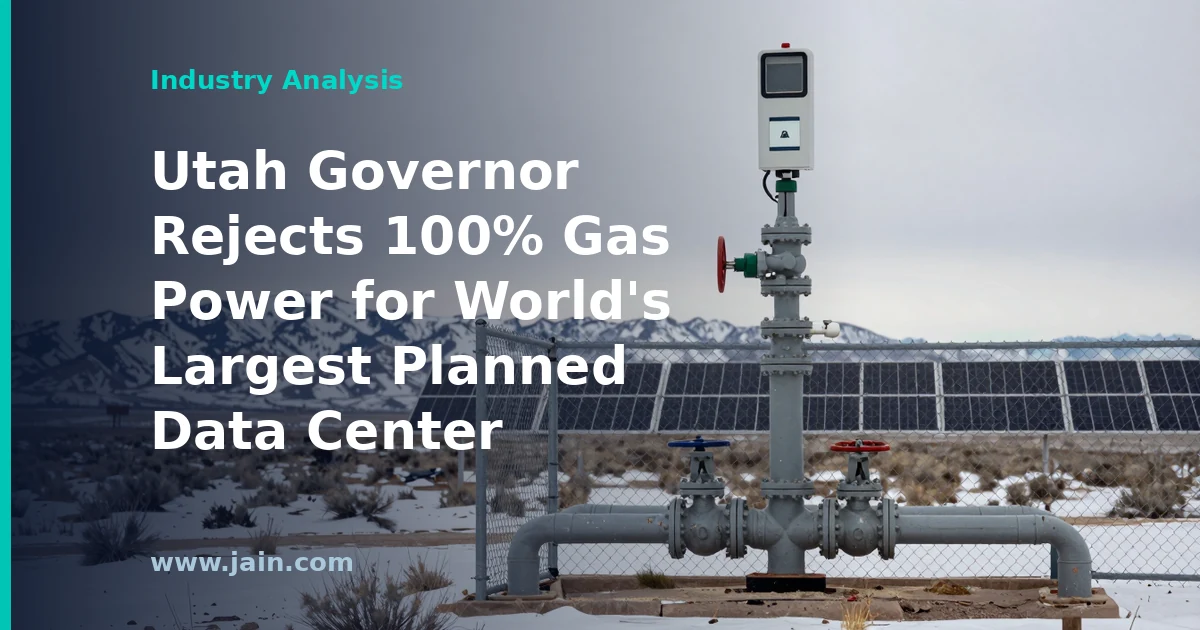
Utah’s Republican governor has publicly rejected plans to run what has been billed as the world’s largest data center entirely on natural gas, declaring the state will “never” accept a 100% gas-fired power plan for the project, according to a report published by the environmental news outlet Grist on May 29, 2026.
The rebuke turns one of the AI era’s biggest proposed construction projects into a test case for a question hanging over the entire industry: when a data center needs power on the scale of a city, who gets to decide where that power comes from?
Executive Summary
According to Grist’s reporting, a data center project described as the largest in the world was planned around a 100% natural gas power supply — and Utah’s governor has now said that will not happen. The report frames a direct collision between a developer’s fastest path to energization and a state’s view of how its energy system should grow.
The announcement matters well beyond Utah. On-site gas generation has become the default answer for AI campuses that cannot wait years in utility interconnection queues — the waiting lines to connect large new loads to the grid. A high-profile state-level veto of a gas-only design, delivered by a Republican governor in an energy-producing state, signals that political consent is now as much a project input as land, fiber, and turbines.
For developers, utilities, and the hyperscale tenants who ultimately lease this capacity, the message is that power sourcing has become a negotiation with the state, not a private procurement decision — and that even in gas-friendly territory, “100% gas, permanently” may be a plan that cannot get to yes.
“Bring Your Own Power” Collides With State Politics
The past two years of AI buildout produced a clear playbook: when the grid can’t deliver gigawatts on the developer’s schedule, build generation on-site. This is called behind-the-meter power — electricity produced and consumed at the campus itself rather than drawn from the utility grid — and natural gas turbines have been the go-to technology because they are dispatchable (they run whenever needed, not just when the sun shines or wind blows) and, on paper, faster than waiting in an interconnection queue.
Utah’s pushback exposes the flaw in treating self-supply as an end-run around public process. Even a fully private power plant still needs air-quality permits, water, land-use approvals, fuel pipelines, and — as this episode shows — the political blessing of state leadership. A governor saying “never” is a reminder that social license is a real project dependency, and one that no amount of capital can simply purchase.
A Red-State “No” Scrambles the Expected Script
The conventional assumption is that Republican-led, energy-producing states welcome gas-fired development. That a Republican governor is the one drawing this line is the most analytically interesting fact in the report, and it deserves a careful reading rather than a partisan one. The headline-level material available does not spell out his reasoning, so the fair questions run in every direction: Is the objection environmental, or about reserving finite gas supply and pipeline capacity for residents and existing industry? Is it about local air quality, ratepayer exposure, or a preference that a marquee project help finance next-generation resources instead?
Utah’s state energy agenda in recent years has emphasized expanding total power production — including nuclear and geothermal alongside existing resources — which suggests the governor’s objection may be to gas as a permanent, sole source rather than to gas playing any role at all. That distinction matters enormously to the project’s fate, and the source material leaves it unresolved.
The Economics of Gas-Only at Gigawatt Scale
Even setting politics aside, a 100% gas design concentrates risk. Large gas turbines are the industry’s current chokepoint, with manufacturer order books stretched years out, so a gas-only campus carries delivery-schedule risk on its single critical component. A sole-fuel plant also locks decades of operating cost to one commodity price, and it must find tenants: the hyperscale cloud and AI companies that lease this kind of capacity have, to varying degrees, public carbon commitments that make gas-only sites harder to underwrite.
If gas-only designs start failing politically, the beneficiaries are developers of firm, cleaner alternatives — geothermal, nuclear, and gas blended with storage and renewables — along with utilities that can offer structured large-load tariffs, and states that can credibly deliver clean firm power. The cost is time: every resource in that alternative set is slower or scarcer today than a gas turbine, which is exactly why developers reached for gas in the first place. The Utah standoff is, at bottom, a fight over who absorbs that time penalty.
Background
The AI boom has turned electricity into the data center industry’s scarcest input. Campuses that once drew tens of megawatts now plan for gigawatts, and with utility interconnection queues stretching years, developers across the U.S. have increasingly proposed building their own on-site gas generation to power sites directly. That workaround has begun colliding with state governments, which control permitting and worry about fuel supply, air quality, and electricity costs for existing customers.
Utah has positioned itself as a growth-friendly energy state, with its leadership publicly championing a major expansion of in-state power production — including next-generation nuclear and geothermal — to attract exactly this kind of investment. That makes the governor’s reported refusal of a gas-only plan less a rejection of data centers than a statement about the terms on which the state will host them.
Source: The world’s largest data center was supposed to run on 100% natural gas. Utah’s Republican governor says ‘never.’ — Grist’s May 29, 2026 report on Utah’s rejection of a gas-only power plan for the world’s largest planned data center.