
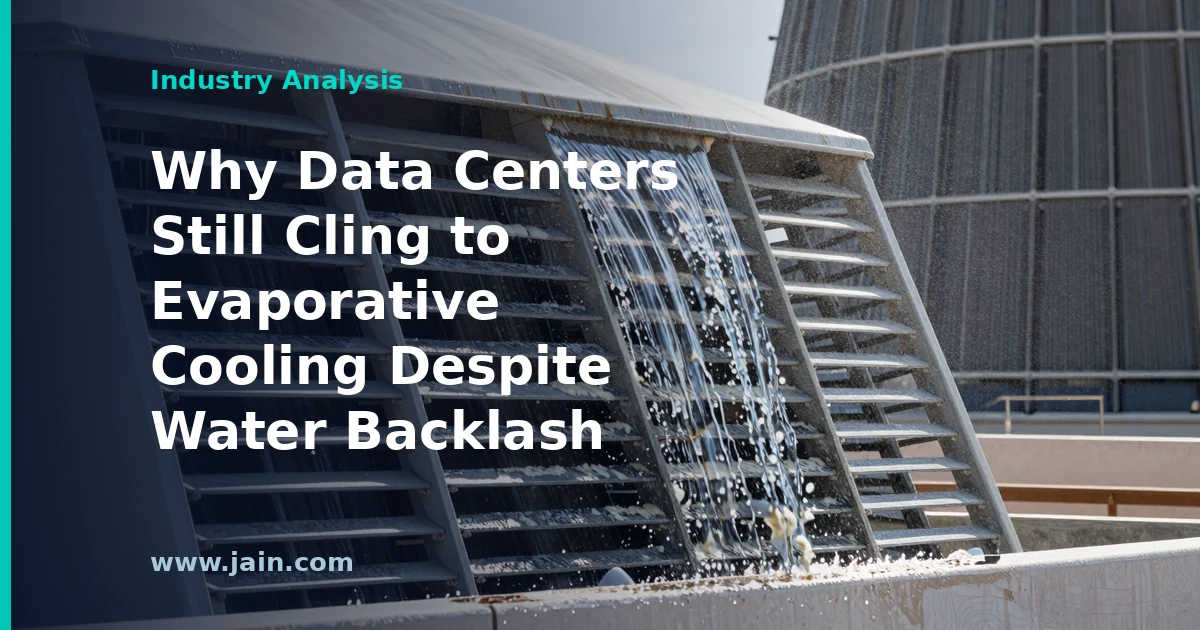
Data Center Knowledge published a report on June 18, 2026 examining why the data center industry continues to rely on evaporative cooling — a heat-rejection method that consumes large volumes of water — even as public and regulatory backlash over water use intensifies. The piece frames the industry’s position as hesitation rather than refusal: operators broadly acknowledge the water problem but have been slow to abandon a technology that remains cheaper and more energy-efficient than the alternatives.
Executive Summary
The report’s core subject is a tension the industry has lived with for years and that the AI build-out has sharpened: evaporative cooling rejects heat by evaporating water, which makes it highly energy-efficient but water-hungry, while the main alternatives — dry (air-cooled) systems and refrigerant-based chillers — save water at the cost of higher electricity consumption, larger equipment footprints, or both. In markets where power is the scarcest commodity a data center can buy, trading water savings for a bigger electrical load is not a simple upgrade; it is a genuine engineering and economic trade-off.
That trade-off is why the headline speaks of hesitation. Operators face mounting pressure from drought-affected communities, local governments, and sustainability commitments to cut water use, and technologies such as closed-loop liquid cooling and hybrid systems are maturing. But retrofitting existing facilities is expensive, and for new builds the calculus depends heavily on local climate, water price, and power availability — variables that differ from one metro to the next. The result is an industry moving unevenly rather than uniformly, which is precisely the dynamic worth understanding for anyone siting capacity or evaluating operators’ sustainability claims.
The Water-for-Energy Trade at the Heart of Cooling
Every data center must move heat from chips to the outside world, and the physics offers no free option. Evaporative systems — cooling towers and their variants — exploit the fact that evaporating water absorbs enormous amounts of heat, which lets a facility reject heat with comparatively little electricity. Dry coolers and air-cooled chillers avoid consuming water but must push heat into the air mechanically, which takes more fan and compressor power, especially on hot days when the temperature difference working in the operator’s favor shrinks. In plain terms: saving water usually means burning more electricity, and in an era when grid connections are the binding constraint on data center growth, extra megawatts spent on cooling are megawatts not available for revenue-generating compute.
This is the economic logic the Data Center Knowledge piece points at with its framing of industry hesitation. An operator that switches a large campus from evaporative to dry cooling is not just paying for new equipment; it is accepting a permanently higher power draw — degrading power usage effectiveness, the industry’s standard efficiency metric — and potentially reducing the sellable IT capacity of a power-constrained site. Where water is cheap and power is scarce, the incumbent technology keeps winning on spreadsheets even as it loses in public opinion.
Why the Backlash Is Getting Harder to Price at Zero
For most of the industry’s history, water was effectively an afterthought in site selection — abundant, inexpensive, and invisible to the public. That has changed. Data center water consumption has become a recurring flashpoint in drought-prone regions, a subject of local permitting fights, and a standard line of questioning for journalists and community groups evaluating new projects. Operators now routinely publish water usage effectiveness figures and, in some cases, commit to becoming “water positive” — replenishing more water than they consume.
The practical consequence is that water carries a growing shadow price beyond the utility bill: longer permitting timelines, conditions attached to approvals, reputational exposure, and in the worst case the loss of a site altogether. The report’s premise — that the industry hesitates rather than transitions — suggests that many operators still judge those risks manageable relative to the hard costs of switching. Whether that judgment holds depends largely on how regulators and communities act next, which varies enormously by jurisdiction.
The Alternatives Are Real, but Not Drop-In
The transition options are well understood in engineering terms. Dry cooling eliminates onsite water evaporation at the cost of energy and space. Hybrid systems run dry most of the year and evaporate water only during peak heat, cutting consumption substantially without the full energy penalty. Direct-to-chip liquid cooling and immersion cooling — increasingly common in AI deployments because high-density chips demand them — move heat in closed loops that consume little or no water onsite, though the heat still has to be rejected somewhere, and that final stage can itself be wet or dry. None of these is a simple swap for an operating facility: cooling infrastructure is capital-intensive, deeply integrated with a building’s design, and typically replaced on decade-plus cycles.
That replacement cycle is the quiet variable in the whole debate. The realistic path for the industry is less about retrofitting the installed base and more about what gets designed into the enormous wave of new construction now underway. If new AI-era facilities standardize on low-water designs where climate and economics allow, the fleet’s water profile shifts over years, not quarters. If they default to evaporative cooling because power constraints dominate, the backlash the report describes is likely to intensify.
Winners, Losers, and the Siting Chessboard
The cooling transition redistributes advantage. Cooler, water-rich regions gain appeal because they make both wet and dry cooling cheaper; hot, arid markets that boomed on cheap land and power face the sharpest version of the water-versus-energy dilemma. Vendors of hybrid and liquid cooling systems benefit from every tightening of water rules. Utilities and municipalities gain leverage, since water service is becoming a negotiated element of large deals rather than a formality. And operators that invested early in low-water designs acquire a permitting and public-relations asset that is difficult for laggards to replicate quickly. Buyers of colocation and cloud capacity should read cooling architecture as a proxy for siting risk: a facility’s water dependence is now part of its long-term cost and continuity profile.
Background
Cooling is one of the two great resource demands of data centers, alongside electricity: every watt a server consumes becomes heat that must be removed. For decades, evaporative cooling towers have been a workhorse of large-scale heat rejection across many industries because evaporating water is thermodynamically cheap. Data centers adopted the approach widely as the industry scaled through the cloud era, and it helped drive the sector’s headline efficiency gains. The AI construction boom that accelerated through the mid-2020s raised the stakes on both sides of the equation — far denser computing produces far more heat, while the communities hosting these facilities have grown increasingly vocal about local water and power impacts. Trade publication Data Center Knowledge, which published the report discussed here, has tracked this cooling debate as one of the defining infrastructure questions of the AI build-out.
Source: Evaporative Cooling in Data Centers: Why the Industry Hesitates to Move On — Data Center Knowledge report, June 18, 2026, on the economics slowing the industry’s shift away from water-intensive cooling.