
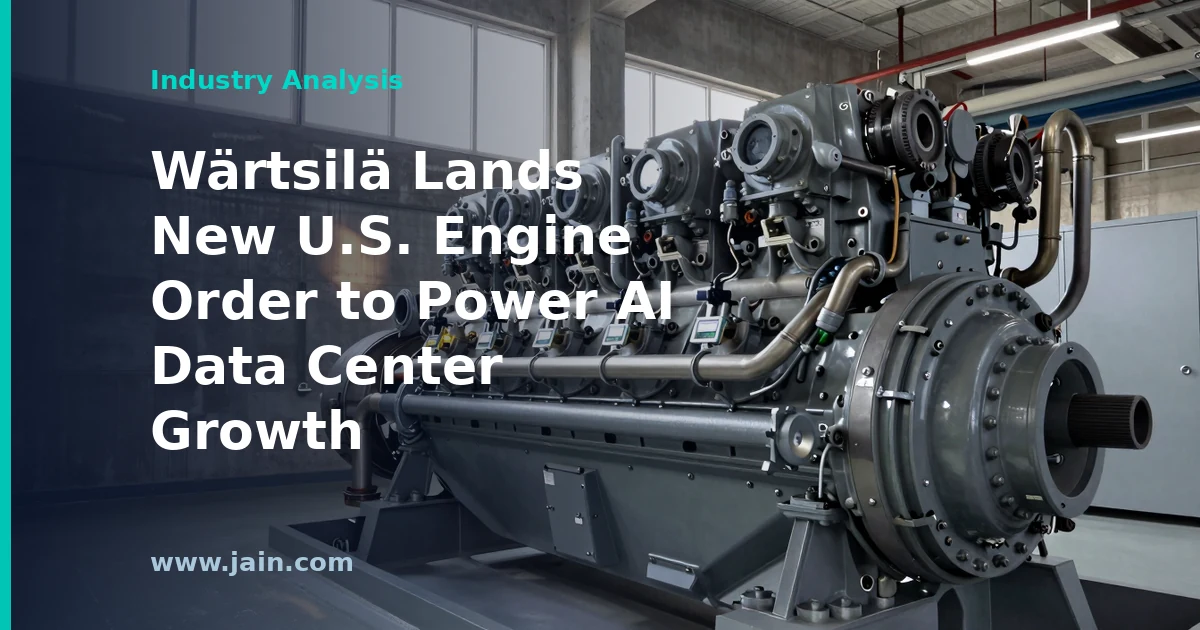
Wärtsilä, the Finnish energy and marine technology group, announced on June 28, 2026 that it has secured a new order in the United States to supply engine-based power generation supporting what the company calls the next wave of AI-driven data center growth. The announcement, distributed as a company release, positions the order within the surge of demand for on-site and grid-support power created by artificial intelligence computing facilities.
The release headline confirms the order’s existence, its U.S. location, and its data center orientation; the version of the announcement circulated via aggregators does not carry further specifics such as capacity, customer, or delivery schedule, which we flag below.
Executive Summary
The announcement is notable less for any single order than for the pattern it extends: reciprocating engine power — large, factory-built internal combustion generators that can be installed and running in months — is becoming a standard answer to the widening gap between when AI data centers need electricity and when utilities can deliver it. In much of the U.S., a new large load or generator can wait years in the interconnection queue, the utility process for studying and approving new grid connections. Data center developers racing to deploy AI capacity increasingly cannot wait, and engine plants offer a bridge: power that arrives on the developer’s schedule rather than the grid’s.
For Wärtsilä, one of the leading global suppliers of medium-speed engine power plants, the U.S. data center segment represents a growth market layered on top of its traditional utility, industrial, and grid-balancing business. The company framing this order explicitly around “AI-driven data center growth” signals that it now treats the segment as a named demand category, not incidental business.
What matters for the industry is the direction of travel: if flexible generation is the default bridge, then engine and turbine order books, gas supply logistics, and air-permitting timelines become part of the data center delivery critical path — alongside chips, land, and fiber.
The Interconnection Gap Is the Real Product
AI training and inference facilities are being planned at scales of hundreds of megawatts — comparable to small cities — and utilities in many U.S. regions cannot study, upgrade, and energize connections for loads of that size quickly. The mismatch between data center construction timelines, often 18 to 30 months, and grid timelines, often several years, has created a market for anything that closes the gap. Engine power plants fit because they are modular, factory-produced, and incremental: capacity can be added in blocks, started fast, and later kept as backup or grid-support assets once a utility connection arrives.
Wärtsilä’s order, as framed, is a data point confirming that this bridge model has moved from workaround to procurement strategy. When a major OEM headlines a U.S. order around AI data centers, it suggests buyers are specifying flexible generation at the planning stage, not scrambling for it after a queue delay.
Engines Versus Turbines Versus the Grid
The fast-power market splits mainly between reciprocating engines, which Wärtsilä and a small number of rivals supply, and gas turbines. Engines generally start faster, hold efficiency better at partial load, and tolerate frequent stop-start cycling — useful traits for a facility that may eventually shift to grid power and keep the engines for peaking or resilience. Turbines tend to win on the largest single-block capacities. Both now face extended delivery lead times as data center demand collides with utility and industrial orders, which means an OEM’s manufacturing slots have themselves become a scarce resource.
The strategic question for buyers is not engines versus grid, but sequencing: bridge generation first, interconnection later, with the on-site plant repurposed rather than stranded. Vendors that can credibly support that full lifecycle — including later conversion to balancing or backup duty, and potential future fuels — have an advantage beyond the initial sale.
What It Means for Data Center Economics
Self-supplied engine power costs more per megawatt-hour than typical utility rates once fuel, maintenance, and capital are counted. That premium is rational when the alternative is an idle, revenue-less AI facility waiting on a queue. In effect, developers are paying for schedule certainty, and the willingness to pay reveals how valuable early AI capacity is believed to be. The risks are real, however: on-site gas generation adds fuel-supply logistics, air-quality permitting, and emissions exposure, and a facility’s bridge plant can become a long-term cost if grid power arrives later than promised — or a stranded asset if the AI demand it serves shifts.
For utilities and regulators, each order like this one is also a signal: load that cannot be served promptly will increasingly self-serve, at least temporarily, which changes forecasting, gas demand, and local emissions profiles in the regions where AI construction concentrates.
Background
Wärtsilä traces its roots to 1834 in Finland and today operates two main businesses: marine propulsion and energy. Its energy arm supplies power plants built around large medium-speed reciprocating engines, along with energy storage and grid-management technology, and has historically served utilities, island grids, and industrial customers needing flexible or fast-starting capacity.
Since roughly 2024, U.S. electricity demand has resumed sustained growth for the first time in about two decades, driven substantially by AI data center construction. That demand surge, colliding with multi-year utility interconnection and transmission timelines, has created a rapidly growing market for on-site and fast-deploy generation — the market context in which this order was announced.
Source: Wärtsilä secures new order to power next wave of AI-driven data center growth in the U.S. — Wärtsilä company announcement, June 28, 2026, on a new U.S. engine power order for AI data center demand.