
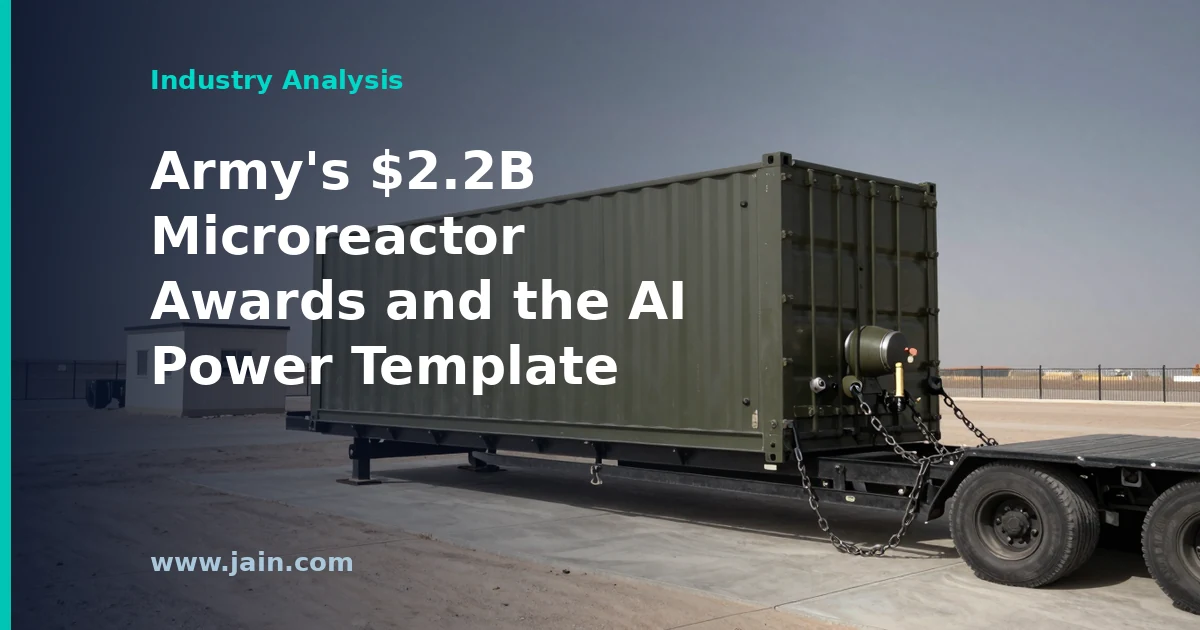
The U.S. Army has awarded contracts worth $2.2 billion for “microreactors” — very small nuclear power units intended to be installed at domestic military bases, according to a report published on May 20, 2026. The awards represent one of the largest federal procurements to date aimed specifically at putting nuclear generation directly on the site that consumes the power.
The reported figure covers the award value; the underlying source available to us does not enumerate the winning vendors, the number of reactors, the installations selected, or the delivery schedule. What is established is the buyer (the Army), the technology class (microreactors), the siting (U.S. bases), and the headline dollar figure.
Executive Summary
Announcements of this size change a technology’s status. Microreactors — reactors typically rated in the single-digit to low-tens of megawatts, small enough to be factory-built and trucked to site — have for a decade been a demonstration-stage technology with more design concepts than operating units. A $2.2 billion award from a single customer with a credible need and a long procurement horizon converts that from a research question into an industrial one.
The Army’s motivation is straightforward and does not require any speculation about climate or commercial policy: military installations depend on commercial electric grids they do not control, and a base that cannot power its mission during a prolonged regional outage is a base with a capability gap. On-site generation that runs for years without refueling addresses that gap in a way diesel gensets, which need continuous fuel convoys, do not.
The reason this matters far beyond the Department of Defense is that the fastest-growing category of commercial electricity demand — AI and high-density computing facilities — has almost exactly the same problem statement: large, constant, uninterruptible load, sited where the grid cannot deliver new capacity quickly. If the Army’s program produces licensed, delivered, operating units, it will have de-risked a supply chain that data center developers have so far been able to talk about but not buy from.
The Military Is Buying Resilience, Not Cheap Electricity
It is important to read a defense energy procurement on its own terms. The Army is not primarily optimizing for the lowest cost per megawatt-hour; it is buying assurance that a specific set of missions keeps running when the surrounding civilian infrastructure does not. That changes the arithmetic entirely. A commercial buyer compares a new generation source against the utility tariff it would displace. A defense buyer compares it against the cost of mission failure, which is not denominated in dollars per megawatt-hour at all.
This is the same logic that makes the federal government a recurring first customer for expensive, immature technologies — jet engines, satellite navigation, integrated circuits. The government tolerates first-of-a-kind cost because it values a capability that markets do not yet price. The commercial spillover comes later, once volume has driven the learning curve down. Whether that pattern repeats here is the entire investment thesis for the microreactor sector, and this award is the first data point large enough to argue from.
A note of proportion is warranted. $2.2 billion is a serious sum, but it is a program-scale commitment, not an industry-scale one. It is roughly the order of magnitude of a single large gas-fired combined-cycle plant or a mid-sized hyperscale data center campus. It is enough to fund a real fleet of first units; it is not enough, by itself, to build the factory-scale production that microreactor economics ultimately depend on.
What $2.2 Billion Buys — and What the Number Does Not Tell You
Large defense award figures are frequently ceilings on multi-year vehicles rather than cash obligated on day one. Without the contract documents, we cannot say whether this $2.2 billion is committed funding, a maximum value across option years, or a shared ceiling across multiple competing vendors who will each draw against it as they hit milestones. Each of those reads implies a very different near-term revenue picture for the winners, and readers evaluating suppliers should insist on that distinction before treating the number as booked business.
The second unknown is unit economics. First-of-a-kind nuclear construction has a long and well-documented history of cost growth, and microreactors are not exempt from it simply because they are small. The sector’s cost argument rests on repetition: build the same unit many times in a factory, and per-unit cost falls. That argument only becomes testable once the first several units are delivered and their actual costs are visible. A single award, however large, does not settle it.
The third is fuel. Many — though not all — advanced microreactor designs are specified for high-assay low-enriched uranium (HALEU), a more concentrated fuel than the enriched uranium that powers today’s commercial reactor fleet, and Western commercial HALEU production capacity has been limited. Because the source does not identify which designs were selected, we cannot say whether these particular awards depend on that fuel supply. If they do, fuel availability — not reactor manufacturing — becomes the schedule-defining constraint, and it is one no single contract can resolve.
The Read-Across to AI Data Centers
The power constraint facing AI infrastructure is not, at root, a shortage of generation. It is a shortage of interconnection — the transmission capacity, substation equipment, and regulatory approvals needed to deliver large blocks of power to a specific location on a specific date. Queue times for large new grid connections in constrained regions are commonly measured in years, and the AI buildout is operating on a procurement cycle measured in quarters. That mismatch is why developers have been chasing power that sits behind the meter: generation built on the customer’s own site, feeding the load directly, without waiting in the interconnection line.
Microreactors are attractive in that frame because they are firm and dense. Unlike solar or wind, their output does not depend on weather, so they can serve a load that runs at high utilization around the clock. Unlike on-site gas turbines, they carry no fuel-delivery dependency and no combustion emissions, which matters for operators with corporate carbon commitments and for siting in air-quality-constrained regions. And their footprint is small relative to output, which suits campuses where land is already spoken for.
The honest caveat is timing. Nothing in this award suggests microreactors will relieve data center power scarcity in the current capacity cycle; the facilities being financed in 2026 will be energized long before any of these units are. The realistic read is that the Army program functions as a de-risking exercise for the 2030s: it funds first units, exercises the licensing pathway, and gives suppliers a reference customer. Commercial buyers benefit from that groundwork later, not now. Winners, if the program executes, are the selected reactor vendors, the fuel-cycle and component suppliers beneath them, and eventually data center developers in power-constrained markets. The pressure lands on incumbent generation and on utilities whose value proposition assumes large loads must come to the grid rather than build around it.
The Failure Modes Worth Watching
The most likely way this template disappoints is schedule slip rather than outright failure. Nuclear projects rarely get cancelled loudly; they get delayed quietly, and each year of delay compounds against the commercial window in which the technology would have been most useful. Any credible assessment of the sector should treat announced in-service dates as the optimistic bound.
Regulatory pathway is the second variable. Reactors on federal military property may be authorized through a different mechanism than a commercial power plant serving the public grid, and if that is the case here, it is a genuine advantage for the Army program — and a genuine limit on how directly the precedent transfers. A commercial data center operator does not get the Department of Defense’s siting posture. Any read-across that skips this distinction is overstating the case, and the specific authorization route for these awards is not something the available source establishes.
Third is public and local acceptance, which is a real cost driver even where it is not a legal barrier. Military installations are comparatively controlled environments with existing security perimeters and a workforce accustomed to sensitive operations. A merchant data center campus outside a metro area is not, and the community engagement burden there is materially heavier. That asymmetry is one of the strongest reasons to treat the Army as a proving ground rather than a direct commercial analogue.
Background
Microreactors sit at the small end of the advanced nuclear sector, below the small modular reactors (SMRs) that have received most public attention. The commercial pitch has always been standardization: instead of building each reactor as a bespoke civil-engineering project, build the same small unit repeatedly in a factory and drive cost down through repetition. That pitch has attracted substantial private capital and considerable federal research support over the past decade, but the sector has produced far more designs than operating units, and its cost claims remain largely untested against delivered hardware.
The demand side has shifted sharply in the same period. The buildout of AI and high-density computing has created large blocks of new electricity demand concentrated in specific locations, colliding with grid interconnection processes and transmission construction timelines that move far more slowly. That collision has pushed hyperscale and colocation operators toward on-site generation, long-term power purchase agreements with existing nuclear plants, and other arrangements that secure firm capacity outside the normal utility queue. Defense energy resilience and commercial data center power have therefore converged on a similar requirement — dense, firm, on-site generation — which is why a military procurement is being read closely by an industry that does not wear a uniform.
Source: Army Awards $2.2 Billion for ‘Microreactors’ On U.S. Bases — The New York Times, May 20, 2026, reporting the Army’s award of $2.2 billion in contracts for small nuclear reactors to be sited at domestic military installations.